

Hobbies to do at home offer an enjoyable way to relax, learn new skills and make better use of your free time. Whether you enjoy making, collecting, growing or creating, there is a home hobby to suit almost every personality and budget.
Some hobbies need muddy boots, train tickets or a car full of equipment. Others begin much more quietly.
They start at the kitchen table, beside a sunny window, on the sofa with a notebook, or in a spare corner where a small project slowly becomes part of your routine.
That is why hobbies to do at home have become so appealing. They fit around real life. They do not always need much money, space or planning. More importantly, they give your free time a little more shape.
A good home hobby can help you relax after work, learn something useful, make something beautiful, collect something meaningful or simply enjoy an hour away from screens.
Quick Answer: What Are Good Hobbies to Do at Home?
Good hobbies to do at home include creative crafts, collecting, indoor gardening, model building, puzzles, writing, baking, sewing, learning an instrument, photography projects and relaxing screen-free activities. The best choice depends on your space, budget, patience and personality.
Why Home Hobbies Are Having a Moment
Home has become more than a place to sleep, eat and catch up on chores.
For many people, it has also become a place to reset. A hobby gives that reset a purpose. Instead of drifting through another evening, you have something small but satisfying to return to.
That matters because a hobby does not need to be dramatic to feel worthwhile. A stamp album, a cactus on a windowsill, a half-built model aircraft or a sketchbook on the table can all create the same feeling: progress.
Progress is powerful.
Even when a project moves slowly, it gives you evidence that your time turned into something. A row of stitches appears. A model takes shape. A puzzle corner fills in. A plant grows new shoots. A collection becomes better organised.
Unlike scrolling, which often disappears from memory almost as soon as it happens, a home hobby leaves something behind.
That is one of the reasons these hobbies feel so rewarding. They turn ordinary evenings into something more memorable. That becomes particularly noticeable as the seasons change. Cooler days and longer evenings naturally make some activities more appealing, while autumn still gives you plenty of opportunities to get outdoors. If you are looking for something seasonal to try, our Autumn Hobbies 2026 guide explores nine creative, relaxing and outdoor hobbies that suit this time of year particularly well.
Why Home Hobbies Work So Well
The best hobbies to do at home fit into everyday life rather than demanding a complete lifestyle change.
They Feel Easy to Begin
You do not need perfect conditions. A small table, a quiet corner or a simple starter kit often provides enough space to begin properly.
They Save Money
Many home hobbies cost far less than regular nights out, subscriptions or paid activities, especially once you have the basic tools.
They Build Routine
A hobby becomes easier to keep when it sits naturally within your week, rather than relying on travel, weather or complicated planning.
They Give You Something Tangible
Whether you make, grow, collect, repair or learn, the results give you a stronger sense of time well spent.

The Best Home Hobby Fits Your Real Life
The most common mistake people make when choosing a hobby is picking something that sounds impressive rather than something they will actually do.
That is why the best question is not, “What hobby looks good?”
The better question is, “What hobby fits the life I already have?”
If you only have twenty minutes in the evening, a hobby with long setup time may frustrate you. However, a sketchbook, puzzle book, stamp album or small craft project can work beautifully.
If you enjoy quiet focus, model building can offer hours of satisfying detail. If you prefer something calm and living, learning how to grow cactus plants at home may feel more natural.
Meanwhile, if you like history, discovery and small details, collecting hobbies can turn a rainy afternoon into a proper treasure hunt. Stamp collecting, coin collecting and postcard collecting all work well at home because they combine research, organisation and curiosity.
The point is simple.
Your hobby does not need to impress anyone else. It only needs to be interesting enough for you to return to it.
Think About What You Want From a Hobby
Some people want relaxation. Others want creativity. Some want a challenge, while others want something easy enough to enjoy without thinking too hard.
There is no wrong answer.
A stressful day may call for needle felting, colouring, baking or a simple jigsaw puzzle. A restless mind may prefer learning a new skill, researching a collection or building something with instructions. A creative person may enjoy gelli plate printing, sewing, writing or photography projects.
Therefore, the right hobby often depends less on the activity itself and more on the feeling you want it to give you.
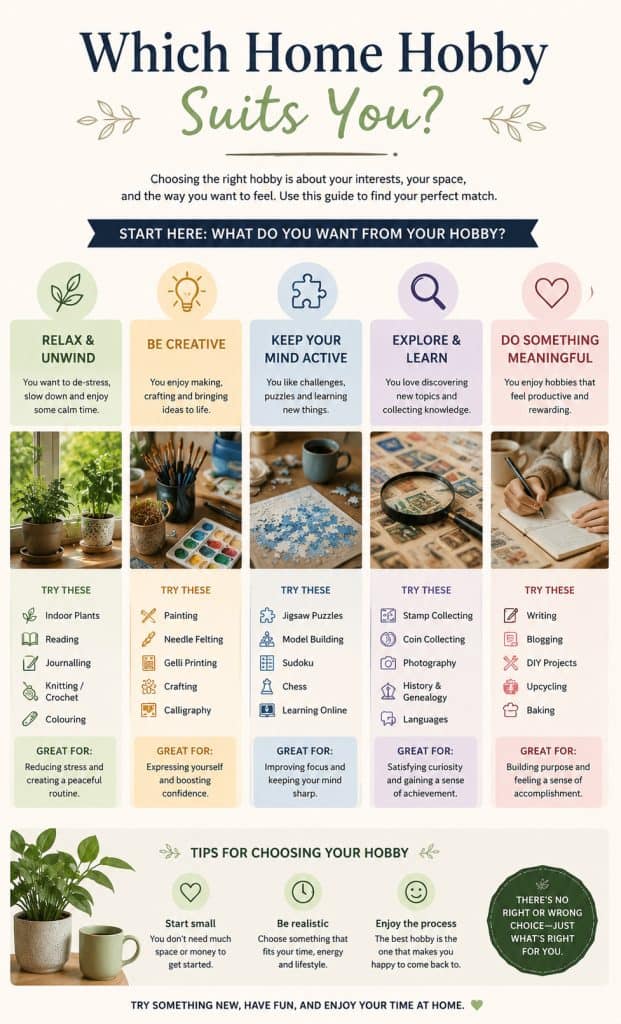
Choose a Home Hobby by How You Want to Feel
Before choosing from a long list of hobbies to do at home, think about the kind of mood you want your hobby to create.
🧘 Do You Want Calm?
- Choose something slow and repetitive.
- Look for hobbies that help you settle rather than rush.
- Try puzzles, knitting, journalling, embroidery or indoor gardening.
🏆 Do You Want Achievement?
- Choose something with visible progress.
- Pick a hobby where each session moves you forward.
- Try model building, baking, learning music or a structured course.
🔍 Do You Want Discovery?
- Choose something that rewards research.
- Look for hobbies where one find leads to another question.
- Try stamp collecting, coin collecting, family history or postcard collecting.
🎨 Do You Want Creativity?
- Choose something that lets you experiment.
- Pick a hobby where you can make choices, colours and styles your own.
- Try painting, collage, gelli plate printing, sewing or photography.
Choose something that lets you make decisions rather than simply follow steps.
This is why hobbies to do at home can suit so many different people. The setting may be the same, but the experience can feel completely different.
Find Hobbies to Do at Home That Match Your Mood
A good home hobby often starts with how you want to feel, not what you think you should be doing. Some days call for calm. Others need colour, curiosity or the quiet satisfaction of finishing something properly.
Find Calm
For creative evenings, look for hobbies that let you experiment without needing perfection. Painting, collage, gelli plate printing, sewing, photography, model painting and simple craft projects all add colour and personality to home life. They suit evenings when you want to make something, play with ideas and enjoy the process as much as the finished result.
Discovery
If you want discovery, collecting hobbies can feel especially rewarding. Stamp collecting, coin collecting, family history, postcard collecting and researching antiques or collectables all turn quiet time at home into a small investigation. One item leads to a date, a place, a maker, a story or a question you had not expected to ask.When you want achievement, choose a hobby with visible progress. Model building, baking, learning an instrument, writing short stories or following a structured course can all give your spare time a sense of movement. You may not finish everything quickly, yet each small step gives you something to show for the time you spent.
HobbyIdeas Tip: Before choosing from a long list of hobbies to do at home, ask yourself what kind of evening you actually want. Calm, creativity, discovery and achievement all lead to different hobbies, and the best choice is usually the one that matches your mood.
Hobbies to do at home Should Not Feel Like Homework
One reason people abandon hobbies quickly is that they accidentally make them too serious.
They buy too much equipment. Comparing themselves with experts. They set unrealistic goals. Then, before the hobby has a chance to become enjoyable, it starts feeling like another obligation.
A better approach is to begin lightly.
Try one small project. Use what you already own where possible. Give yourself permission to be average at the beginning. More importantly, let the hobby earn its place in your life.
Do all Hobbies Suit?
Some hobbies will not suit you, and that is fine. Discovering that you like the idea of watercolour painting more than the reality. You could find you love collecting stamps, but dislike mounting them neatly. You might enjoy baking, but only when the recipe feels simple.
Those small discoveries still help.
They teach you what kind of hobbyist you are.
Over time, you begin to understand whether you prefer peaceful repetition, creative mess, technical detail, research, collecting, making, learning or growing.
That knowledge makes choosing your next hobby much easier.
Wonderful Hobbies to Do at Home
Once you stop looking for the “perfect” hobby, home suddenly offers far more possibilities than you might expect.
The trick is to choose something that feels inviting rather than intimidating. A good hobby should pull you back gently. It should make you think, “I might do a little more of that tonight.”
Here are some of the best hobbies to do at home if you want something enjoyable, practical and easy to begin.
Model Building
Model building suits people who enjoy detail, patience and visible progress. A box of parts slowly becomes an aircraft, car, ship, railway scene or science-fiction model, and every session adds something new.
It also works beautifully at home because you only need a small workspace and a little organisation. If this appeals to you, our full guide to model building explains how beginners can get started. If you like the idea of a hobby with visible progress, an unbuilt plastic model kit, such as the Revell Jaguar SS 100, gives you a proper project to work through at home. It suits quiet, focused evenings because you can build in stages, improve your hand skills and end up with something satisfying to display.
Needle Felting
Needle felting looks soft and gentle, yet it feels surprisingly absorbing once you begin. Wool gradually takes shape under the needle, and simple projects such as mushrooms, animals or decorations can feel very satisfying.
It suits quiet evenings because the process encourages focus without needing much space. Our beginner guide to needle felting for beginners covers the basics in a friendly, practical way. If you want a creative hobby with a soft, hands-on feel, a needle-felting starter kit with wool, tools, and beginner supplies gives you everything you need to try the hobby without buying separate bits and pieces. It suits quiet evenings because you can start small, learn the basic stabbing motion and build confidence one shape at a time.
Growing Cactus Plants Indoors
Indoor gardening does not have to mean turning your home into a greenhouse. Cacti are ideal for beginners because they need very little space, cope well with bright windowsills and reward careful observation rather than constant attention.
They also bring colour, shape and life into a room without demanding daily care. If you want a calm plant hobby, learn how to grow cactus plants at home.
If indoor gardening appeals to you, the Royal Horticultural Society offers excellent advice for beginners, including practical guidance on choosing plants, caring for houseplants and creating an indoor growing space.
Stamp Collecting
Stamp collecting is one of the best home hobbies for people who enjoy history, design and discovery. A small envelope of stamps can lead you into geography, postal history, printing methods and stories from around the world.
Better still, it can begin cheaply and grow slowly. Our guide to stamp collecting explains how to start without feeling overwhelmed.
If stamp collecting catches your interest, a black-page stamp stockbook makes a simple but very useful first upgrade. The dark pages help stamps stand out clearly, while the stockbook format keeps everything tidy, protected and easy to rearrange as your collection grows.
Coin Collecting
Coin collecting brings history into your hands. Old pennies, commemorative coins, foreign change and silver coins all tell stories about trade, monarchs, design and everyday life.
It is also a hobby you can build gradually. You do not need rare coins to begin, only curiosity and a willingness to learn. If that sounds appealing, our guide on how to start coin collecting will help you take the first steps.
Gelli Plate Printing
Gelli plate printing is colourful, playful and wonderfully unpredictable. Instead of worrying about perfect results, you build layered prints with paint, texture, paper and simple tools.
This makes it ideal for people who want creativity without strict rules. It also creates beautiful papers for cards, collage, journals and craft projects. Our guide to gelli plate printing shows how the process works.
Puzzle-Solving Hobbies
Some evenings call for a hobby that keeps your mind active without making the room messy. Puzzle-solving hobbies fit that role perfectly.
Jigsaws, crosswords, logic puzzles, sudoku, escape-room style puzzle books and mystery games all offer a satisfying challenge. They also work well alone or with family. If you enjoy a good mental workout, explore our guide to puzzle-solving hobbies.
Soap Making
Soap making feels part craft, part kitchen experiment and part useful life skill. Colours, scents, moulds and textures give the hobby plenty of creative variety, while the finished results make lovely gifts.
It is especially satisfying because you create something practical rather than purely decorative. Start simple, follow safety advice carefully and enjoy the process of making something by hand.
Photography Projects at Home
You do not need mountain views or expensive travel to enjoy photography. Home photography projects can focus on objects, food, crafts, collections, pets, plants, textures or seasonal displays.
For hobbyists who make or collect things, photography also helps you record progress and share finished work online. Our guide on how to photograph handmade items includes useful tips for lighting, staging and simple improvements.
Learning to Sew
Sewing remains one of the most useful hobbies to do at home because it combines creativity with practical value. You can mend clothes, make cushions, create gifts, try quilting or eventually move towards dressmaking.
It also encourages a slower relationship with the things you own. Instead of throwing something away, you begin to see possibilities for repair, reuse and improvement.
Choosing the Best Hobbies to Do at Home
Different home hobbies suit different moods, spaces and personalities. The best place to begin is usually not with the hobby that looks most impressive, but with the one that fits naturally into the way you already live.
If space is limited, choose a hobby that can live happily in a box, folder or small corner of a room. Stamp collecting, coin collecting, journalling, sketching, puzzles and cactus growing all work well because they do not take over the house. You can enjoy them at a table, pack them away quickly and return to them whenever you have a spare half hour.
For creative evenings, look for hobbies that give your hands something satisfying to do. Needle felting, gelli printing, sewing, soap making, painting and collage all add colour and texture to home life. They also suit people who like the pleasure of making something physical after a day spent staring at screens.
When you want calm focus, slower hobbies often work best. Model building, embroidery, indoor gardening, jigsaw puzzles and organising a collection all reward patience rather than speed. These hobbies create a steady rhythm, which makes them especially useful when you want to slow down without feeling completely inactive.
If you enjoy learning, choose a hobby that keeps opening new doors. Photography, family history, collecting, learning music and online courses all give your spare time a stronger sense of progress. Each small improvement leads to another question, another skill or another discovery, which keeps the hobby interesting over time.
HobbyIdeas Tip: Start with the hobby that feels easiest to begin this week. The right home hobby does not need to impress anyone else. It simply needs to make you want to come back tomorrow.
How to Make a Home Hobby Stick
Starting a hobby feels exciting. Continuing it feels more difficult.
The easiest way to keep going is to make the hobby visible and convenient. If your sketchbook disappears into a drawer, you may forget about it. When your model kit takes twenty minutes to unpack every time, you may avoid it. If the craft supplies are spread across three rooms, even a small project can feel like work.
Therefore, give your hobby a small home of its own.
That might mean a tray, box, shelf, basket or corner of a desk. It does not need to look impressive. It simply needs to make starting easier.
Also, avoid turning every hobby into a performance. You do not need to monetise it, post it online or become brilliant at it. Sometimes the private pleasure of doing something badly but happily matters more than producing something polished.
A hobby becomes part of your life when it feels welcoming. Keep it simple enough to return to, and it has a much better chance of lasting.
Frequently Asked Questions About Hobbies to Do at Home
What are the easiest hobbies to do at home?
The easiest hobbies to do at home usually need little equipment and almost no setup time. Puzzles, journalling, sketching, stamp collecting, coin collecting, reading, indoor gardening and simple crafts all make good starting points.
Which home hobbies are good for relaxing?
Slow, repetitive hobbies often feel relaxing. Knitting, embroidery, colouring, model building, puzzles, cactus growing and gentle creative projects can all help you unwind after a busy day.
Do hobbies to do at home have to cost much?
No. Many home hobbies cost very little to start. Collecting, sketching, puzzles, reading, seed growing, writing and basic crafts can all begin on a modest budget.
Can home hobbies become small businesses?
Some can. Sewing, soap making, photography, craft projects, personalised gifts and digital products may become small income streams. However, it is often better to enjoy the hobby first before trying to turn it into work.
Your Best Hobby Is the One You Return To
The best hobbies to do at home are not always the trendiest, cheapest or most impressive.
They are the ones you actually want to continue.
A hobby can be small and still matter. Ten minutes with a stamp album counts. So does watering a cactus, sanding a model wing, finishing a puzzle corner, sewing a button, baking a loaf or taking one thoughtful photograph.
Over time, those small moments add up.
They give your evenings texture. Help your home feel more personal, and remind you that leisure does not have to mean doing nothing.
So choose one hobby that feels possible, not perfect. Give it a little space. Try it for a few weeks. Then notice whether you keep coming back.
That quiet pull is often the best sign that you have found a hobby worth keeping.
Affiliate Disclosure: HobbyIdeas.co.uk participates in the Amazon Associates Programme. This means we may earn a small commission if you purchase through links on this page, at no additional cost to you. We only recommend products that are relevant to the hobby or activity being discussed.