

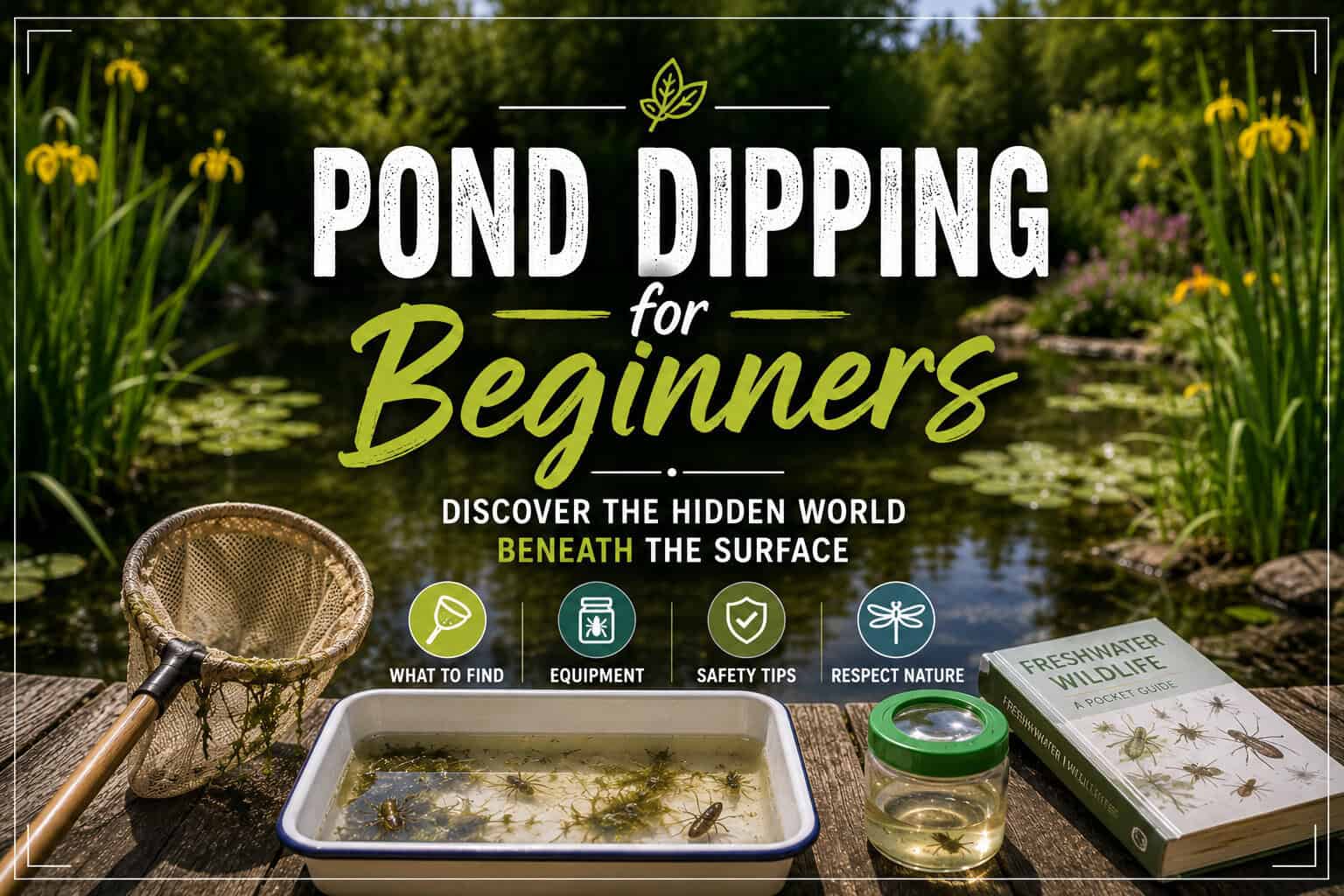
Pond dipping for beginners starts with one of the simplest pleasures in nature: wondering what might be hiding somewhere you cannot quite see. A pond may appear peaceful from the bank, with insects skimming the surface and reeds moving gently in the breeze. Beneath the water, however, there is an extraordinarily busy world waiting to be discovered.
Lower a net gently among the plants and transfer the contents into a shallow tray. Almost immediately, the apparently empty water begins to change. A tiny creature darts beneath a leaf, something wriggles through the vegetation and an unfamiliar insect suddenly catches your attention. What began as a casual sweep of a net can quickly become an absorbing exercise in natural history.
That sense of discovery makes pond dipping a particularly rewarding outdoor hobby. It requires little equipment and suits adults just as well as children. Moreover, it encourages you to notice wildlife that normally remains hidden. You do not need to recognise every creature before you begin, either. Curiosity, patience and a willingness to return everything safely to the pond are much more useful starting points.
Quick Answer: What Is Pond Dipping?
Pond dipping is a simple wildlife activity where you gently sweep a fine-mesh net through pond water and vegetation, then transfer what you find into a shallow tray for observation. You may discover water beetles, dragonfly nymphs, caddisfly larvae, aquatic snails, tadpoles and other freshwater wildlife. Beginners need little more than a pond net, a light-coloured tray and permission to use a suitable pond.
Why Pond Dipping Is More Interesting Than It Sounds
Stand beside a pond for a few minutes and most activity appears to happen above the water or on its surface. Pond skaters move across the top, dragonflies patrol the margins and an occasional frog disappears among the vegetation. However, the quieter world beneath the surface contains much of the real intrigue.
Small freshwater habitats can support an impressive variety of life. According to The Wildlife Trusts, even small ponds can support a wealth of species. Shallow margins and surrounding vegetation also create valuable habitats for freshwater wildlife.
For anyone trying pond dipping for beginners, the names of those creatures matter less initially than learning to notice them. Look closely and a tray containing leaves and murky water becomes a miniature landscape. Some animals swim rapidly through it, while others crawl across vegetation. A few remain almost motionless until one sudden movement reveals where they were hiding.
Patience genuinely improves the experience. Frantically sweeping a net through the pond usually produces little except mud and disturbed vegetation. In contrast, a careful dip followed by several quiet minutes examining the tray reveals considerably more.
“The magic of pond dipping begins when a tray of muddy-looking water stops looking empty.”
What Do You Need for Pond Dipping?
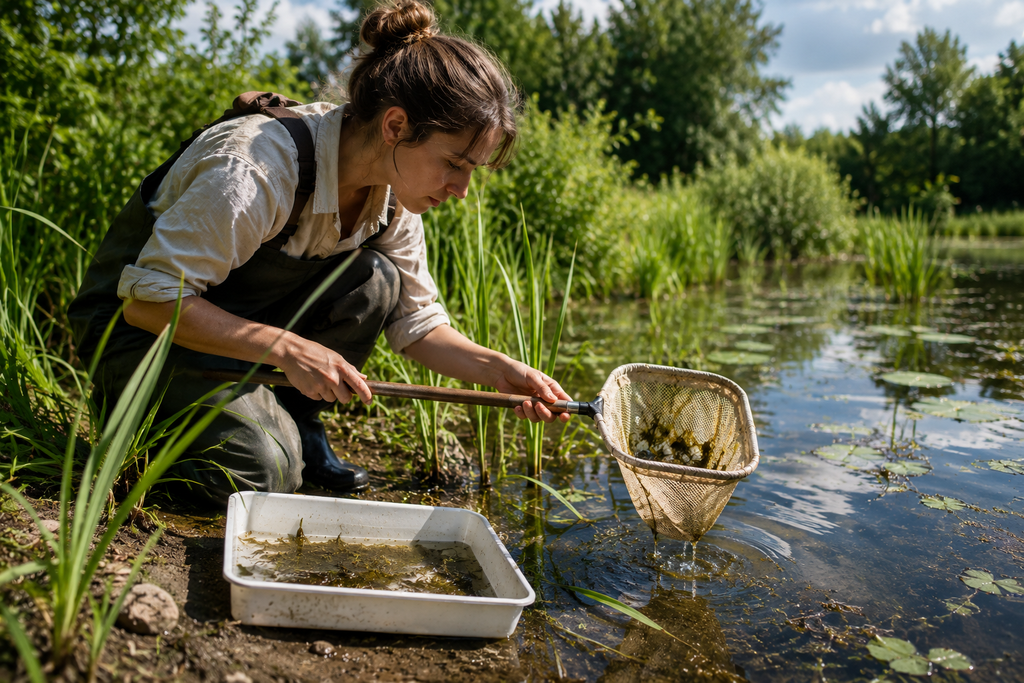
There is refreshingly little equipment standing between a beginner and a first pond dip. At its simplest, you need a suitable pond net and a shallow tray containing water from the pond. A pale or white tray works particularly well because small dark creatures become much easier to spot. If you need a net, the Selections Telescopic Pond Net is a practical option, with a lightweight handle that extends to 190cm and a 35cm fine-mesh head. The extra reach is particularly useful when exploring pond margins without leaning too far over the water.
A few clear containers can help when you want to examine an individual creature more closely. The Lightweight Clear Fish Viewing Container is a useful option because its transparent sides make it easier to observe small pond creatures from different angles. However, anything collected should remain in water from the same pond and return to its habitat promptly. A magnifying glass is another inexpensive addition that can reveal details almost invisible to the naked eye.
An identification guide becomes useful once you start wondering exactly what you have found. Nevertheless, there is no need to turn your first trip into an examination. Instead, photograph an unfamiliar creature and identify it afterwards. This often works better than keeping wildlife in a tray while you search through pages of pictures.
Sensible footwear matters more than specialist equipment because pond margins can become slippery. A towel is also worth carrying, particularly when children are involved. Of course, experience suggests that adults are perfectly capable of getting themselves equally wet.
Pond Net
A fine-mesh pond net lets you sweep gently through submerged plants and shallow margins without needing to disturb the bottom of the pond.
Light-Coloured Observation Tray
A shallow white or pale tray makes tiny freshwater creatures much easier to see. Add a little water from the pond before emptying the net into it.
Magnifying Glass or Viewing Pot
A simple magnifying glass or clear viewing container can reveal surprisingly fine details. Keep creatures in pond water and return them promptly after observation.
Identification Guide & Notebook
A freshwater wildlife guide helps put names to your discoveries, while a notebook lets you record what appears as the pond changes through the seasons.
Choosing a Good Pond for Pond Dipping
A large lake is not automatically better than a small garden pond. In fact, a modest wildlife pond with shallow edges and plenty of vegetation can provide an excellent introduction. Many freshwater creatures live among plants around the margins rather than in deep open water.
Your own garden pond provides the easiest starting point because permission is straightforward and you can return throughout the year. Elsewhere, suitable ponds may exist at nature reserves, country parks and community wildlife areas. However, public access does not automatically mean that pond dipping is permitted.
Always check signs and site information before putting a net into the water. Some ponds support sensitive wildlife, while conservation groups manage others for particular species. Therefore, when access or permission remains unclear, ask the landowner or site manager before dipping.
Safety should influence your choice as well. Look for a stable bank where you can reach the water comfortably without leaning dangerously forward. Avoid steep, crumbling or heavily overgrown edges. Fortunately, there is usually plenty to discover within easy reach of a safe shallow margin.
How to Go Pond Dipping for Beginners
The best technique is much gentler than repeatedly scooping at the bottom. Lower your net close to submerged or marginal vegetation, then move it slowly through the plants. A loose figure-of-eight movement works well because it samples a small area without causing unnecessary disturbance.
After several gentle sweeps, lift the net and transfer its contents into your tray. Beforehand, add a shallow layer of water from the same pond. Then swish the net carefully through the tray so that its contents drift free without vigorous shaking.
Now give the tray time to settle before deciding that you have found nothing. At first glance, you may see little more than weed, leaf fragments and sediment. Within a short time, however, movement begins to reveal what the net has collected.
Something may crawl from beneath a leaf, while another creature swims across the tray before disappearing into the vegetation. Rather than repeatedly dipping the same patch, explore several small areas within safe reach. A sweep beneath floating leaves may produce different finds from one taken beside upright plants.
Gradually, you begin to understand that a pond contains numerous tiny habitats rather than one uniform body of water. This is where pond dipping for beginners becomes much more than putting a net into water. You start noticing where different creatures live and why one corner of the pond can differ completely from another.
What Can You Find While Pond Dipping?
There is no guaranteed catch, which is precisely why the hobby remains interesting after your first attempt. What appears depends on the pond, its vegetation, the season and a considerable amount of luck.
Water beetles are among the more energetic discoveries and can move surprisingly quickly around the tray. Water boatmen are similarly entertaining. Their long legs create a distinctive rowing movement that makes their common name immediately understandable.
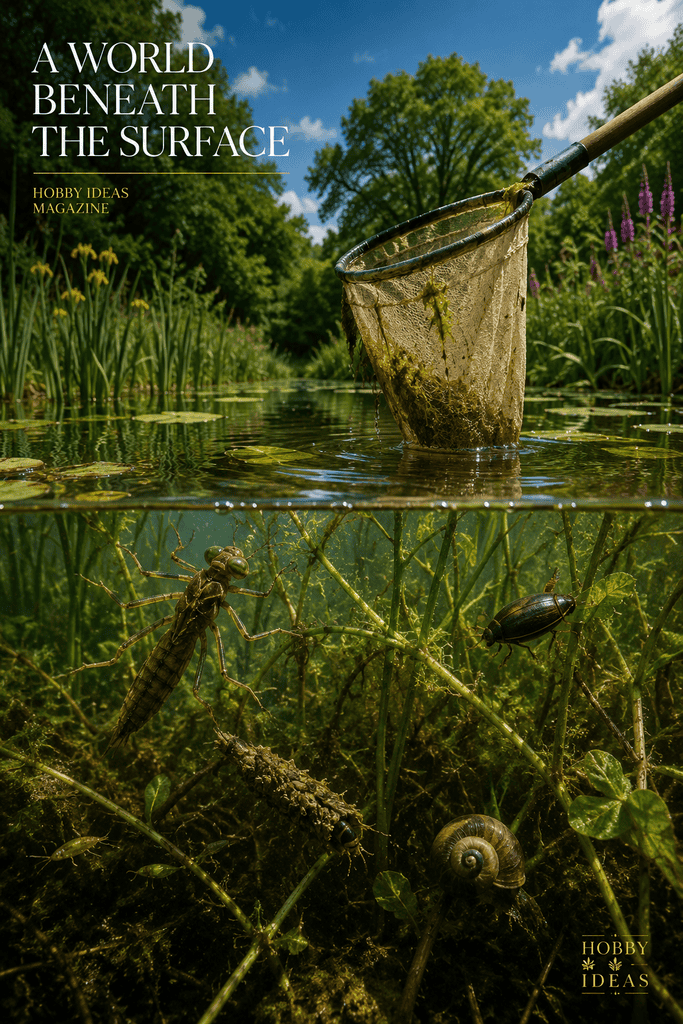
Dragonfly and damselfly nymphs offer a glimpse into a life that normally remains hidden. Before familiar adult dragonflies patrol summer ponds, they spend an important part of their lives underwater. Finding a nymph makes the eventual transformation from aquatic hunter to flying insect seem even more remarkable.
Caddisfly larvae can be equally fascinating because some build protective cases from material around them. Tiny pieces of plants, sand and other debris become portable shelters. Consequently, what initially resembles an unremarkable fragment of pond material may suddenly begin crawling across the tray.
Aquatic snails provide a slower spectacle, while tiny crustaceans may require a magnifying glass before their details become clear. Depending on the season, tadpoles and other amphibian life may also appear. Observe these carefully and return them promptly.
Learning to Identify Freshwater Wildlife
Trying to identify every creature immediately can turn an enjoyable afternoon into an unnecessarily difficult biology lesson. Instead, begin by noticing differences in shape and behaviour. Your knowledge will then develop naturally with repeated visits.
Watch how an animal moves before worrying about its name. Does it swim freely, crawl along vegetation or wriggle through the water? Next, consider its general shape and size. Obvious legs, shells, tails and other features can provide useful clues. Watch how an animal moves before worrying about its name. Does it swim freely, crawl along vegetation or wriggle through the water? Next, consider its general shape and size. Obvious legs, shells, tails and other features can provide useful clues.
A straightforward reference such as the Concise Pond Wildlife Guide can then help you compare those clues with common pond species without turning a relaxed afternoon into a biology lesson.
Photography makes identification considerably easier because you can return the creature before continuing your investigation. Take a clear close-up photograph and make a note of its size and movement. Recording where you found it can also help to narrow down the possibilities.
There is something enjoyable about not immediately knowing the answer. A strange creature discovered on Saturday afternoon might inspire an evening spent comparing photographs and identification guides. In this way, the experience continues long after you leave the pond.
“You do not need to know the name of everything you find. Learning to notice the differences is where becoming a naturalist begins.”
Pond Dipping Through the Seasons
Summer is particularly rewarding because many aquatic invertebrates become active and easier to encounter. The Wildlife Trusts identifies summer as the best time for pond dipping. Typical finds can include water beetles, water fleas, dragonfly nymphs, caddisfly larvae and aquatic snails.
However, treating pond dipping for beginners purely as a summer activity means missing one of its most interesting possibilities. Return to the same pond throughout the year and you will see how dramatically freshwater habitats change.
Water levels rise and fall, vegetation develops and retreats, while different creatures appear at different stages of their life cycles. Even returning several weeks after your first visit can produce a tray that looks surprisingly different.
A simple notebook therefore adds considerable value. Record the date, weather, location and a few creatures you recognised. You could also add photographs or sketches if you enjoy nature journalling. After several visits, those notes become your own record of a changing freshwater habitat.
Pond Dipping Safety and Wildlife Care
Although pond dipping is generally a gentle activity, any body of water deserves respect.
A quick word about water safety: Always choose a stable, easily accessible pond edge and never lean further over the water than feels comfortable. Children should stay within close adult supervision, and nobody should enter the water to retrieve a net, container or other dropped equipment. Avoid steep, slippery or unstable banks, and move to another spot if you cannot reach the water safely from firm ground.
Stay securely on the bank and avoid wading into deeper water. Cover existing cuts before handling pond water. Afterwards, wash your hands thoroughly and always do so before eating or drinking.
Good practice also means protecting the pond itself. Move nets gently through vegetation rather than tearing plants or repeatedly dredging sediment. Keep wildlife in water from the same pond and place observation trays away from strong sunshine. Shallow water can warm surprisingly quickly.
Equipment deserves particular attention when you visit more than one freshwater site. Invasive species and aquatic diseases can travel on wet nets, footwear and other equipment. UK environmental guidance promotes the Check, Clean, Dry approach to reduce this risk.
After dipping, inspect your equipment and remove plants, mud or other visible material. Leave that material at the water body where you found it. Then clean the equipment and allow it to dry thoroughly before visiting another freshwater location. These simple habits help protect the habitats that make the hobby possible.
Returning Your Pond-Dipping Finds Safely
Everything you collect should eventually go back into the same pond. Ideally, return it close to the place where it entered your net. Pond dipping for beginners is about observation rather than collecting, so leave the jars of pond life behind.
Once you have finished looking, bring the tray close to the water. Then gently allow its contents to flow back into the pond. Avoid pouring creatures from height or releasing them somewhere away from their original location.
An unusual discovery can make the temptation to keep something surprisingly strong. However, a photograph makes a much better souvenir. You can investigate the mystery later while the animal continues its life exactly where it belongs.
Why Pond Dipping Makes Such a Rewarding Outdoor Hobby
Many outdoor hobbies revolve around covering ground, reaching destinations or improving physical performance. Pond dipping offers something quite different. An absorbing afternoon can take place within a few metres of the same patch of water.
The challenge is not how far you travel, but how much you notice. Therefore, the hobby particularly suits anyone who enjoys wildlife, photography or simply having a reason to slow down outdoors.
It can also change the character of an ordinary walk. Once freshwater wildlife interests you, ponds that previously seemed like background scenery start demanding attention. You notice vegetation around the margins, insects above the surface and subtle differences between one body of water and another.
If discovering overlooked wildlife appeals to you, rockpooling offers a fascinating coastal equivalent. Instead of searching freshwater vegetation, you explore miniature habitats exposed by the retreating tide. Both hobbies prove that apparently ordinary places can contain far more life than expected.
Turning Pond Dipping Into a Lasting Interest
The easiest way to deepen your interest in pond dipping for beginners is not to travel further but to return. Repeated visits to one pond allow you to recognise changes that a single afternoon could never reveal. Familiarity also makes unusual discoveries easier to notice.
Photography can become part of the hobby without requiring elaborate equipment. Even a phone camera may capture enough detail for later identification. If your interest develops, macro photography can eventually reveal an entirely different world.
Nature journalling provides another route. Sketch a dragonfly nymph or record the first tadpoles of the year and individual visits become part of a longer story. Eventually, you may recognise creatures that seemed completely mysterious only a few months earlier.
Those connections help explain why simple outdoor hobbies can become surprisingly absorbing. Pond dipping may lead towards wildlife photography, nature recording, walking and other forms of outdoor exploration. Our hiking for beginners guide offers another accessible way to spend more purposeful time outside.
Common Pond Dipping Mistakes Worth Avoiding
Most beginner mistakes come from enthusiasm rather than bad intentions. People often sweep the net too vigorously because a bigger scoop feels more likely to produce wildlife. In practice, aggressive dipping disturbs plants and sediment. It can also fill the tray with so much mud that seeing anything becomes difficult.
Keeping creatures out for too long is another easy mistake. Identification can become absorbing, especially when several people have different ideas about an unusual find. Instead, take a photograph and return the animal. You can continue searching through an identification guide afterwards.
It is also worth resisting the urge to judge a pond by the number of creatures in one dip. A quiet tray does not necessarily mean that the pond lacks wildlife. Move gently to another area or try vegetation with a different structure. Alternatively, return at another time and see what has changed.
Finally, avoid moving wet equipment directly from one pond to another. Good biosecurity may not be the glamorous side of pond dipping for beginners, but it matters. Protecting freshwater habitats is part of enjoying them responsibly.
Why Adults Enjoy Pond Dipping Too
Pond dipping often appears among children’s nature activities, which rather undersells it. Children understandably enjoy the excitement of discovering something alive in a net. However, freshwater natural history can become as detailed and absorbing as any adult chooses to make it.
A casual introduction to pond dipping for beginners may develop into an interest in aquatic insects, amphibians or wildlife photography. Nature journalling and environmental recording offer further possibilities. There is always another level of knowledge available, yet none of it is necessary before you can enjoy the hobby.
That balance is one of its strengths. You can spend an hour beside a garden pond simply enjoying whatever appears. Alternatively, you can gradually learn to recognise species, understand life cycles and notice environmental changes between visits.
For anyone seeking inexpensive ways to spend more time outdoors, the hobby also fits naturally beside our guide to free hobbies for adults. Once you have access to basic equipment, the real investment is attention rather than money.
Pond Dipping for Beginners: Frequently Asked Questions
A Small Pond Can Contain a Surprisingly Big Hobby
The pleasure of pond dipping for beginners comes from discovering how much can hide within an apparently ordinary patch of water. You need very little equipment and no specialist knowledge to begin. Nevertheless, every visit has the potential to reveal something you have never seen before.
More importantly, the hobby teaches observation without making it feel like a lesson. After several visits, a pond stops being simply water surrounded by plants. You begin to recognise different habitats around its edges and notice insects that previously escaped your attention. Eventually, the creatures in your tray become part of a much larger freshwater community.
Perhaps that is why pond dipping remains so satisfying despite its simplicity. The net provides the opportunity, but curiosity does most of the work. Once an apparently lifeless tray has revealed its inhabitants, walking past another pond becomes surprisingly difficult. There is always that irresistible question: what might be living beneath the surface?
Affiliate Disclosure: This article contains affiliate links. If you buy something through one of these links, Hobby Ideas may earn a small commission at no extra cost to you. This helps support the site and allows us to continue creating useful, independent hobby guides.