

Puzzle solving hobbies offer something far more exciting than simply watching another detective drama on television. Instead of sitting back while someone else follows the clues, you step into the role of investigator, code-breaker, note-taker and final-case solver.
Picture the scene. The lights sit low, a notebook lies open on the table, and a folder of witness statements, maps, timelines and strange symbols waits in front of you. Perhaps you are solving a fictional cold case. Maybe you are decoding a historical cipher. Alternatively, you might be playing a murder mystery game with friends around the dining table.
Whatever route you choose, this is one of those hobbies that feels instantly immersive. It mixes storytelling, logic, memory, pattern recognition and curiosity. Better still, it works for solo evenings, family nights, rainy weekends and screen-free gatherings with friends.
For anyone who enjoys mysteries, puzzles, cryptography, detective stories or true-crime-style entertainment, puzzle solving hobbies can turn an ordinary evening into something surprisingly memorable.
What Are Puzzle Solving Hobbies?
Puzzle solving hobbies are activities built around clues, deduction, codes, mysteries and problem-solving. They can include murder mystery games, cold case investigation boxes, escape-room-style puzzles, cryptography challenges, detective board games and historical riddle hunts.
Some puzzle solving hobbies feel theatrical. Others feel logical and quiet. However, they all share the same basic appeal: you receive a problem, study the clues and work towards a solution.
This makes them ideal for people who enjoy thinking hobbies rather than purely physical activities. In fact, many readers discover them while looking for new ideas in our guide to hobbies for seniors. Moreover, they offer a satisfying alternative to scrolling, streaming, or passively watching someone else solve the mystery.
Why Armchair Detective Hobbies Are So Appealing
There is something deeply satisfying about connecting clues that did not make sense at first glance.
A name appears in one document. Then, a date appears in another. Meanwhile, a map reveals a route that changes everything. Suddenly, the story opens up and you begin to feel like a real investigator.
That moment of discovery explains why armchair detective hobbies have become so popular. They give people a safe, structured way to experience mystery, suspense and deduction from home.
Unlike many hobbies, they also suit a wide age range. Younger adults may enjoy them as unusual game-night entertainment. Families may use them for collaborative evenings with older teenagers. Meanwhile, older adults may enjoy the mental challenge, memory work and careful reasoning.
If you already enjoy relaxing hobbies for adults, this can offer a slightly sharper, more investigative alternative while still keeping the screen-free feel.
Why Puzzle Solving Hobbies Work Across Generations
One of the strengths of puzzle solving hobbies is their flexibility.
For people in their twenties and thirties, murder mystery games and cold case boxes can create a far more memorable evening than another takeaway and film night. Friends can gather around a table, read statements aloud, argue over motives and celebrate when someone spots the missing clue.
For people in their forties and fifties, these hobbies can work beautifully as family activities. Older teenagers often enjoy the mixture of story, evidence and competition, especially when everyone gets a role in the investigation.
For people in their sixties and seventies, puzzle solving hobbies can provide active cognitive exercise. Reading documents, comparing clues and testing theories all keep the mind engaged. However, the activity still feels like entertainment rather than homework.
As a result, this is one of the rare indoor hobbies that can genuinely appeal across several generations.
Types of Puzzle Solving Hobbies to Try
The world of puzzle solving hobbies is broader than many beginners expect. You do not have to start with anything complicated. In fact, the best first choice depends on the kind of mystery you enjoy.
Murder Mystery Games
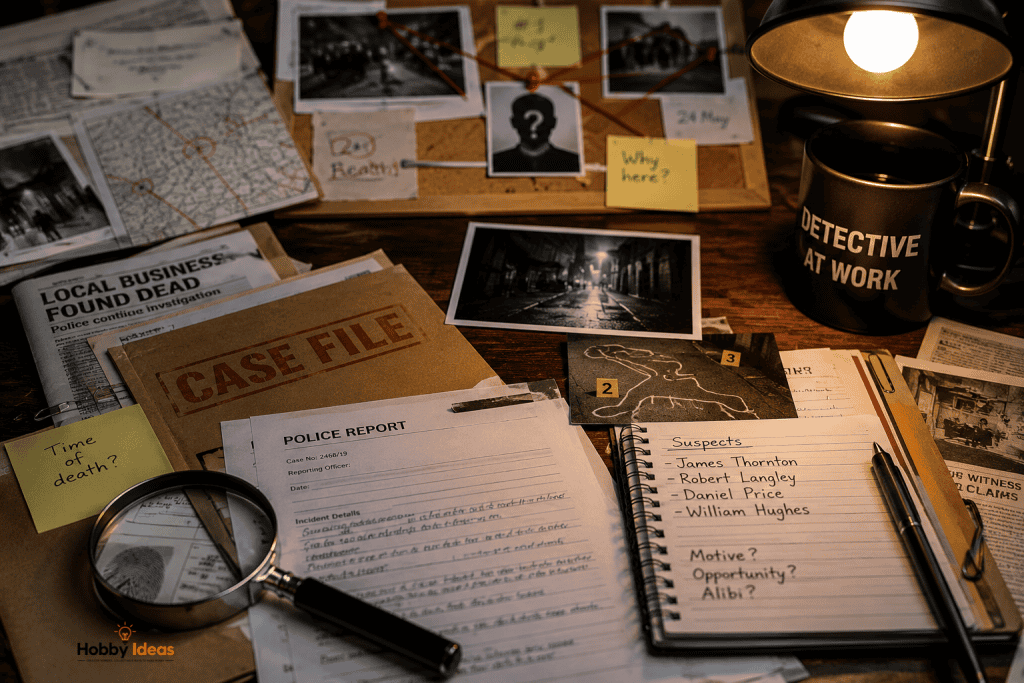
Murder mystery games are often the easiest way to begin. Some work like party games, where each player takes on a role. Others provide documents, clues and staged evidence for everyone to examine together.
These games suit social evenings because they create conversation immediately. Moreover, they give quieter guests something to focus on, which can make them less awkward than ordinary party games.
Cold Case Investigation Boxes
Cold case mystery games usually feel more detailed. They may include police-style files, suspect statements, maps, photographs, newspaper clippings and evidence cards.
These boxes suit people who enjoy slow-burn storytelling. Instead of racing through clues, you build a theory gradually. Then, you test that theory against each piece of evidence.
Although many cold case boxes use fictional cases, they can still feel atmospheric and absorbing.
Cryptography and Code-Breaking
Cryptography puzzles appeal to people who enjoy codes, hidden messages, ciphers and patterns.
This area can feel especially satisfying because the answer often sits in plain sight. You simply need the correct method to reveal it. As a result, cryptography suits people who enjoy logic, history, maths or wordplay.
For historical inspiration, the Bletchley Park codebreaking history offers a fascinating look at real code-breaking work during the Second World War.
Escape Room Games at Home
Escape room games bring the locked-room experience into your living room. Instead of visiting a physical venue, you solve puzzles from cards, booklets, envelopes or printed materials.
These games often move quickly, which makes them ideal for groups that enjoy energy, teamwork and a little pressure.
Printable Mystery Puzzles
Printable mystery puzzles can provide a low-cost way to test the hobby before buying a full game or subscription box.
They often include clues, maps, codes, word puzzles or detective-style challenges. Additionally, they work well for rainy afternoons, family evenings and solo problem-solving sessions.
If you like simple at-home activities, our guide to printable games for adults includes more ideas for screen-free entertainment.
How to Set Up Your First Detective War Room
You do not need a genuine office, leather chair or dramatic desk lamp to enjoy this hobby. However, a little preparation makes the experience much more immersive.
Clear a Proper Workspace
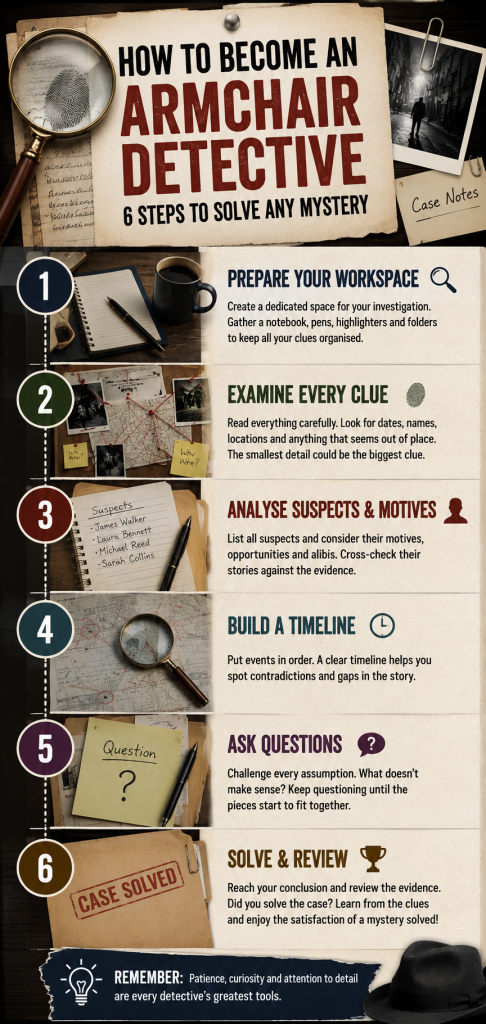
Start with a dining table, large desk or clear floor space. You need enough room to spread out notes, clues and evidence without losing track of important details.
If you plan to play over several evenings, consider using a tray, folder or noticeboard so you can keep everything organised between sessions.
Gather Your Detective Tools
Simple stationery makes the whole experience feel more satisfying. Keep a notebook, highlighters, sticky notes, paper clips and pens nearby.
A magnifying glass is not essential, although it does add a little theatrical charm. Meanwhile, a corkboard or pinboard can help if you enjoy building timelines and suspect webs.
Create a Timeline
Most mystery games become easier once you build a timeline.
Write down key dates, times, locations and events. Then, compare each new clue against that timeline. Often, the most important contradiction appears when someone could not have been where they claimed to be.
Track Suspects and Motives
Keep a separate list of suspects, motives, opportunities and alibis. This simple method prevents the case from becoming muddled.
Furthermore, it helps groups discuss theories without everyone talking over one another.
Set the Mood
A little atmosphere can turn the hobby into a full evening event. Dim the lights, make drinks, choose background music and treat the case like a proper project.
However, avoid music with lyrics if people need to read documents carefully. Low, atmospheric instrumental music usually works best.
What Makes a Good Beginner Mystery Game?
A good beginner mystery game should feel challenging without becoming frustrating.
Look for a game that clearly explains how to begin. It should provide enough structure that you know what to examine first, yet enough freedom that you can form your own theories.
For a first attempt, avoid anything that requires hours of online research or specialist knowledge. Instead, choose a game with physical clues, clear documents and a satisfying final reveal.
Also, check whether the game works best solo, in pairs or with a group. Some games suit quiet individual solving, while others need discussion and teamwork.
Recommended Starter Kits for New Armchair Detectives
If you would like to try puzzle solving hobbies for yourself, a good mystery game can make all the difference. The best beginner experiences provide enough challenge to keep you thinking without becoming frustrating. These three options offer very different styles of investigation, so there is something here for solo sleuths, couples and groups alike.
Murder at the Movie Theater
If you enjoy the idea of sorting through evidence, studying witness statements and uncovering hidden clues, Murder at the Movie Theater by Cryptic Killers provides an immersive cold-case experience that suits individuals, date nights and party groups. It works particularly well for people who enjoy discussing theories and following leads together.
The Case of Little Gomersal
For those who prefer a more traditional detective investigation, The Case of Little Gomersal offers a detailed case file packed with evidence, clues and suspect information. Many players enjoy this style because it feels like stepping into a television detective drama, except this time you are responsible for solving the crime.
Murdoku: Murder Mystery Logic Puzzles
Not every puzzle solving hobby requires a table full of evidence. Murdoku combines logic puzzles with cosy crime storytelling, making it ideal for solo puzzlers who enjoy deduction, problem-solving and quiet evenings with a notebook and a cup of tea.
Puzzle Solving Hobbies for Solo Players
Solo puzzle solving can feel surprisingly relaxing.
You can work at your own pace, pause whenever you like and return to the case later with fresh eyes. This makes it ideal for people who enjoy reading, journaling, crosswords or quiet evening hobbies.
Solo players may enjoy cold case boxes, cryptography books, puzzle novels and printed investigation packs. Additionally, some escape-room-style games work perfectly well for one person.
Puzzle Solving Hobbies for Groups
Group solving creates a different kind of fun.
One person spots a strange date. Another notices an odd phrase. Meanwhile, someone else remembers a clue from twenty minutes earlier. The best group games reward different thinking styles.
Murder mystery games, party investigations and escape room boxes work especially well with friends or family. They encourage conversation, laughter and debate without relying on screens.
Can You Help with Real Cold Cases?
Some people become interested in real-world cold cases after enjoying fictional mystery games. However, this area needs care, respect and common sense.
Never contact victims’ families, witnesses, suspects or officials because of something you read online. Also, never interfere with active investigations.
If you want to help responsibly, look for legitimate volunteer projects involving public records, archive transcription or missing-person charities. These projects usually provide clear instructions and ethical boundaries.
For most hobbyists, fictional cases, historical puzzles and archive-based research provide the safest and most enjoyable route.
Why Puzzle Solving Hobbies Beat Passive Television
Television can be enjoyable, but it rarely asks much from you. Puzzle solving hobbies work differently.
They ask you to read carefully, compare details, remember clues, test theories and revise your thinking. Consequently, they feel active rather than passive.
That active involvement makes the final solution much more satisfying. You did not simply watch a detective reveal the answer. You earned it.
Frequently Asked Questions About Puzzle Solving Hobbies
What are puzzle solving hobbies?
Puzzle solving hobbies are activities that involve clues, logic, deduction, codes or mystery-solving. They include murder mystery games, cold case boxes, cryptography puzzles and escape-room-style games.
Are murder mystery games good for adults?
Yes. Murder mystery games can work extremely well for adults because they combine storytelling, deduction, conversation and teamwork.
Can puzzle solving hobbies improve your brain?
Puzzle solving hobbies can help keep your mind active because they involve memory, attention, pattern recognition and problem-solving. However, they should still feel enjoyable rather than like formal training.
What do I need to become an armchair detective?
You only need a mystery game or puzzle, a notebook, a pen and enough space to organise your clues. A pinboard, highlighters and folders can make the experience more immersive.
Are cold case games real?
Most cold case games use fictional stories inspired by detective work. Some real-world projects involve public archives or volunteer research, but beginners should start with fictional or historical puzzles.
Final Thoughts
Puzzle solving hobbies offer a brilliant mix of curiosity, logic and atmosphere. They turn ordinary evenings into investigations and give you a reason to gather around a table, open a case file and follow the clues.
Whether you prefer murder mystery games, cold case boxes, cryptography puzzles or escape-room-style challenges, the appeal remains the same. You are not just watching the story unfold. You are part of it.
So, clear the table, sharpen a pencil and prepare your first suspect list. Your next favourite hobby might begin with a single clue.
Disclosure: HobbyIdeas.co.uk participates in the Amazon Associates programme. If you purchase through links on this page, we may earn a small commission at no additional cost to you. This helps support the site and allows us to continue creating free hobby guides and inspiration.