

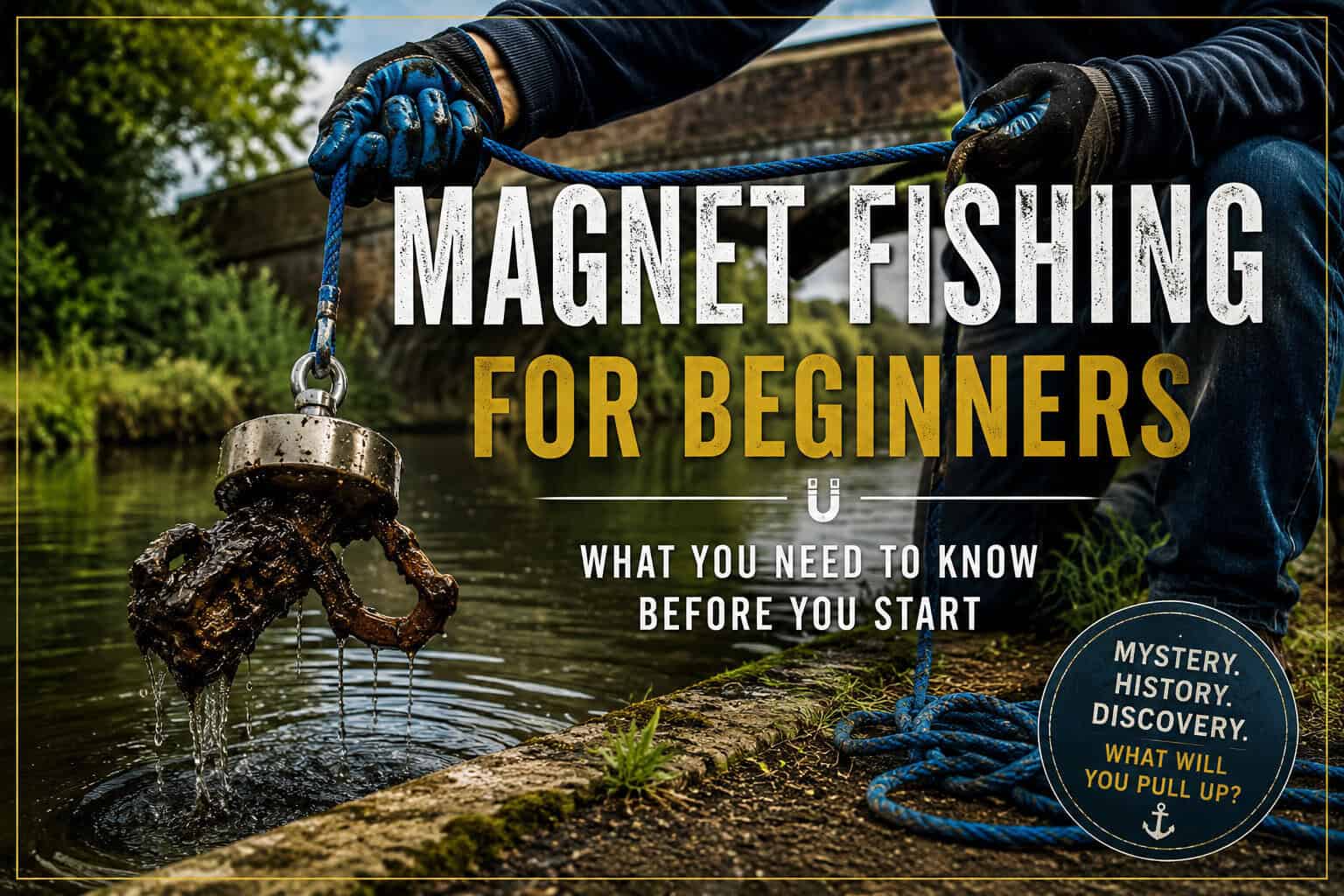
Magnet fishing for beginners has an irresistible quality that is difficult to appreciate until you have a rope in your hands. Somewhere beneath the surface, a powerful magnet is moving across the bottom. You retrieve it slowly, feeling every scrape and bump through the rope, until suddenly there is resistance. At that moment, even the most sensible person begins wondering what might be about to emerge from the water.
Usually, of course, it isn’t buried treasure. Your mysterious discovery may turn out to be an old bolt, a length of chain or a thoroughly corroded piece of iron. Occasionally, however, an old tool, bicycle part, lock or sign breaks the surface. Dripping with water and carrying the marks of its time below, even an ordinary object can suddenly become fascinating.
That uncertainty makes magnet fishing such an appealing outdoor hobby. It combines treasure hunting, collecting and local history with the simple pleasure of being outside. Better still, the equipment required to get started is surprisingly modest. Nevertheless, UK beginners need to understand one important point before heading for the nearest bridge. Access to the water does not automatically give you permission to magnet fish there.
So, let us begin properly. We will look at where you can magnet fish and what equipment you actually need. We will also cover your first cast, realistic finds and the practicalities of enjoying the hobby safely and responsibly.
Quick Answer: What Is Magnet Fishing?
Magnet fishing is an outdoor hobby that uses a powerful magnet, usually a neodymium magnet attached to strong rope, to recover magnetic metal objects from water. Beginners need relatively little equipment, but permission is essential because different waterways have different owners and rules. In particular, the Canal & River Trust does not permit magnet fishing on the waterways it manages. Once you find a suitable permitted location, you lower or cast the magnet and retrieve it slowly across the bottom. Then you discover what has attached itself along the way.
Why Magnet Fishing Has Become Such an Addictive Hobby
Humans appear to have a remarkable inability to resist wondering what is hidden beneath things. We search beaches after storms, turn over old boxes at car boot sales and investigate mysterious signals with metal detectors. Magnet fishing appeals to exactly the same instinct. However, this time the search takes place beneath water, where we cannot see the target at all.
There is also something pleasantly uncomplicated about the process. Once you have permission for a suitable location, you do not need an elaborate workshop or years of training. You cast or lower the magnet, allow it to reach the bottom and retrieve it steadily. Every throw gives you another chance of feeling that distinctive extra weight on the rope.
However, the real appeal is not necessarily finding anything valuable. An old spanner can become interesting when you recover it beside a former workshop. Meanwhile, a battered lock or piece of machinery may send you searching through old maps and photographs when you get home. As a result, magnet fishing can quietly develop into a fascination with local history as well as a hunt for submerged objects.
Anyone who enjoys discovering forgotten objects will recognise the attraction. It has much in common with the hobbies in our Collecting & Antiques section. Magnet fishing simply adds the considerable complication that your collecting ground is underwater.
Magnet Fishing for Beginners Starts With Permission
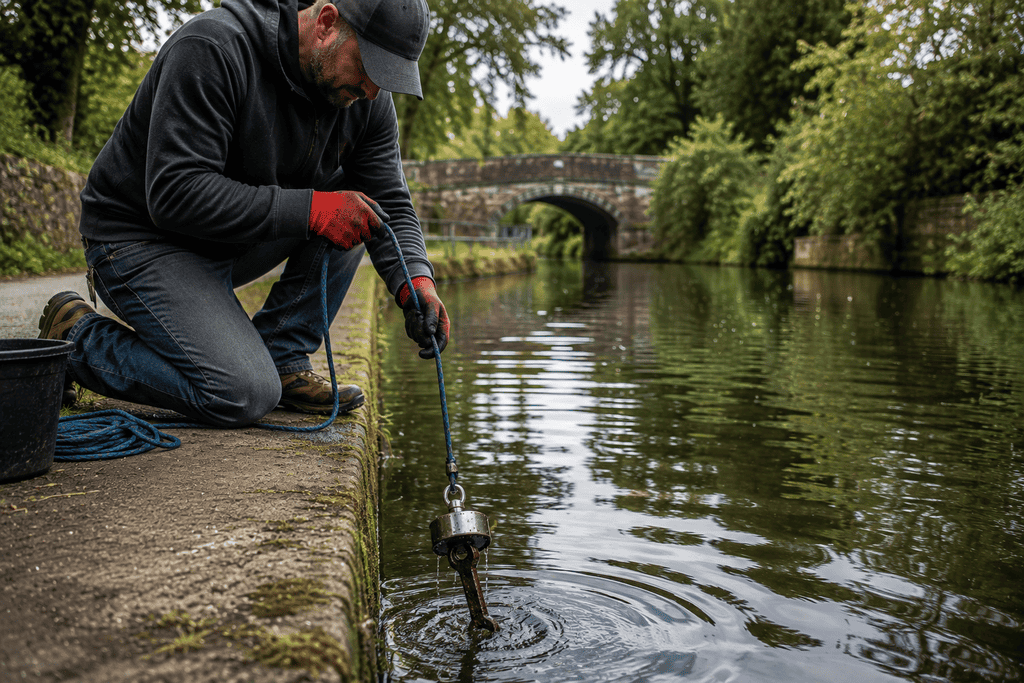
The most important preparation for your first trip does not involve tying knots or choosing magnets. Instead, establish who owns or manages the water you intend to search. Then find out whether they allow magnet fishing.
This matters particularly in Britain because different organisations control many apparently perfect locations. The Canal & River Trust, for example, states that it does not permit magnet fishing on its waterways. Therefore, an attractive canal bridge and public towpath do not automatically give you somewhere to start searching.
Private landowners, local authorities, navigation authorities or other organisations may control different stretches of water. Their rules can vary considerably. Consequently, identify whoever controls the particular location and obtain any necessary permission before visiting. Historic, protected or environmentally sensitive locations may carry additional restrictions.
This might sound like an inconvenient beginning to an otherwise spontaneous hobby. However, it can save considerable trouble later. More importantly, you can enjoy the search knowing that you have permission to be there. For magnet fishing for beginners, that certainty is far more useful than simply copying a location seen in somebody else’s video.
“The first thing to find when magnet fishing should not be treasure. It should be permission.”
What Equipment Do You Need for Magnet Fishing?
One attraction of magnet fishing for beginners is the refreshingly short equipment list. You certainly do not need to turn the spare bedroom into a tackle shop before making your first cast.
At the centre of the setup is a purpose-made fishing magnet. Most models use powerful neodymium magnets inside protective steel casings. An eye bolt or another secure attachment connects the magnet to the rope. Manufacturers offer numerous sizes and strengths, although the largest pulling-force figure does not automatically make the best beginner choice.
You will also need a strong rope that suits the magnet and its intended use. Buying the main components together can remove some of the guesswork for a first setup. For example, this double-sided complete magnet fishing kit includes a 400kg-rated magnet, 20-metre rope with carabiner, gloves and threadlocker in one package. Robust gloves are particularly important because wet rope can quickly become uncomfortable, while recovered metal may be sharp, rusty or covered in debris.
Finally, bring something suitable for containing your finds. A sturdy bucket works well for smaller pieces, while larger scrap requires more forward planning. Waterproof boots make sense around muddy banks. Any additional safety equipment should reflect the particular location and conditions.
In other words, the essentials are straightforward. A simple and manageable setup usually makes magnet fishing for beginners more enjoyable than starting with equipment you can barely control.
Your First Magnet Fishing Kit
🧲 Fishing Magnet
Choose a purpose-made neodymium fishing magnet with a manageable pulling strength. You do not need the most powerful model available to enjoy your first trips.
🪢 Strong Rope
Use rope suited to your magnet and the type of searching you plan to do. Check the knot and attachment carefully before every session.
🧤 Protective Gloves
Good gloves protect your hands from wet rope and help when handling rusty, sharp or dirty objects that emerge from the water.
🪣 Bucket or Container
Bring something sturdy for muddy finds and unwanted metal. Anything you recover should leave with you rather than becoming a new pile of rubbish on the bank.
Choosing Your First Magnet
This is where beginners can easily become distracted by impressive specifications. Sellers frequently promote fishing magnets with enormous pulling-force figures. Consequently, choosing one can start to feel rather like selecting an engine for a tugboat.
Yet maximum strength is only part of the story. A very powerful magnet can attach firmly to a large submerged steel object and create a problem rather than solve one. The same magnet can also snap violently towards nearby metal if you handle it carelessly. For that reason, a manageable purpose-made magnet from a reputable supplier makes more sense for a beginner.
Single-Sided Fishing Magnets
A single-sided magnet concentrates its principal magnetic face underneath. This arrangement suits vertical searching particularly well. When you lower the magnet from a suitable platform or edge, the active face naturally points towards the bottom.
The design is straightforward and effective. Therefore, it can provide an entertaining introduction to the hobby without unnecessary complication.
Double-Sided Fishing Magnets
A double-sided magnet provides magnetic attraction on two faces. Consequently, it can work particularly well when you cast from a bank. As you retrieve the magnet horizontally across the bottom, either side may encounter an object.
However, read the specifications carefully when comparing models. A quoted combined pulling force does not necessarily apply to each individual face. For a first purchase, concentrate on ease of handling and how you intend to search. Those considerations matter far more than the largest number printed on the packaging.
Preparing for Your First Magnet Fishing Trip
Set up your equipment at home rather than working everything out beside the water. Follow the manufacturer’s instructions when fitting the eye bolt or attachment hardware. Also check whether the maker recommends thread-locking compound to stop threaded components loosening during repeated use.
Your rope connection deserves similar attention. Use a secure knot that suits the equipment and inspect it carefully. Make sure you also have enough rope for the location. Losing a brand-new magnet because of a hurried knot would certainly make your first expedition memorable, although probably for the wrong reason.
Before leaving home, think about the less exciting end of the hobby too. What will you do with muddy objects? Where will the wet rope go afterwards? How will you transport unwanted scrap? A bucket, strong container and something to protect the car can prove every bit as useful as the magnet itself.
How to Magnet Fish for the First Time
Once you reach a permitted location, spend a few minutes looking at the water and surrounding area. Check the stability of the bank and notice other water users. Also consider where your rope will lie while you work. Boats, anglers, wildlife and people using nearby paths all deserve consideration.
If you are searching from a bank, make a controlled cast into an appropriate clear area. Then allow the magnet to sink. There is no advantage in attempting to throw it halfway across the county. Once it reaches the bottom, retrieve the rope slowly so the magnet can pass across potential targets.
Alternatively, you can lower a magnet vertically where the location and conditions suit this technique. You can then work the area immediately beneath you. Single-sided magnets are particularly well suited to this approach.
Part of the appeal of magnet fishing for beginners is discovering how quickly you start recognising different sensations through the rope. Stones, mud, branches and uneven ground all feel slightly different as the magnet moves. However, a solid contact followed by unexpected resistance quickly gets your attention. When that happens, apply steady pressure and begin bringing the magnet towards you.
Then comes the reveal. Perhaps a recognisable object appears through the surface. Perhaps the magnet carries nothing more than a shapeless lump of iron. Alternatively, it may have collected three bottle caps and something suspiciously like half a hinge. All three count as genuine magnet fishing.
What Do People Really Find While Magnet Fishing?
Realistic expectations make magnet fishing for beginners considerably more enjoyable. Online videos inevitably concentrate on extraordinary discoveries. After all, nobody becomes an internet sensation by recovering their seventeenth rusty nail. Ordinary finds are part of the hobby rather than evidence that you have chosen the wrong location.
Common finds include bolts, nails, brackets, wire, fishing tackle, tools, bicycle components and pieces of machinery. You will probably encounter plenty of assorted scrap iron too. Locations with a long industrial or transport history may produce objects connected with former businesses and activities. However, an apparently promising location never guarantees an interesting find.
Occasionally, something emerges that deserves closer attention. Perhaps you notice an old maker’s mark, unusual shape or unfamiliar mechanical component. Suddenly, an unremarkable piece of rust becomes an evening of research. That detective work is one of the hobby’s underrated pleasures.
Precious metals are another matter. Gold and silver are not ferromagnetic, so a fishing magnet will not simply attract a gold ring or silver coin. Magnet fishing concentrates primarily on magnetic materials, particularly iron and many types of steel.
The Hidden History Beneath the Water
To understand why an old piece of iron can become interesting, stop looking at a waterway simply as scenery. Britain’s rivers, docks and navigations were working landscapes long before Sunday walkers and leisure boats arrived.
Warehouses crowded waterfronts, workshops operated beside rivers and countless people crossed bridges every day. Workers dropped tools, machinery broke and bicycles disappeared. People also discarded unwanted objects deliberately. Later, entire areas changed beyond recognition as industries closed and buildings vanished.
Research can therefore add another dimension to a permitted magnet-fishing trip. Historic maps, local archives and old photographs may reveal what once occupied the surrounding land. Meanwhile, the objects you recover can make that history unexpectedly tangible.
Of course, historical interest also demands restraint. Protected archaeological sites and historically sensitive areas are not treasure-hunting playgrounds. Significant discoveries may also require specialist advice or reporting. Nevertheless, learning about the working history of an approved location can turn a pleasant afternoon outside into something much richer.
“The best magnet-fishing find is not necessarily the most valuable. It is the object that makes you wonder how on earth it ended up there.”
Magnet Fishing Safety Without Taking the Fun Out of It
Safety matters with magnet fishing for beginners, but a few sensible habits deal with many obvious risks. Water, powerful magnets and unidentified metal deserve respect. Fortunately, none of this needs to turn an enjoyable afternoon into an expedition to Everest.
Wear sturdy gloves whenever you handle the rope or recovered objects. Corroded metal can have extremely sharp edges. Equally, keep your fingers away from the gap between a powerful magnet and a substantial steel object. Neodymium magnets can move towards metal with surprising force, and trapped fingers are considerably less entertaining than finding treasure.
Keep loose rope organised rather than spreading it across paths or around your feet. In addition, never wrap the rope around your hand, wrist or body while pulling. If a heavy submerged object refuses to move, leave it alone. No find is worth losing your balance and ending up in the water.
Water edges also deserve attention. Mud, algae, wet stone and crumbling banks can make apparently easy access treacherous, particularly after rain. Therefore, if conditions look unsafe, choose another day or another location.
What If You Find Something Dangerous?
Most magnet-fishing finds are harmless pieces of metal. However, British waterways have also produced firearms, ammunition and old ordnance. Beginners therefore need to know what not to do before they encounter something potentially dangerous.
If an object looks like ammunition, an explosive device or a firearm, do not clean or dismantle it. The same applies to anything else that causes concern. Avoid unnecessary handling, keep other people away and contact the police for advice. Call 999 for an immediate emergency; otherwise, 101 may be appropriate for a non-emergency police report.
Never assume that age or corrosion makes ammunition or ordnance safe. Curiosity is a wonderful ingredient in a hobby. Occasionally, however, the correct response to a mysterious discovery is to leave it to professionals.
When Your Magnet Refuses to Come Back
Sooner or later, you may pull the rope and discover that your magnet has developed a deep emotional attachment to something beneath the water.
Do not immediately haul on the rope with every ounce of strength. The magnet may have attached itself to a large steel object. Alternatively, it might sit wedged beneath a branch, rock or submerged structure. Changing the direction of pull can often help, so move carefully along the bank to create a different angle. Sometimes the problem is not a stuck magnet but an awkward find that the magnet cannot hold securely enough to recover.
Some magnet fishers carry a separate heavy-duty grappling hook with 15-metre rope for suitable objects that need a different point of purchase. However, extra equipment does not make an unsafe recovery sensible. If an object is excessively heavy, dangerously positioned or requires you to put yourself at risk, leave it where it is.
Gentle, controlled pressure usually makes more sense than violent jerking. Most importantly, never enter dangerous water or climb onto prohibited structures merely to recover equipment. Do not put yourself at risk. Magnets are replaceable; you are not.
A Good Magnet Fisher Takes the Rubbish Home
Removing discarded metal from water can bring obvious environmental satisfaction. However, the job does not finish when the object reaches the bank. Leaving rusty scrap beside a path simply moves the rubbish from one place to another. Worse still, it can create a hazard for people and wildlife.
Instead, plan to take unwanted finds away and use an appropriate recycling or disposal route. This becomes particularly important when you recover larger pieces. They can prove awkward, dirty and surprisingly heavy once they leave the water.
At the same time, do not assume that every unusual object automatically becomes yours because your magnet found it. Identifiable property, potentially historic material and suspicious items may require further enquiries. When in doubt, seek appropriate advice rather than quietly adding something questionable to the shed.
Cleaning and Identifying Magnet Fishing Finds
Back home, the temptation is to attack every rusty object immediately with a wire brush. Before doing so, take a closer look.
Ordinary scrap destined for recycling needs little ceremony. However, an older or unusual object may retain markings, paint or construction details that help identify it. Aggressive grinding or chemical rust removal can destroy precisely the clues you need.
For anything interesting, begin gently. Remove loose mud and photograph the object. Then examine it for lettering, numbers, makers’ marks or distinctive shapes. Once you know what you have found, you can make a better decision about conservation or cleaning.
This is also where magnet fishing frequently wanders into collecting. One recovered tool leads to research about its manufacturer. That leads to the history of the nearby factory, which somehow results in you studying Victorian maps at midnight. Hobbies have a habit of doing that.
Magnet Fishing vs Metal Detecting
The two hobbies share the same fundamental thrill: searching for something you cannot see. Both reward patience and research. Unfortunately, both also produce plenty of rubbish between the memorable finds. However, the way they work is very different.
A metal detector can respond to numerous conductive metals in the ground. These include non-ferrous targets that a fishing magnet cannot attract. A magnet, by contrast, relies on magnetic attraction. Therefore, it concentrates primarily on ferrous materials such as iron and many steels.
Magnet fishing also gives you less information before recovery. A detectorist can interpret a signal and investigate a precise spot. Meanwhile, the magnet fisher may know only that something heavy has attached itself beneath opaque water. That uncertainty makes the moment when an object appears particularly satisfying.
If searching for hidden objects appeals to you, our Outdoor Hobbies section has plenty of other ways to turn an ordinary day outside into a proper hobby.
Is Magnet Fishing Expensive to Start?
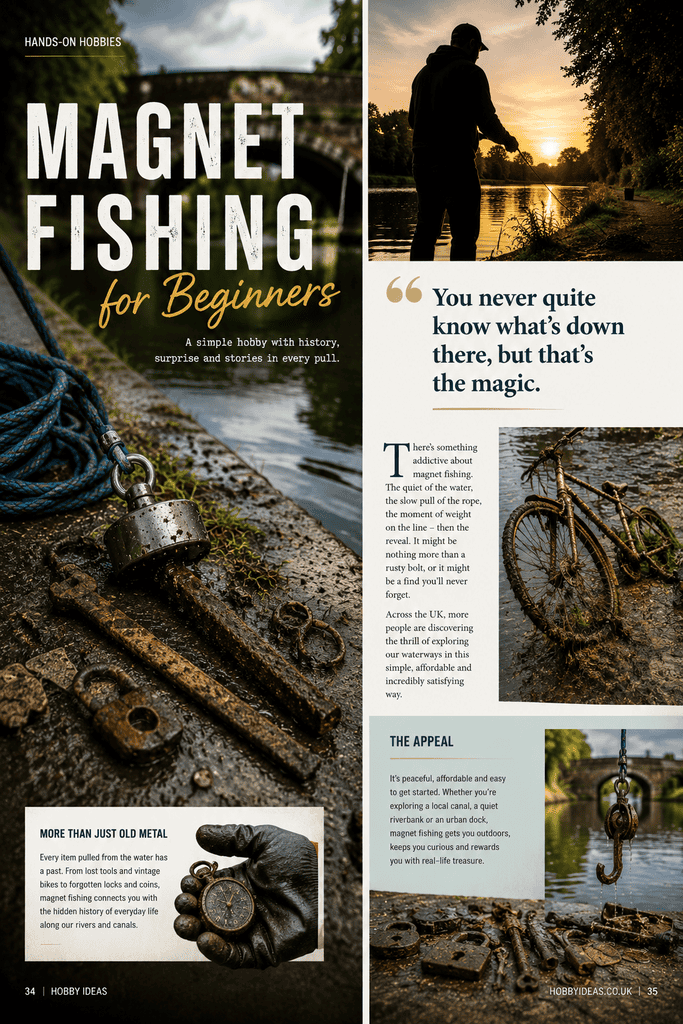
Compared with many outdoor pursuits, magnet fishing has a fairly modest entry cost. After all, there are relatively few essentials. A suitable beginner magnet, rope and gloves provide the basic equipment. You may already own useful extras such as buckets, boots and containers.
Complete kits can make starting easier because they include both the magnet and rope. However, specifications and quality vary. There is no need to buy an enormous collection of accessories before discovering whether you actually enjoy the hobby.
Start simply and learn how the equipment behaves. Later, experience will tell you whether an upgrade would genuinely improve your trips. The best beginner equipment is gear you understand and can use safely, not necessarily the most impressive setup on social media.
Planning Your First Magnet Fishing Adventure
Good preparation makes magnet fishing for beginners far more rewarding, particularly when you have already researched your destination. Choose an interesting location and establish who owns or manages it. Most importantly, confirm that they permit magnet fishing. Then consider practical details such as access, parking, bank conditions and how you will remove your finds.
On the day, take your magnet, rope, gloves and containers, along with clothing suitable for the weather. When you arrive, assess the conditions again rather than assuming everything will be as expected. High water, slippery banks or heavy boat traffic provide perfectly good reasons to postpone the session.
Once you are satisfied, make your first controlled cast and allow the magnet to settle. Retrieve it steadily while paying attention to the sensations travelling up the rope. Your first few throws may produce absolutely nothing, which is entirely normal.
Then perhaps you will feel a bump followed by resistance. The rope becomes heavier and something begins moving across the bottom. For a few seconds, you have absolutely no idea what you are bringing towards the surface.
That moment explains magnet fishing better than any equipment specification ever could.
Magnet Fishing for Beginners: Frequently Asked Questions
Is magnet fishing legal in the UK?
There is no simple blanket rule covering every UK waterway. Different waterways have different owners, managers and restrictions, so you should establish who controls the location and obtain any necessary permission before starting. The Canal & River Trust does not permit magnet fishing on the waterways it manages.
Can you magnet fish in UK canals?
Do not assume that you can. The Canal & River Trust specifically prohibits magnet fishing on its waterways. Other canals and waterways may have different owners or managers, so always check the rules for the exact location before visiting.
What magnet is best for a beginner?
A manageable purpose-made neodymium fishing magnet is a sensible starting point. Single-sided magnets suit vertical searching particularly well, while double-sided designs can work well when dragging across the bottom. Do not choose purely by the largest advertised pulling force.
What do you need to start magnet fishing?
The basic kit is surprisingly simple. You need a suitable fishing magnet, strong rope, protective gloves and a sturdy bucket or container for your finds. Suitable footwear and additional safety equipment may also be sensible depending on the location.
What can you actually find while magnet fishing?
Common finds include bolts, nails, tools, bicycle parts, fishing tackle, brackets and assorted scrap iron. Occasionally, older or unusual objects emerge too. However, ordinary rusty metal makes up a large part of the hobby, so arrive with realistic expectations.
Can a fishing magnet find gold or silver?
Not directly. Gold and silver are not ferromagnetic, so a normal fishing magnet will not attract a gold ring or silver coin. Magnet fishing primarily recovers magnetic materials such as iron and many types of steel.
What should I do if I find a gun, ammunition or unexploded ordnance?
Do not clean, dismantle or unnecessarily handle anything that may be dangerous. Keep other people away and contact the police for advice. Call 999 if there is an immediate emergency; otherwise, 101 may be appropriate for a non-emergency report.
Should I take unwanted magnet fishing finds home?
Yes, you should take responsibility for unwanted material you recover and use an appropriate recycling or disposal route. Leaving rusty scrap beside the water simply moves the rubbish and can create a hazard for other people and wildlife.
Is Magnet Fishing for Beginners Worth Trying?
Magnet fishing for beginners offers something increasingly rare: a simple hobby with an unpredictable outcome. Once you deal with permission and safety, the actual activity requires little explanation. Put the magnet into the water, retrieve it and see what happens.
Yet every location has a different story. One afternoon may produce nothing beyond scrap metal. Another might uncover an object that sends you into a fascinating piece of local-history research. Even an ordinary old tool can become interesting when you know where you found it and start wondering who last held it.
That is why magnet fishing works best when you approach it as exploration rather than a shortcut to treasure. The rusty bolts are part of the hobby. So are the muddy gloves, stubborn magnets and occasional objects that remain completely mysterious.
Find somewhere you genuinely have permission to search and use sensible equipment. Respect the water and take responsibility for everything you recover. Then enjoy that wonderfully uncertain moment when the rope becomes heavier and something begins rising towards the surface.
It will probably be another piece of rusty iron. But you will still want to know what it is.
Affiliate Disclosure: This article contains affiliate links. If you buy something through one of these links, Hobby Ideas may earn a small commission at no extra cost to you. This helps support the site and allows us to continue creating useful, independent hobby guides.