

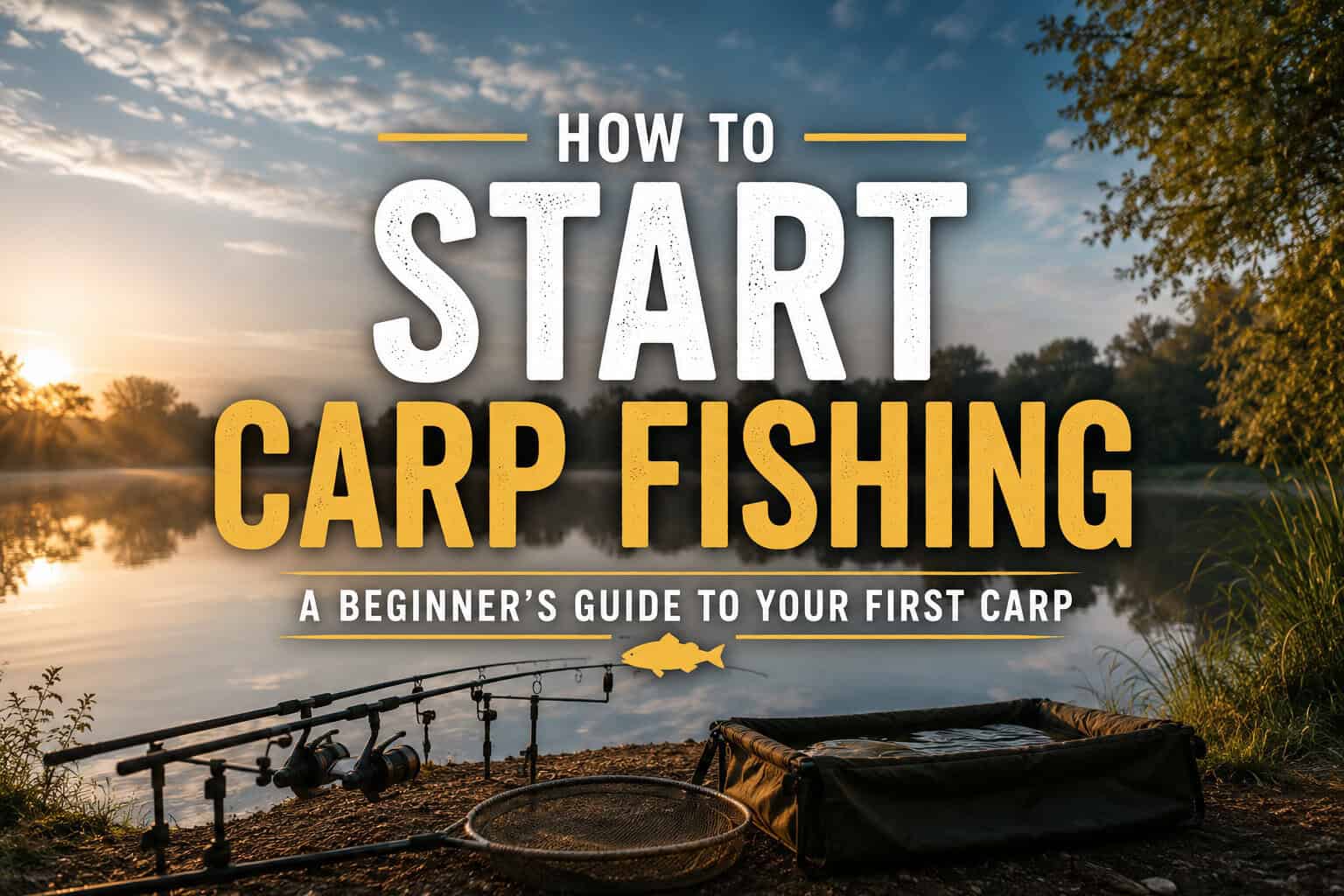
There is a moment when you start carp fishing that tends to stay with you. The rod has been sitting quietly for what feels like hours. Suddenly, it comes alive and the bite alarm screams. Line disappears from the reel, and every careful plan for playing your first carp temporarily vanishes.
That moment explains much of the fascination with carp fishing, but getting there can look unnecessarily complicated from the outside. Visit a well-stocked tackle shop and carp fishing can suddenly look complicated. Experienced anglers may arrive with three rods, alarms and a bivvy. Add a bedchair, barrow and enough camouflage to disappear completely, and the beginner could reasonably wonder where to start.
You do not. If you want to start carp fishing, the important things are far simpler: a suitable venue, dependable tackle, a safe rig, sensible bait, basic watercraft and the ability to handle a carp properly once you catch one. Everything else can develop later.
This guide is about getting those foundations right. Specialist carp tackle certainly has a purpose, but beginners need to know what matters and what can wait. Finding the fish usually makes a bigger difference than buying more equipment.
Quick Answer: What Do You Need to Start Carp Fishing?
To start carp fishing, a beginner needs a suitable carp rod and reel, strong main line, a simple safe rig, hooks, leads, bait, a large landing net and proper equipment for unhooking and returning carp safely. You will also need permission to fish the water and, in England and Wales where required, the appropriate rod fishing licence.
Choose an easy, well-stocked day-ticket or club water for your first sessions rather than a difficult specimen lake. Learn to find feeding carp, cast accurately and fish one straightforward rig confidently before worrying about advanced tackle and complicated presentations.
Why Carp Fishing Captures People’s Imagination
Carp fishing sits somewhere between ordinary coarse fishing and a form of hunting. You are not simply putting bait into the water and waiting for whatever happens to swim past. As you gain experience, you begin looking for signs of particular fish and thinking about where they might feed. You also notice how weather and changing seasons affect the lake.
Fishing also sits within a wider return to slower, more absorbing ways of spending time outdoors. If that appeals, our guide to the most popular outdoor hobbies for 2026 explores other interests built around fresh air, discovery and time away from screens.
Carp themselves help make the hobby addictive. They can be powerful, cautious and surprisingly difficult to predict. A lake that seemed lifeless at lunchtime can suddenly show several feeding fish during the evening. A swim that produced beautifully last weekend can feel completely empty seven days later.
This uncertainty is part of the appeal. Carp fishing rewards observation as much as equipment. An angler spotting bubbles beneath a tree can outperform someone using expensive tackle in the wrong swim.
There is also plenty of room to grow. Carp anglers often talk about different “types” of carp, although common, mirror and leather carp belong to the same species. Their scale patterns provide the easiest way to tell them apart. Ghost carp have distinctive ornamental colouring and are less commonly encountered in UK fisheries. Learning these differences makes identifying each catch another enjoyable part of carp fishing. Individual mirror carp can even be recognised by their unique scale patterns. That progression can keep the hobby interesting for decades.
“The most expensive tackle in the lake cannot catch a carp that is feeding somewhere else. Learning to find fish is one of the first skills worth taking seriously.”
Before You Start Carp Fishing, Get the Legal Basics Right
For anglers in England and Wales, the first piece of equipment is effectively permission. If you are fishing for freshwater fish with a rod and line, you generally need a valid rod fishing licence from the age of 13, including when fishing on private lakes. Anglers aged 13 to 16 require a junior licence, which is free, while children under 13 do not need one. You also need permission from the owner or fishery, usually in the form of a day ticket, membership or fishing permit.
The official GOV.UK rod fishing licence guidance explains the current requirements and is the right place to check them before fishing.
Do not assume that buying a rod licence gives you permission to fish anywhere. It does not. Each commercial fishery, syndicate, angling club or private lake can have its own rules. These may cover permitted baits, hook patterns, landing nets, unhooking mats, lead systems and the number of rods allowed.
There are also national and regional fishing byelaws.In England and Wales, coarse fishing on rivers generally closes from 15 March to 15 June inclusive. Most enclosed stillwaters and canals remain open throughout the year. However, individual fisheries can impose their own close periods. Check the current freshwater fishing rules on GOV.UK and the rules of the venue itself before setting out.
For a beginner, a managed stillwater is usually the simplest place to learn. The rules are clear, the carp population is normally known and you can concentrate on fishing rather than wondering whether you are allowed to be there.
Choose Your First Carp Water Carefully
A huge, windswept gravel pit might be what inspired you to start carp fishing. However, it is probably not the best place to catch your first carp. Some famous waters contain relatively small numbers of heavily pressured fish. Even experienced anglers can spend days or weeks pursuing a single bite.
A beginner needs opportunities. Look for a well-run day-ticket or club lake with a healthy stock of carp in a range of sizes. Fish of 5lb, 10lb or 15lb will teach you exactly the same basic skills of location, presentation, playing and landing as something considerably larger, while giving you a much better chance of putting those skills into practice.
Ask the fishery owner or regular anglers how the lake tends to fish. Information about depths, snags and productive areas can be extremely useful. It also helps to know whether local carp favour boilies, pellets, sweetcorn or other common baits. Knowing why carp favour an area is more valuable than knowing where somebody caught one yesterday.
For the first few sessions, convenience matters too. A smaller water where you can see much of the lake, move easily and cast comfortably is an excellent classroom. You are trying to learn how carp behave, not prove that you can endure hardship beside forty acres of apparently empty water.
Know Your UK Carp
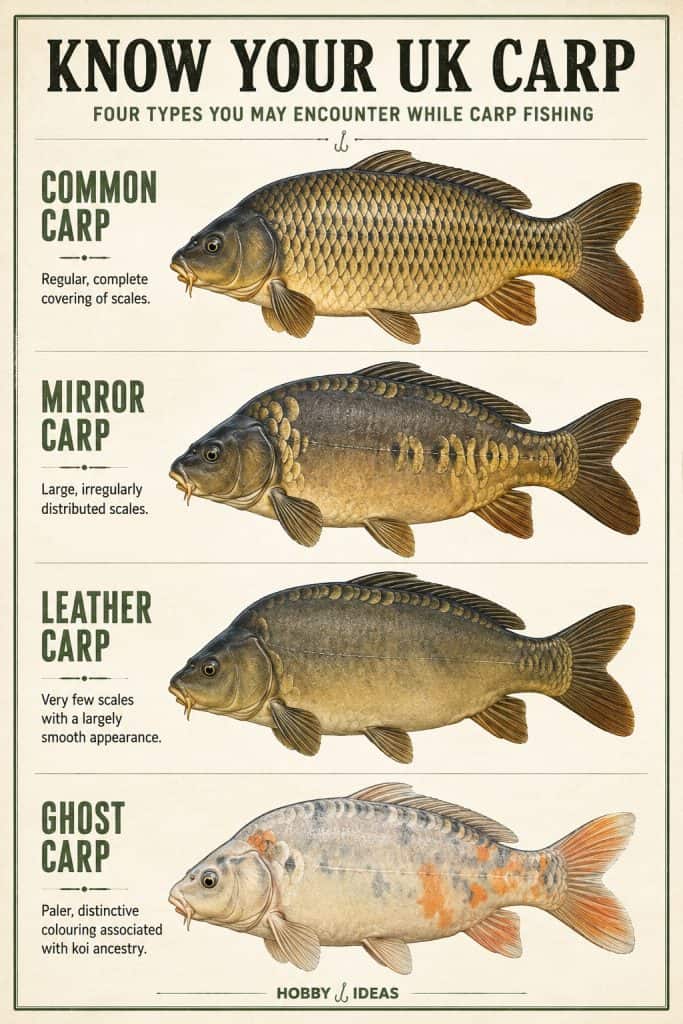
Carp anglers often talk about different “types” of carp. Common, mirror and leather carp all belong to the species Cyprinus carpio. Their scale patterns provide the easiest way to tell them apart. Ghost carp have distinctive ornamental colouring and are less commonly encountered in UK fisheries. Learning these differences makes identifying each catch another enjoyable part of carp fishing. Individual mirror carp can even be recognised by their unique scale patterns.
The Essential Tackle You Need to Start Carp Fishing
Carp tackle can become highly specialised, but the basic fishing system is reassuringly straightforward. You need equipment strong enough to cast the required distance, control a powerful fish and land it safely. Buying sensible tackle once is preferable to buying something inadequate and replacing it after three sessions.
A typical beginner set-up might include the following:
A 12ft carp rod around 2.75lb to 3lb test curve is a versatile starting point for many ordinary stillwaters, although shorter rods can be more convenient on small or confined venues.
Choose a reliable reel with a smooth drag and enough capacity for suitable main line. Around 12–15lb monofilament is a common starting range for general carp fishing, but venue conditions and fishery rules should guide the final choice.
Use a large, fish-friendly landing net appropriate for carp and make sure it complies with both legal requirements and the fishery’s rules.
A proper padded unhooking mat or cradle and a bucket or container for wetting the mat and fish are essential pieces of carp-care equipment, not optional luxuries.
If you would rather begin with a matched rod and reel, the NGT Carp Max 12ft Rod and Max 40 Reel Set is a sensible beginner option. The three-piece rod has a versatile 2.75lb test curve, which suits the type of general stillwater carp fishing covered in this guide. Buying them together also removes some of the guesswork when choosing your first set-up, without pushing you towards specialist tackle before you need it.
You will also need hooks, leads, swivels and rig components, bait, a bankstick or rod support, bite indication and basic tools such as scissors and forceps. A chair is pleasant, waterproof clothing is sensible and a tackle bag keeps everything organised, but none of those things catches the carp for you.
One rod is enough to learn with. Although many carp anglers eventually use two or three, concentrating on a single rod makes casting, baiting, bite indication and fish care easier to manage during the first few sessions.
Do You Need Bite Alarms?
Electronic bite alarms have become almost synonymous with modern carp fishing, particularly because carp anglers often fish with the rod resting on supports rather than holding it continuously. When line moves through the alarm, rollers or sensors produce an audible signal, helping the angler recognise a run or other movement at the rig.
A simple alarm can therefore be useful, but a beginner does not need an elaborate wireless set with illuminated receivers and enough settings to operate a small aircraft. A basic reliable alarm, combined with a visual indicator such as a bobbin, can provide all the information needed while you learn.
Whatever system you use, remember that fishing rods must remain under your control. National rules make it illegal to leave a rod and line unattended with bait or hook in the water. An alarm is a bite indicator, not permission to disappear back to the car for half an hour.
Start With a Simple Carp Rig You Understand
Carp rigs are where beginner research can go spectacularly wrong. Search online and you will encounter chod rigs, Ronnie rigs, spinner rigs, hinged stiff rigs, German rigs and enough knots and components to make the apparently simple act of attaching a hook to a line resemble an engineering qualification.
All of these approaches have their place, but your first rig needs to do three things well: present the bait effectively, hook fish reliably and behave safely if the main line breaks.
A straightforward hair rig is an excellent concept for a beginner to understand. Rather than placing a boilie or other firm bait directly onto the hook, the bait sits on a short hair extending beyond it, leaving the hook exposed. When a carp takes the bait, the arrangement allows the hook to enter the mouth efficiently.
Pair that with a simple lead arrangement designed so that a carp is not left towing a dangerous fixed weight if the main line fails. This is an area where fishery rules matter enormously, because many waters specify exactly which lead systems and rig components they permit.
Do not merely copy a rig from a photograph without understanding how it works. Learn what every component does, test the knot carefully and pull the completed rig firmly before casting it. A neat complicated rig tied badly is considerably worse than a simple one tied properly.
“Your first carp rig does not need to be clever. It needs to be safe, strong and simple enough that you understand exactly what happens when a fish picks it up.”
What Bait Should a Beginner Use for Carp?
Carp will eat an extraordinarily wide range of foods, which is both useful and dangerous for beginners. It is useful because effective baits are easy to find; dangerous because the tackle-shop shelves can make it appear that success depends on choosing precisely the right flavour from several hundred possibilities.
Boilies are popular because they are convenient, durable and available in many sizes and flavours. Pellets can be excellent for attracting carp, while sweetcorn remains one of the simplest and most recognisable baits available. Depending on the venue, bread, meat and other permitted baits can also catch plenty of fish.
For your first sessions, use a bait that the fishery’s carp are accustomed to seeing and keep the approach uncomplicated. If the venue regularly produces fish on a standard boilie or pellet, there is little reason to arrive with six tubs of brightly coloured alternatives because somebody online described one as irresistible.
Quantity matters too. More bait does not automatically mean more carp. Putting a huge bed of food into a quiet swim can give the fish plenty to eat without ever taking your hook bait, and once the bait is in the lake you cannot take it back out. Starting with a modest amount and adding more when carp are clearly feeding is usually a much more forgiving approach.
Finding Carp Matters More Than Finding the Perfect Bait
Before assembling everything in the first empty swim beside the car park, walk around the lake if the venue allows it. Carp frequently reveal themselves, particularly when conditions encourage them to move or feed near the surface.
Look for fish rolling, jumping or cruising. Watch for patches of small bubbles that may indicate feeding, muddy water where carp have disturbed the bottom, movement in reeds and repeated activity around islands, margins, overhanging trees or other features.
Wind can influence carp location because it affects water movement, temperature and where natural food accumulates, although the simplistic rule that carp are always found at the windward end of a lake should not be treated as law. Sunlight, angling pressure, depth, temperature, available cover and time of day all affect where fish feel comfortable.
Most importantly, spend time watching. Ten minutes of observation before setting up can save several hours of fishing an empty part of the lake.
Four Places Beginners Should Watch for Carp
Carp regularly patrol close to the bank, particularly where there is cover, food or quieter water.
These provide obvious features and areas where fish may feel secure, although accurate casting is essential around snags.
Natural food and shelter can attract carp, but fish must never be hooked where they cannot be safely controlled.
Showing fish, bubbling and repeated movement can be more useful than any attractive-looking feature on the bank.
Learn the Bottom Before You Put a Rig on It
Knowing that carp are in an area is only half the problem. Your rig still needs to land somewhere it can fish effectively. A hook bait buried in thick weed or a lead dropped into deep soft silt may behave very differently from the neat presentation you imagined while tying it at home.
On straightforward venues, fishery information and careful casting can tell you plenty. More experienced carp anglers often use marker equipment or interpret how a lead feels as it reaches the bottom, gradually building a picture of depth, weed, gravel, silt and harder areas.
You do not need to become an expert feature finder on day one, but you should begin thinking about what lies beneath the surface. Cast gently to likely areas and pay attention to how the lead lands. As experience develops, subtle differences in the rod and line begin to provide surprisingly useful information.
This is one of the reasons carp fishing becomes more absorbing over time. The lake stops being a flat sheet of water and starts becoming an underwater landscape.
Accurate Casting Beats Heroic Casting
The ability to cast 120 yards looks impressive, but it is irrelevant if the carp are feeding twenty yards from the bank. For a beginner, accuracy and consistency are far more valuable than distance.
Practise casting to an obvious feature at a comfortable range, keeping well clear of other anglers and dangerous snags. The aim is to place the rig where you intend it to go without tangling it, frightening every carp in the swim or decorating an inaccessible tree with tackle.
If you need to fish close to reeds, branches or other hazards, consider whether you can safely control a hooked carp before casting there. Experienced anglers may fish extremely close to snags with tackle and techniques designed for the situation, but that does not make every inviting-looking gap a sensible beginner target.
There is no shame in fishing closer and more safely. Carp regularly feed in the margins, and some of the most exciting fishing happens surprisingly near your feet.
What Happens When You Get Your First Carp Run?
After several quiet hours, the first proper run can produce an impressive amount of panic. The alarm sounds, the spool turns and suddenly every article you read about playing fish disappears from memory.
Stay controlled. Pick up the rod promptly, make contact with the fish and allow the rod and correctly adjusted reel drag to absorb sudden lunges. Do not attempt to drag the carp towards you as quickly as possible; equally, do not give it unrestricted freedom to reach weed, branches or other obvious hazards.
Keep steady pressure and let the fish tire gradually. As it approaches the bank, expect renewed bursts of energy. Carp often make their strongest-looking lunges when they first see the landing net or reach shallow water.
Have the net ready before the fish arrives. Draw the carp over the submerged net rather than chasing it around with the net itself, then lift carefully once the whole fish is safely inside.
This is also why setting up properly before casting matters. Discovering that the landing net is still folded in its bag while your first carp circles beneath the rod tip is an avoidable form of excitement.
Carp Care Is Part of Carp Fishing, Not an Optional Extra
Catching the fish is only half the responsibility. Carp can be large, heavy and powerful, yet once removed from the support of the water they are vulnerable to injury. Good fish care should therefore be part of your first session rather than something learned after an accident.
Prepare the unhooking mat or cradle before fishing and keep it somewhere practical. Wet the mat before placing a carp onto it, keep the fish low and controlled, and have unhooking tools ready so that you are not searching through tackle while the carp waits.
If you want a photograph, organise the camera first and keep the fish close to the mat rather than standing upright with it. Never carry a carp around unnecessarily for a better background, and do not prolong the process because the first photograph was not perfect.
Return the fish carefully and give it time to recover while supporting it in the water if necessary. When it is strong enough to swim away under its own power, let it go.
Fishery-specific carp-care rules can be stricter than national regulations, so read them before arriving. National freshwater rules also regulate landing nets and prohibit knotted or metallic mesh; the Environment Agency tackle rules provide the current legal requirements.
Do You Need a Bivvy to Start Carp Fishing?
The carp bivvy has become such a familiar part of the hobby that beginners sometimes assume one belongs on the essential tackle list. For an ordinary morning or afternoon session, it does not.
Start with day sessions while you learn the fundamentals. Appropriate clothing, waterproofs and perhaps an umbrella or simple shelter can be enough depending on the weather and venue. You will spend more time watching the water, moving if necessary and learning what is happening rather than building a temporary home beside the lake.
A bivvy becomes much more useful when you progress to long sessions, nights or changeable weather. It provides shelter for you and your equipment and can make extended fishing considerably more comfortable, but there is little reason to buy one before you know that long-session carp fishing is something you actually want to do.
If longer sessions eventually become part of your carp fishing, a dedicated shelter starts to make more sense. The Michigan 1-2 Man Bivvy Brolly Shelter offers enough room for one or two anglers, with a detachable groundsheet and ventilation for longer stays. It is the sort of equipment worth considering once short day sessions begin turning into nights beside the lake.
How Long Should Your First Carp Fishing Session Be?
You do not need to spend twenty-four hours beside a lake to catch carp. In fact, a manageable half-day session can be much more useful while you are learning because you remain alert enough to watch the water and think about what you are doing.
Choose a period when the fishery is likely to be reasonably active and arrive with enough time to look around before setting up. Early mornings and evenings can be productive, but carp feed at many times depending on season, weather and the individual water.
If nothing happens, resist the temptation to change every part of the rig every twenty minutes. First ask whether you have seen carp. If fish are repeatedly showing somewhere else and moving is permitted, relocating may be more productive than replacing a perfectly adequate boilie with one of a different colour.
Blank sessions are part of carp fishing. They are not necessarily failed sessions if you leave knowing more about the lake than when you arrived.
Common Mistakes When You Start Carp Fishing
Most beginner mistakes are understandable because enthusiasm encourages us to make things more complicated than they need to be. A little restraint can make the first season much more enjoyable.
Learn what type of carp fishing you enjoy before investing in specialist equipment for long-range, overnight or highly technical fishing.
Walk, watch and listen before deciding where to spend the next several hours.
A simple rig tied well and presented properly is preferable to an advanced rig you do not fully understand.
Begin cautiously and respond to feeding activity rather than assuming more bait automatically creates more bites.
Another common mistake is measuring success entirely by weight. Your first 8lb carp can teach you more than watching somebody else catch a 30-pounder, and learning to find and land fish consistently is a much stronger foundation than immediately becoming obsessed with personal bests.
How Much Does It Cost to Start Carp Fishing?
Carp fishing is not a free hobby, but it does not need to be extravagantly expensive either. A sensible beginner outfit can be assembled gradually, particularly if you begin with one rod and avoid buying equipment designed for sessions you are not yet undertaking.
Spend money first on things that affect reliability and fish welfare. A dependable rod and reel, suitable line, safe terminal tackle, a proper landing net and good unhooking equipment deserve priority. Decorative accessories and elaborate bankside comfort can wait.
Second-hand tackle can offer excellent value, particularly rods, reels and luggage, although safety-critical components such as line and terminal tackle should be inspected carefully and replaced when there is any doubt about their condition.
Day-ticket costs vary enormously between fisheries, so include access in the budget alongside bait and travel. If you find yourself returning regularly, joining a local angling club can sometimes open access to several waters for a single annual membership.
Carp fishing does require some equipment, so it will never be one of the cheapest hobbies to begin. If cost is the main consideration, our guide to free hobbies for adults explores interests you can try before spending anything at all.
How to Make Your First Carp Session Simpler
A good first session is not the one with the most equipment. It is the one where you can concentrate on a small number of things and understand what happened afterwards.
Before You Leave Home
- Check your rod licence, fishery permission and venue rules.
- Tie and test a couple of simple spare rigs rather than attempting them for the first time on the bank.
- Pack the landing net and fish-care equipment before worrying about comfort accessories.
- Choose one or two proven baits rather than taking half the tackle shop.
When You Reach the Lake
- Look for carp before choosing a swim.
- Ask sensible questions if the fishery owner or bailiff is available.
- Set up the landing net and unhooking mat before casting.
- Fish accurately, watch the water and change something only when you have a reason.
Those habits sound almost too simple to matter, but they create the foundations of good carp fishing. The advanced techniques make much more sense once the basics have become automatic.
Where a Good Carp Fishing Book Still Earns Its Place
There is no shortage of carp-fishing information online, but that abundance can be a problem for a beginner. One video insists that a particular rig is essential, another contradicts it, and a third begins with twenty minutes explaining a baiting system designed for a completely different type of water.
A well-written carp-fishing book provides something the endless stream of short videos often lacks: structure. It can take you from watercraft and basic rigs through bait, seasonal behaviour and more advanced techniques in an order that allows one skill to build upon another.
For anyone who wants a reference beside them as their skills develop, the Fox Guide to Modern Carp Fishing is a useful next step. It covers rigs, tackle, bait, knots and modern carp-fishing tactics, with illustrated step-by-step guidance. Rather than trying to absorb everything immediately, use it as a book to return to as new techniques become relevant.
That makes a good beginner book a particularly natural companion to practical experience. Read about a technique, try it on the bank and then return to the explanation with some real-world context. Once you have actually watched carp feeding, felt different lakebeds through a lead or played a fish around marginal weed, the written advice suddenly means considerably more.
Start Carp Fishing With the Intention of Learning, Not Just Catching
The first carp is obviously the prize everybody wants, but concentrating solely on whether the bite alarm eventually sounds can make you miss half of what is happening around you.
Watch where fish show. Notice whether the wind has changed. Look at the margins before walking heavily along them. Remember where bubbles appeared, how the lead felt when it landed and what time activity increased. Even on a blank session, those observations begin building the mental picture that experienced carp anglers call watercraft.
The wonderful thing about carp fishing is that you never really finish learning it. A technique that works beautifully on one lake can be ineffective on another, while the same water can behave completely differently in spring, summer and winter.
If you start carp fishing expecting instant mastery, that unpredictability can be frustrating. If you begin expecting a hobby that gradually reveals more of itself, it becomes one of its greatest attractions.
Start Carp Fishing: Frequently Asked Questions
What do I need to start carp fishing?
A beginner needs a suitable rod and reel, strong main line, safe terminal tackle and rigs, bait, a large landing net and proper unhooking equipment. You also need the appropriate fishing licence where required and permission to fish the chosen venue.
What is the best carp rod for a beginner?
For many ordinary stillwaters, a versatile 12ft carp rod around 2.75lb to 3lb test curve provides a useful starting point. However, shorter rods can suit small waters and restricted swims, while the venue and distances you expect to fish should influence the final choice.
What is the easiest bait for beginner carp fishing?
Boilies, pellets and sweetcorn are straightforward and widely used carp baits, but the best beginner choice is often something that already catches carp regularly on the venue you are fishing. Check the fishery rules because permitted baits vary between waters.
Do I need bite alarms for carp fishing?
They are useful when fishing with rods on supports because they provide audible indication of line movement, but beginners do not need an expensive alarm system. A simple reliable alarm and visual indicator can be sufficient while learning.
Do I need a bivvy to start carp fishing?
No. A bivvy is useful for overnight and longer sessions, but it is unnecessary for most short beginner sessions. Start with day fishing and decide whether you actually enjoy longer sessions before investing in substantial bankside accommodation.
Where is the easiest place to catch a first carp?
A well-stocked day-ticket or club stillwater is usually easier for a beginner than a large, difficult specimen lake. Look for a venue with plenty of carp, manageable casting distances, clear rules and a reputation for producing regular bites.
Your First Carp Matters More Than Its Weight
Carp fishing has a natural tendency to become obsessed with numbers. Twenty pounds, thirty pounds and forty pounds acquire enormous significance as anglers progress, and there is nothing wrong with enjoying the pursuit of a personal best. Yet the carp you remember most may not be the largest one you ever catch.
Your first carp represents something different. It means you found a place where a fish was prepared to feed, presented a bait effectively enough for it to take, recognised the bite, played the fish, landed it and returned it safely. For a beginner, that is a substantial collection of new skills coming together at once.
Start on a water that gives you a realistic chance, use straightforward tackle and learn one safe rig properly. Spend more time watching the lake than watching other anglers on your phone, and judge the early sessions by what you learned as well as what you caught.
Once that first bite alarm finally screams, there will be plenty of time for bigger carp, longer sessions, cleverer rigs and more equipment. The important thing when you start carp fishing is to build the foundations properly, because those are the skills you will still be using long after the beginner tackle has been replaced.
Affiliate Disclosure: Hobby Ideas may earn a small commission from qualifying purchases made through links in this article, at no extra cost to you. We only recommend products or resources that we believe are relevant and useful to our readers.