

Free hobbies for adults are surprisingly easy to overlook. We have become accustomed to hobbies arriving with starter kits, subscriptions, specialist equipment and an enthusiastic person on YouTube explaining why the version we already own is hopelessly inadequate. Before we have discovered whether we actually enjoy something, we can be £100 poorer and wondering where to store it.
Yet some of the most rewarding hobbies begin with almost nothing. Walking somewhere unfamiliar, drawing with an ordinary pencil, borrowing a library book, photographing overlooked corners of your town, researching your family history or learning the night sky can provide years of interest without demanding an entrance fee.
The important distinction is between finding something free to do and finding a hobby. A free activity fills an afternoon; a hobby makes you curious about the next one. You gradually notice more, learn more and become better at something because you keep returning to it. That progression is what makes a hobby satisfying, and fortunately it does not come with a price tag.
Quick Answer: What Are the Best Free Hobbies for Adults?
Some of the best free hobbies for adults include walking and local exploration, reading through your library, drawing, creative writing, phone photography, birdwatching, stargazing, nature journalling, genealogy, learning new skills and volunteering. The easiest way to begin is to choose something that uses what you already own and give it enough time to discover whether the interest lasts before buying specialist equipment.
Why Free Hobbies for Adults Are About More Than Saving Money
Saving money is obviously part of the appeal. Leisure has become remarkably accomplished at finding ways to charge us every month, so an enjoyable pastime that does not quietly acquire another direct debit is welcome. However, there is another advantage to beginning for free: you can experiment without feeling committed to the result.
Spend a fortnight sketching and discover that you would rather be walking. Investigate your family tree until you encounter an ancestor who appears to have vanished from Norfolk in 1873. Try identifying garden birds and realise that what really fascinates you is photographing them. Nothing has been wasted. In fact, those exploratory weeks are part of finding out what genuinely holds your attention.
Starting for free also separates an interest in a hobby from an interest in buying things for a hobby. There is considerable pleasure in choosing cameras, art materials, binoculars and beautifully made notebooks, but buying equipment can occasionally become the pastime before the original pastime has been given much of a chance.
Beginning with what you already have reverses that process. First find the interest. If you are still returning to it months later, better equipment becomes an informed choice rather than the price of admission.
“A hobby does not become more worthwhile because you spent money starting it. Curiosity is still one of the best pieces of equipment you can own.”
Choose a Hobby for the Life You Actually Have
One reason hobbies disappear almost as quickly as they begin is that adults often choose them for the life they imagine having rather than the one they actually live. A hobby requiring three uninterrupted hours every Saturday morning is unlikely to flourish if Saturday already contains shopping, family, work and the mysterious household jobs that regenerate faster than they can be completed.
Many free hobbies for adults work well precisely because they can expand or contract around real life. You can sketch for fifteen minutes or two hours. A walk can circle the neighbourhood or occupy an entire afternoon. Stargazing can mean ten minutes looking at the Moon before bed or several hours beneath a properly dark sky.
That flexibility is worth considering before choosing anything. Instead of asking which hobby sounds most impressive, ask what you would genuinely look forward to doing when half an hour unexpectedly becomes your own.
Match a Free Hobby to the Way You Like Spending Time
Try walking, local exploration, birdwatching, nature journalling, photography or stargazing.
Try drawing, creative writing, poetry or photography using equipment you already own.
Try genealogy, local history, wildlife identification or learning the night sky.
Try language learning, library research, free courses, educational podcasts or volunteering.
Walking: The Free Hobby Hiding in Plain Sight
Walking may be the most underestimated free hobby because most of us think of it as exercise or a way of getting somewhere. Give the walk a purpose, however, and it becomes exploration.
Take the road you normally pass. Follow a public footpath because you have always wondered where it emerges. Explore churchyards, riversides, old lanes, parks, villages or overlooked parts of your own town. Add another interest and an ordinary walk changes again: photograph unusual buildings, identify trees, look for historic boundary markers or learn something about the places you pass.
Suddenly the interesting question is not simply how far you walked, but what you found.
Walking also happens to bring physical benefits. The NHS describes walking as a simple and free way to become more active, and even suggests varying routes through parks, heritage trails, canal towpaths, riversides and nature reserves to keep walking interesting.
None of this means a hobby walk needs to become a fitness challenge. Wandering around an unfamiliar village because an old church tower looked interesting from the road remains a perfectly legitimate use of an afternoon.
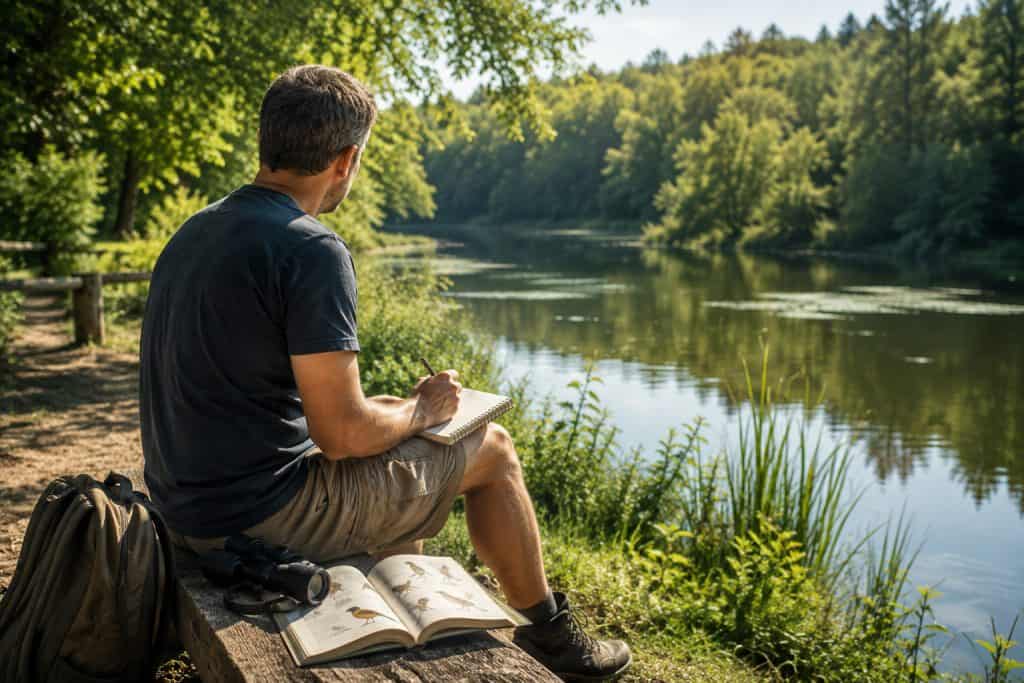
Drawing Without Waiting to Become an Artist
Adults have an unfortunate tendency to believe they should already be good at something before they are allowed to enjoy doing it. Drawing exposes this beautifully. A child can produce a dog with seven legs, pronounce it magnificent and immediately begin another. An adult draws one questionable chair and concludes that artistic talent has passed them by.
That makes drawing one of the most interesting free hobbies for adults to try, because the first challenge is not artistic at all. It is becoming comfortable with being a beginner.
An ordinary pencil and scrap paper are enough. Draw a mug, a pair of shoes, the view through a window or an interesting building while you are out. The point is not to create something worthy of framing. Drawing forces you to look properly at things that your eyes normally register without much thought.
Keep the early attempts, including the terrible ones. Several months later they become evidence that you have learned something, and seeing that progress is far more satisfying than pretending page three of the sketchbook never happened.
Your Library Is a Hobby Department With Free Membership
Reading only becomes an expensive hobby when every book has to be bought. A library turns it into something quite different: an opportunity to explore subjects, authors and entire genres without worrying whether every choice deserves a permanent place on the bookshelf.
The trick is to give your reading some direction. Work through the novels of an author you have always meant to read, investigate a period of history you barely know, spend a summer reading travel writing or alternate fiction with biography. A small personal project turns occasional reading into something you anticipate.
Libraries are useful for another reason too. They are gateways into hobbies you have not yet considered. The book borrowed to identify a garden bird might lead to nature writing; a local-history title could send you exploring old streets; a beginner’s drawing guide can provide enough exercises to keep a pencil busy for weeks.
In that sense, a library card is not really one free hobby. It is a starter kit for dozens of them.
Creative Writing Without Needing to Become a Novelist
Writing is another hobby burdened by the idea that it ought to lead somewhere. Mention that you enjoy writing and somebody will eventually ask whether you are writing a book. You do not have to be. A hobby is allowed to exist simply because the process is enjoyable.
Write a short story, keep a journal, record family memories or describe the places you visit. Try poetry. Invent a character and put them in an awkward situation. Write 500 words about something that happened when you were ten and see what else you remember while doing it.
The equipment barrier is almost nonexistent. A notebook you already own is fine, as is a basic document on a phone or computer. What matters is whether you begin thinking about the next piece when you are away from the page. Once that happens, writing has stopped being something you tried and started becoming something you do.
Phone Photography: Stop Waiting for a Better Camera
Photography has a remarkable ability to convince people that the missing ingredient in their pictures is a more expensive camera. Better equipment certainly creates possibilities, but if you already own a smartphone you probably possess everything required to learn the most important photographic skill: noticing things worth photographing.
Give yourself projects rather than simply accumulating pictures. Photograph reflections for a week. Record old shop signs around your town. Photograph the same tree through the seasons, search for interesting shadows or look for one colour appearing in unexpected places.
A project changes the way you see familiar surroundings. You stop waiting for spectacular scenery and start noticing photographs in ordinary places. If photography eventually becomes serious enough to justify a dedicated camera, the cameras will still be available. By then, importantly, you will know why you want one.
“The best free hobbies change what you notice. A familiar street, garden or night sky becomes more interesting because you have learned how to look at it.”
Birdwatching Begins Before You Buy Binoculars
Birdwatching can involve extraordinarily sophisticated equipment, but none of it is required to discover whether birds interest you. The hobby can begin at a kitchen window with the birds that appear every day.
Rather than attempting to identify everything immediately, learn the regular visitors first. Notice which birds feed on the ground, which arrive in groups, how they move and which ones seem determined to spend most of the day arguing with their neighbours. Then start listening. Connecting a familiar call with the bird making it adds another layer to an ordinary walk.
A simple record of what you see can make the hobby surprisingly absorbing. A bird that once required frantic searching gradually becomes recognisable from shape, movement or sound. Binoculars may eventually make distant identification easier, but they are an upgrade rather than a membership card.
If, and when, birdwatching becomes one of the hobbies you keep returning to, that is when a decent pair of binoculars starts to make sense. The OM SYSTEM 10×50 S Binoculars combine 10x magnification with large 50mm objective lenses and a wide field of view, making them well suited to birdwatching and general nature observation. They are certainly not necessary for spotting your first garden birds, but they are the sort of upgrade that can open up the hobby once you find yourself wanting a clearer look at everything further away.
Stargazing May Be the Biggest Free Hobby of All
Few hobbies offer quite such an absurdly generous subject for no admission charge. The entire night sky is available simply by going outside and looking upwards, yet many beginners assume astronomy begins with buying a telescope.
It does not. Start with the Moon and learn how its appearance changes through the month. Find a couple of easily recognised constellations and use them as landmarks. Identify a bright planet and notice how the evening sky itself changes as the seasons pass.
The first nights can feel confusing because the stars appear to be an anonymous scatter of lights. Gradually the patterns stick. One constellation points towards another; a bright star acquires a name; a familiar patch of sky begins to feel like somewhere you know.
If this appeals, our guide to stargazing as a hobby takes the next step without assuming you need expensive equipment. We also have a practical guide to stargazing with binoculars if curiosity eventually makes you want to see a little more.
Nature Journalling Makes an Ordinary Walk More Interesting
Nature journalling sounds more formal than it needs to be. At its simplest, it means recording what you notice outdoors. Write a few lines about the weather, sketch a leaf, note the first frost or record the date blossom appears on a particular tree.
You do not need to be an artist, botanist or naturalist. The real subject is attention. Once you know you might record something, you begin looking for things worth recording.
Over time the notebook becomes both a record of the seasons and evidence of how much more observant you have become. It also combines naturally with walking, drawing, birdwatching and photography, making it a particularly good choice for somebody who likes the outdoors but cannot quite decide which hobby to pursue.
Genealogy: Begin With the People Who Can Still Tell You the Story
Family history is now closely associated with subscription databases, yet some of the most valuable research costs nothing. In fact, the best place to begin may be sitting across the table from somebody who remembers things that no database ever recorded.
Start with names, dates, places and relationships you already know, then talk to older relatives. Ask about jobs, schools, houses, wartime experiences, family sayings and unidentified faces in photographs. Label those photographs while somebody can still tell you who is standing in them.
Only then begin pushing backwards. Libraries, archives and free online resources can take the research further before a paid subscription becomes necessary. The pleasure of genealogy lies in the way one answer produces several new questions. A name becomes an address, an occupation, a marriage, a military record or an unexpected branch of the family.
Eventually you realise you are not simply collecting names. You are reconstructing lives.
Learning Can Be One of the Best Free Hobbies for Adults
Not every hobby needs to produce a physical object or visible achievement. Sometimes the pleasure is simply discovering that a subject you knew almost nothing about three months ago has begun to make sense.
Choose something because you are genuinely curious rather than because you think you ought to learn it. Astronomy, local history, architecture, wildlife, art history, languages, philosophy, coding and music theory can all become absorbing subjects. Libraries, podcasts, lectures and free online materials mean there is little reason to pay for a course before discovering whether the subject holds your attention.
There is one trap: collecting learning resources instead of learning. Downloading six apps, bookmarking forty videos and enrolling on four free courses can create the comforting illusion of progress. Choose one route instead and stay with it long enough for ideas to begin connecting. That is usually the point at which learning stops feeling like homework.
Volunteering: A Hobby Where Somebody Else Benefits Too
Volunteering sits slightly outside the traditional definition of a hobby, but for many adults it provides exactly what they are hoping to find in their spare time: purpose, routine, social contact and the pleasure of becoming useful at something.
The possibilities extend far beyond the roles people first imagine. Heritage organisations, conservation projects, community groups, charities and specialist organisations all rely on volunteers, while some opportunities make use of professional or practical skills you already possess.
It can also lead somewhere unexpected. Helping with conservation may spark an interest in wildlife identification; volunteering at a heritage project can awaken a fascination with local history. GOV.UK maintains a useful guide to finding volunteering opportunities, including routes into environmental volunteering and roles that use specialist skills.
Free Fitness Hobbies Without a Gym Membership
Exercise becomes considerably easier to sustain when the activity itself is enjoyable rather than something endured because somebody said it was good for you. Walking is the obvious starting point, but running, bodyweight exercise and guided home workouts can also be explored without a gym membership.
If fitness is the attraction, progression can provide the hobby element. Walk new routes, gradually increase distance, work through a beginner running programme or learn exercises properly rather than simply counting calories burned. The NHS recommends adults aim for at least 150 minutes of moderate-intensity activity each week and also provides free beginner resources and home workouts. The NHS Better Health activity guide is a sensible place to start.
Anyone who has not exercised for some time, or who has medical concerns, should make sure the activity and intensity are appropriate; NHS guidance recommends speaking to a GP first where necessary.
How to Keep a Free Hobby Free
Search online for almost any new interest and within minutes somebody will explain the ten essential things every beginner apparently needs. Usually, you do not need ten things. You may eventually want them, which is quite different.
A simple approach prevents enthusiasm from becoming shopping:
Begin with the phone, pencil, shoes, notebook or computer already available.
Libraries, friends and community resources can help you test an interest first.
One exciting afternoon proves very little; see whether you still choose it once the novelty fades.
Spend money when you know precisely what your existing equipment prevents you from doing.
That last point makes an enormous difference. If you keep drawing and want a greater range of tones, better pencils make sense. If distant birds have become frustrating to identify, binoculars may transform the experience. When you have learned your way around the night sky and now desperately want to see Saturn’s rings, perhaps it really is time to investigate telescopes.
By then you are no longer buying equipment in the hope that a hobby appears. You are buying something because a hobby already has.

What Makes Free Hobbies for Adults Worth Keeping?
The price has very little to do with it. A worthwhile hobby gives you a reason to anticipate spare time. You think about the next walk, photograph, chapter, family-history discovery or clear night before the opportunity arrives.
It also changes as you improve. A new birdwatcher struggles to separate similar garden birds; eventually behaviour and calls provide clues before binoculars are even raised. A reluctant sketcher stops apologising for every drawing and starts wondering what to draw next. A walker who once followed the same route begins studying maps for paths not yet explored.
That sense of progress is satisfying precisely because there is no examination at the end. You are allowed to become better at something simply because becoming better is enjoyable.
If cost is the main reason you have been putting off finding something new, you might also enjoy our guide to cheap hobbies you can start for less than £20. And if you are looking for ideas for the rest of the family, our new guide to free hobbies for kids follows the same principle: interest first, spending later.
Free Hobbies for Adults: Frequently Asked Questions
What hobbies can adults start for free?
Walking, drawing, creative writing, library reading, phone photography, birdwatching, stargazing, nature journalling, genealogy, learning and some forms of volunteering and fitness can all be started without specialist equipment.
Can a hobby really be completely free?
Yes. Many hobbies can begin with resources or equipment you already have. Some may eventually tempt you to spend money, but wanting an upgrade later is very different from needing one before you begin.
What is a good free hobby to do at home?
Drawing, creative writing, reading, genealogy and learning are particularly easy to pursue at home. Birdwatching from a window and stargazing from a garden can also require almost no preparation.
What free hobbies can help you meet people?
Volunteering, walking groups, library groups and community projects can combine an interest with social contact. Local libraries and community organisations are useful places to discover what is available nearby.
What free hobbies get you outdoors?
Walking, local exploration, birdwatching, nature journalling, phone photography and stargazing are all outdoor hobbies that can be started using things you already own.
When should I spend money on a free hobby?
Wait until you know you enjoy the hobby and can identify something that would genuinely improve the experience. This makes an eventual purchase useful rather than simply part of the excitement of starting something new.
Start for Free, Then Let the Hobby Decide What Comes Next
The real advantage of starting a hobby for free is not that you must keep it free forever. It is that you get to discover what genuinely interests you before spending money on it.
Begin with the pencil you already own, the camera in your phone, the birds outside the window or the footpaths around your neighbourhood. Give yourself time to become interested, frustrated, curious and, hopefully, a little better. If the enthusiasm disappears after three weeks, you have lost nothing. If you are still doing it three months later, that tells you something useful.
That is also when buying equipment can become part of the pleasure rather than part of the gamble. A keen birdwatcher may eventually appreciate better binoculars; somebody filling page after page with drawings may enjoy better art materials; a walker might decide that comfortable footwear or a good daypack would make longer adventures more enjoyable.
The difference is that by then you know why you are buying it.
Take A Hobby Further
If one of these free hobbies for adults does develop into something you want to take further, our Hobby Ideas Amazon storefront brings together books, starter equipment and useful hobby gear covering many of the interests featured across the magazine. There is no rush to buy any of it; think of it as somewhere to look when a hobby has earned its upgrade.
For now, the important part is simply to start. Try something that costs nothing, give it a fair chance and notice whether you find yourself looking forward to doing it again. If you do, you have already found the bit that money cannot buy: an interest that makes your spare time feel like your own.
Affiliate Disclosure: Hobby Ideas may earn a small commission from qualifying purchases made through links in this article, at no extra cost to you. We only recommend products or resources that we believe are relevant and useful to our readers.