

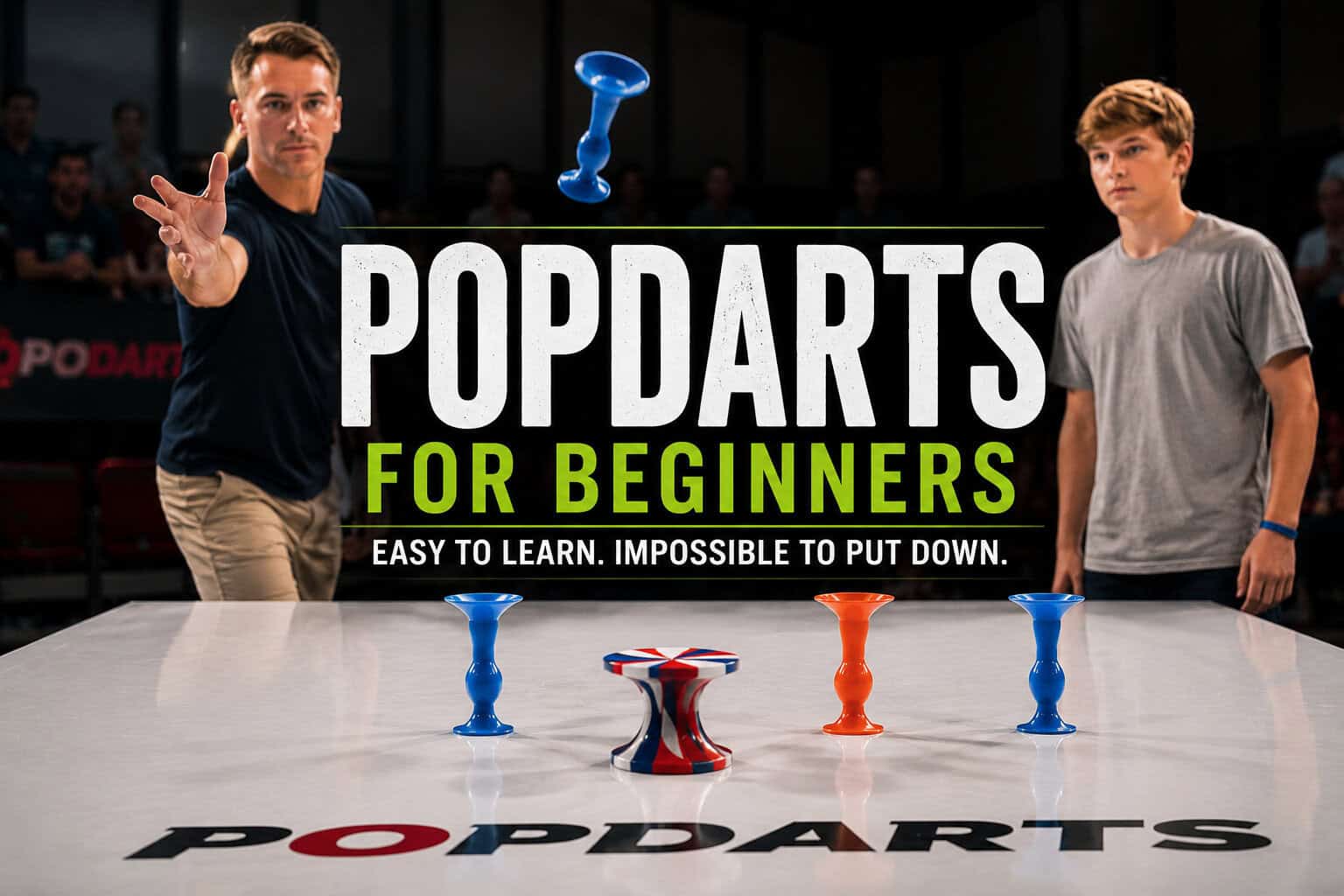
Popdarts for beginners starts with a wonderfully simple proposition: take a handful of colourful suction-cup darts, choose a smooth surface, place a target and see who can land closest. Give it five minutes, however, and you may find yourself discussing Wigglenobbers, T-Bones and Kisses with the seriousness normally reserved for the final of a major sporting event.
That mixture of simplicity and silliness is a large part of the appeal. Popdarts is easy enough to understand during the first round, yet there is genuine skill hiding behind those soft silicone darts. Throwing technique matters, different surfaces behave differently and the movable target means you can completely change the challenge from one round to the next.
It is also refreshingly portable. Instead of needing a permanent dartboard or dedicated games room, Classic Popdarts can be played on suitable smooth, non-porous surfaces around the home and elsewhere. Consequently, a kitchen worktop, window or glass door can suddenly become part of the game.
For UK players discovering Popdarts for the first time, here is how the game works, how the scoring makes close rounds surprisingly competitive and, perhaps most importantly, why landing something called a Wigglenobber is considerably more impressive than it sounds.
Quick Answer: What Is Popdarts?
Popdarts is a target game played with soft suction-cup darts that stick to smooth surfaces. In Classic Play, players take turns throwing three Popdarts towards a movable target marker from at least 10 feet away. The closest sticking dart scores three points, other sticking darts score one point and cancellation scoring determines the points won in each round. The first player or team to reach or exceed 21 points wins.
“Any game that expects you to use the word ‘Wigglenobber’ seriously deserves at least one afternoon of investigation.”
Why Popdarts Is More Than Just Another Dart Game
The clever thing about Popdarts for beginners is that it borrows the satisfying accuracy of darts without being tied to a dartboard. Traditional darts asks you to stand in the same place and repeatedly attack a fixed target. Classic Popdarts encourages you to move the target and invent the challenge.
The winner at the beginning chooses where to put the target marker and establishes the parameters for the round. Provided you have a suitable smooth surface and follow the rules, that immediately creates opportunities for creativity. A straightforward throw across a table can become a longer shot onto a kitchen counter, while another round might use a window or other suitable non-porous surface.
That changing environment is important because Popdarts rewards more than raw accuracy. You begin judging distance, throwing angle, surface position and how the dart behaves when it lands. A throw that works beautifully from one position may be hopeless from another.
It also means games naturally acquire personality. Players start attempting increasingly ambitious shots, rivalries appear remarkably quickly and somebody will inevitably discover that successfully sticking one difficult throw is enough encouragement to attempt something ridiculous for the next twenty minutes.
How to Play Popdarts for Beginners
The rules become much easier once you actually start throwing. First, decide who begins; the official Classic Play rules use rock, paper, scissors. The winner chooses the first target-marker position and their team’s Popdart colour.
The opening player then chooses a suitable smooth surface, places the target marker and calls the parameters for that round. Both players must attempt the same challenge, so the ability to move the marker does not remove the competitive element. Instead, it lets players continually alter the test.
Players alternate throws until they have used all three Popdarts. The basic objective is to make your darts stick as close to the target marker as possible. A dart that does not remain upright counts as a dead dart and stays where it is until the round ends.
Once everyone has thrown, you calculate the score. The player or team awarded points in that round chooses the target-marker location for the next one. Play continues through successive rounds until somebody reaches or exceeds 21 points.
If you enjoy simple hobbies that can become unexpectedly competitive, you might also like our guide to hobby ideas in the UK, which explores plenty of other ways to find something new to do with your spare time.
What Do You Need for Popdarts for Beginners?
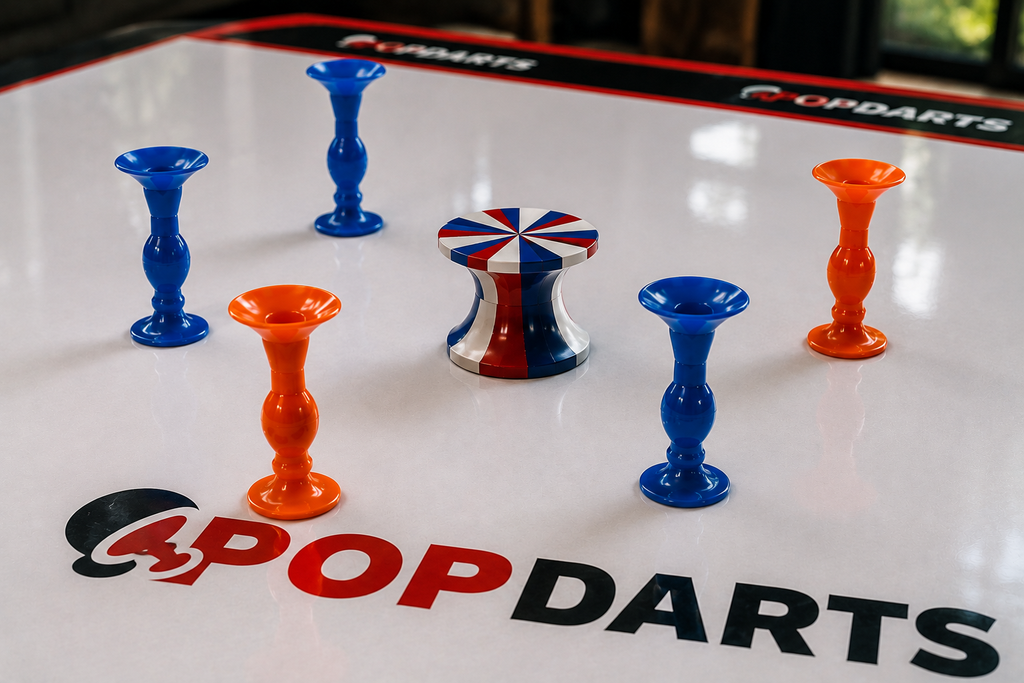
One attraction of Popdarts for beginners is the lack of equipment. Classic Play does not require a permanent installation, large playing area or cupboard full of accessories. A basic game revolves around the darts themselves, the target marker and a suitable surface.
For a first game, concentrate on these four essentials:
1. Popdarts
Each player uses three Popdarts in Classic Play, with different colours distinguishing the players or teams. The suction-cup design allows the darts to grip appropriate smooth surfaces when they land correctly.
2. Target Marker
The target marker provides the focus for each round. Rather than remaining permanently fixed in one position, it can move between rounds, which is one reason Classic Popdarts can create so many different challenges from a very small amount of equipment.
3. A Smooth, Non-Porous Surface
Suction cups need the right surface. Smooth worktops, glass, windows and similar non-porous surfaces are suitable choices, whereas rough, porous or heavily textured materials are unlikely to provide a reliable grip. Before playing on furniture or another valued surface, make sure it is clean, suitable and unlikely to be damaged.
4. Enough Throwing Space
Official Classic Play requires players to stand at least 10 feet from the target marker. You therefore need enough clear space to throw safely without people, fragile objects or the family television becoming unintended participants.
How Does Popdarts Scoring Work?
Scoring is one of the few parts of Popdarts for beginners that can look slightly unusual on paper because the game uses cancellation scoring. In practice, however, it keeps games close and takes only a round or two to understand.
In standard Classic Play, the closest Popdart that sticks scores three points. Every other Popdart that sticks scores one point. A dart touching the target marker earns an additional point, creating the shot known as a Kiss.
The clever part comes after both sides have calculated their totals. Instead of both players simply adding their scores to a running tally, the lower score is subtracted from the higher score. Only the difference goes onto the winning player’s total.
Imagine that you score five points during a round while your opponent scores three. The three points cancel three of yours, leaving you with two points for the round. Your opponent adds nothing.
This makes every successful dart useful. Even when you appear to have lost a round, sticking another dart can reduce the number of points your opponent actually takes from it. Consequently, games can swing quickly rather than becoming a procession once somebody establishes an early lead.
The Popdarts Shot Names You Will Want to Learn
This is where Popdarts develops a language of its own. Plenty of games have technical terminology, but considerably fewer allow you to announce that you have just landed a Wigglenobber.
The Kiss
A Kiss occurs when a sticking Popdart touches the target marker. In Classic Play, that contact earns an additional point. It may not sound as spectacular as some of the trick shots, yet in a close game that extra point can make a considerable difference after cancellation scoring.
The Wigglenobber
The Wigglenobber is one of the signature Popdarts shots. It happens when a thrown Popdart lands on top of another Popdart. Under the official Classic Play rules, a Wigglenobber is worth double the value of the dart it lands on, whether that dart belongs to you or your opponent.
That last detail makes the shot particularly entertaining. A spectacular throw is not automatically a clever throw if you have doubled something you would rather have left alone.
The T-Bone
A T-Bone is another eye-catching trick shot, although the official rules make an important distinction: looking impressive does not earn it additional points. That makes the T-Bone more about bragging rights than tactical scoring.
The terminology continues beyond these basic examples as players move deeper into trick shots and different versions of the game. Popdarts even maintains official world-record challenges involving feats such as long-distance and elevated Wigglenobbers. What begins as a simple target game can therefore become a surprisingly technical pursuit for anyone who enjoys practising difficult shots.
Why the Wigglenobber Changes the Game
A successful Wigglenobber illustrates why Popdarts has more depth than its simple equipment suggests. Getting one suction dart to stick to a flat surface is relatively straightforward once your technique improves. Landing it accurately on another small dart introduces a much finer target.
It also creates a decision. You can concentrate on reliable throws that accumulate ordinary points, or start attempting lower-percentage shots with a potentially greater reward. As confidence grows, that balance between sensible scoring and showing off becomes part of the fun.
There is now enough trick-shot culture around the game for the official Popdarts website to maintain a dedicated world-record section, with defined challenges and submission requirements. Anyone curious about how far players have taken these shots can explore the official Popdarts World Records.
Popdarts for Beginners: Learning How to Throw Properly
A beginner’s first instinct is often to throw a Popdart exactly like a conventional dart. However, the suction cup changes what needs to happen at the end of the flight. Accuracy matters, but so does presenting the suction end cleanly to the landing surface.
Start at the standard distance rather than immediately attempting heroic throws from the other side of the room. A controlled, repeatable action will teach you considerably more than throwing harder. Watch what happens when the dart arrives at the surface and adjust the release rather than simply increasing the force.
The surface itself also matters. Dust, grease and texture can affect suction, so an apparently poor throw may sometimes have more to do with where you are playing than your technique. Clean, smooth surfaces provide a fairer test and make improvement easier to judge.
Once you can stick darts reliably, accuracy becomes the next obsession. Aim for repeatability first, then start moving the target and experimenting with different angles. Trick shots become much more satisfying when they grow from genuine control rather than several hundred hopeful attempts.
Although, admittedly, several hundred hopeful attempts remain a perfectly legitimate way to spend a wet Sunday afternoon.
Where Can You Play Popdarts?
Portability is one of the strongest attractions of Popdarts for beginners. Because Classic Play uses a movable target rather than a fixed board, suitable surfaces can turn otherwise ordinary spaces into temporary playing areas.
The official guidance recommends smooth surfaces where a suction cup can work effectively, including countertops, windows, glass doors and similar materials. Rough wood, textured walls and porous surfaces are poor choices because the cups cannot form the seal they need.
That flexibility makes Popdarts particularly interesting as a social hobby. A set can travel to a friend’s house or come out during a family gathering without requiring much preparation. Equally, two regular players can create increasingly difficult challenges around the same room simply by changing the target position.
Use some common sense when choosing the location. Clear away glasses, ornaments and anything fragile before throwing. Avoid positions that encourage players to climb, lean dangerously or throw through areas where somebody might unexpectedly walk.
Is Popdarts Suitable for Adults?
Very much so, and this is perhaps where appearances can be misleading. Although Popdarts for beginners looks wonderfully uncomplicated, colourful suction darts can initially make the game appear aimed mainly at children. Yet the combination of accuracy, competitive scoring and increasingly difficult trick shots gives adults plenty to chase.
The attraction is similar to many successful pub and garden games. The rules need to be simple enough that a newcomer can join immediately, while the underlying skill needs to be difficult enough that experienced players still care whether the next throw lands.
That makes Popdarts particularly well suited to mixed groups. You do not need months of practice before playing against somebody else, and physical strength offers little advantage. A beginner can enjoy the game immediately while still having obvious room to improve.
If that accessible, screen-free side appeals to you, our guide to low stress hobbies for adults has more ideas for enjoyable ways to spend free time away from constant scrolling and notifications.
“The best social games take a minute to understand and considerably longer to master. Popdarts fits that description rather neatly.”
Classic Popdarts and Board Play Are Not Quite the Same
Beginners searching for rules online may encounter apparently conflicting scoring systems. Usually, the explanation is simple: Popdarts can be played in different formats.
The movable-target version described throughout most of this guide is Classic Play. There is also an official Board Play format. Board Play uses designated scoring areas rather than measuring which dart finishes closest to a movable target marker.
On the official board, a Popdart completely inside the white PD circle scores six points, while one completely inside the grey circle scores three. Other darts that stick to the board score one point, and cancellation scoring still applies. Board Play also introduces an Instant Win attempt under the official rules.
For players who prefer having a dedicated playing surface rather than relying entirely on suitable tables, worktops and windows, the Popdarts SwapTop™ OG Classic Game offers another way to play. Its double-sided design provides different styles of Popdarts play, making it particularly interesting once you have mastered the basics and want a more defined playing area.
Therefore, check which version somebody is playing before arguing passionately about the score. You may both be correct, which is deeply inconvenient when you were looking forward to proving the other person wrong.
Can Popdarts Become a Serious Skill Hobby?
It certainly has the ingredients. The difference between an occasional game and a skill hobby usually appears when you stop hoping a shot will work and start understanding why it worked.
Regular players can experiment with throwing distance, release angle, target position and different shot types. You can record personal bests, create household challenges or attempt established trick shots. The official world-record challenges demonstrate just how far that progression can go.
There is also satisfaction in visible improvement. During an early game, simply getting all three darts to stick may feel like an achievement. Later, you begin worrying about proximity to the marker. Eventually, an ordinary three-point shot might seem disappointingly sensible when a Wigglenobber is sitting there waiting to be attempted.
Common Popdarts for Beginners Mistakes to Avoid
Most early mistakes come from trying to progress too quickly. Beginners often throw too hard, choose unsuitable surfaces or immediately attempt spectacular trick shots before they can reliably stick an ordinary dart.
Another mistake is overlooking cancellation scoring. The aim is not simply to produce the highest raw score in isolation. Preventing an opponent from taking a large number of points can matter just as much as improving your own total.
Finally, do not make every round identical. Moving the target and changing the challenge is central to the personality of Classic Play. If you continually throw towards exactly the same spot from exactly the same position, you remove one of the game’s most entertaining features.
Is Popdarts Worth Trying as a New Hobby?
Popdarts for beginners occupies an appealing space between casual game and skill-based hobby. You can bring it out occasionally when friends visit and enjoy it without taking anything seriously. Alternatively, you can practise accuracy, learn trick shots and become worryingly invested in whether you can land one dart on top of another.
The modest amount of equipment also lowers the barrier to entry. There is no lengthy setup and no complicated rulebook to memorise before your first throw. Once you understand the basic scoring, most of the learning happens naturally through playing.
More importantly, it produces those little moments that keep simple games interesting: the dart that somehow sticks when everybody expected it to miss, the final throw that cancels an opponent’s lead, and the ridiculous trick shot somebody attempts as a joke and then actually lands.
Those moments are difficult to manufacture. They are also precisely why seemingly simple games can become genuine hobbies.
Popdarts for Beginners: Frequently Asked Questions
What is Popdarts?
Popdarts is a target game using soft suction-cup darts. In Classic Play, players throw towards a movable target marker on a suitable smooth surface and score according to where their sticking darts finish.
How many Popdarts does each player throw?
In standard Classic Play, each player has three Popdarts. Players take turns until all of the darts have been thrown, then calculate the round using cancellation scoring.
How far away do you stand in Popdarts?
The official Classic Play rules specify a minimum throwing distance of 10 feet from the target marker.
How do you score Popdarts?
The closest sticking Popdart scores three points, while other sticking Popdarts score one point. Touching the target marker earns an additional point. Cancellation scoring then subtracts the lower player’s round score from the higher score, with only the difference awarded.
What is a Wigglenobber in Popdarts?
A Wigglenobber occurs when a thrown Popdart lands on top of another Popdart. Under the official Classic Play rules, it scores double the value of the Popdart it lands on, whether that dart belongs to your team or your opponent.
What is a Kiss in Popdarts?
A Kiss is a Popdart that sticks while touching the target marker. In Classic Play, touching the marker adds one point to that dart’s score.
What score wins a game of Popdarts?
The first player or team to reach or exceed 21 points wins under the official Classic Play rules. You do not need to land on exactly 21.
What surfaces can you play Popdarts on?
Popdarts work best on smooth, non-porous surfaces where suction cups can form a reliable seal. Suitable examples include smooth countertops, windows and glass doors. Rough, porous and heavily textured surfaces should be avoided.
From First Throw to First Wigglenobber
There is something rather refreshing about a hobby whose basic equipment can fit into a small bag and whose rules can be explained before the kettle has boiled. Popdarts does not demand specialist knowledge before you begin. It simply gives you a target, three darts and the immediate suspicion that your next throw could be better than the last one.
Yet underneath that simplicity sits enough technique to keep the game interesting. Cancellation scoring makes every sticking dart relevant, movable targets prevent Classic Play from becoming repetitive and the trick-shot vocabulary gives improving players something considerably more entertaining to pursue than another anonymous high score.
For Popdarts for beginners, that is probably the best way to approach it. Learn to make the darts stick consistently, understand the scoring and gradually make the target more challenging. The T-Bones, Kisses and Wigglenobbers can follow.
Although once you land your first Wigglenobber, there is every possibility that everyone within hearing distance will be told about it.
Affiliate Disclosure: This article contains affiliate links. If you buy something through one of these links, Hobby Ideas may earn a small commission at no extra cost to you. This helps support the site and allows us to continue creating useful, independent hobby guides.