


Stargazing with binoculars may not sound as dramatic as owning a telescope, but it is often the better way to begin. Binoculars are cheaper, easier to use, faster to set up and far less intimidating when you are still learning your way around the night sky.
Almost everyone who becomes interested in astronomy imagines buying a telescope first.
It is understandable. Telescopes dominate films, documentaries and astronomy magazines, so they feel like the obvious place to begin.
Yet spend a little time talking to experienced stargazers and a surprising pattern soon appears. Ask them what they would recommend to someone buying their very first piece of astronomy equipment, and many will not mention a telescope at all.
Instead, they will point towards a good pair of binoculars.
It sounds almost too simple. However, binoculars offer a wide view of the night sky, require virtually no setup and cost far less than a quality telescope. They can reveal lunar craters, star clusters, distant galaxies and even Jupiter’s brightest moons, all while helping beginners learn the sky properly.
In many ways, binoculars are not a compromise. They are the smarter place to begin.
Quick Answer: Is Stargazing with Binoculars Worth It?
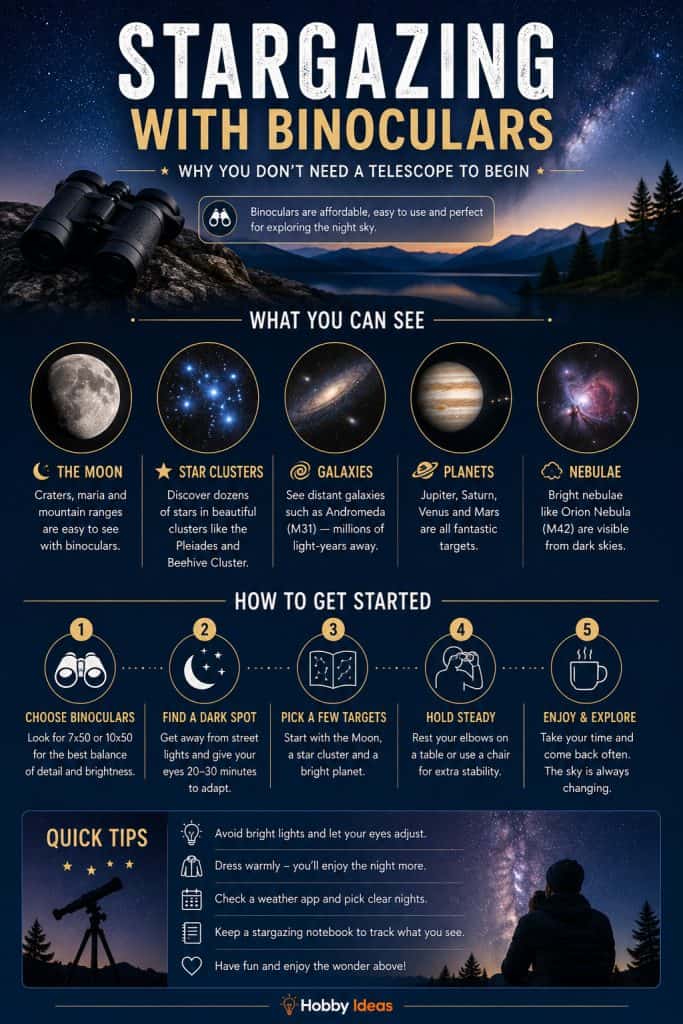
Yes. Stargazing with binoculars is one of the best low-cost ways to begin astronomy. A good pair of 7×50 or 10×50 binoculars can show the Moon in detail, star clusters, bright nebulae, the Milky Way, and even Jupiter’s four largest moons under good conditions.
Why Binoculars Make Stargazing Easier
A telescope sounds exciting until you try to use one for the first time on a cold evening.
There may be a mount to assemble, an eyepiece to choose, a finder to align and a narrow view that makes objects surprisingly difficult to locate. None of that is impossible, and learning to use a telescope can eventually become part of the pleasure. On a first night, however, it can turn a peaceful evening under the stars into a frustrating equipment session.
Binoculars feel different.
You lift them, look up and begin.
That simplicity matters. Beginners do not yet know the constellations, the seasonal sky or where bright objects sit in relation to each other. With a telescope, magnification can actually make that lack of familiarity more confusing. You may know that the object you want is somewhere near Orion, point the telescope towards it and then discover that your eyepiece contains an anonymous patch of dark sky and several stars you do not recognise.
Binoculars give you much more context. Their wider field of view allows you to see an object alongside the stars surrounding it, making it easier to understand where you are looking and move from one recognisable landmark to another.
With binoculars, you can sweep across Orion, follow a rich stretch of the Milky Way, linger on the Moon or search for the Pleiades without feeling as though the equipment is getting in the way. If you lose your target, lower the binoculars, find it again with your eyes and simply raise them back into position.
There is another advantage that becomes obvious after ten minutes outside: binoculars encourage wandering.
A telescope often begins with a target in mind. Binoculars invite you to explore. Start at a bright star, move slowly across the surrounding sky and see what appears. A seemingly empty patch can suddenly contain dozens of faint stars. A hazy object can become a cluster. A bright point beside Jupiter may turn out to be one of its moons.
This makes stargazing feel more natural. Instead of spending the first night wrestling with knobs and tripods, you spend it noticing patterns. You begin to understand that the night sky is not a flat scatter of identical dots. Some stars look warmer, some look colder, some sit in clusters and some reveal hidden companions when magnified.
Perhaps most importantly, binoculars make it easy to have a short observing session. If the clouds unexpectedly clear for twenty minutes, you can be outside and looking upwards almost immediately. There is no feeling that setting everything up is hardly worth the effort.
That accessibility is why binoculars make such a good bridge between simply looking at the night sky and becoming someone who genuinely knows their way around it. A telescope may eventually show you more, but binoculars can teach you where to look.
If you are completely new to astronomy, our guide to stargazing as a hobby gives a broader introduction to learning the night sky, choosing good viewing spots and building confidence as a beginner.
What Can You See When Stargazing with Binoculars?
The first surprise is the Moon.
Through binoculars, the Moon stops being a flat silver disc and becomes a world. Craters, bright rays, dark plains and rugged edges appear clearly, especially around the line where lunar day meets lunar night. That shadow line, known as the terminator, often reveals the most dramatic detail.
Then come the star clusters.
The Pleiades, sometimes called the Seven Sisters, look beautiful with the naked eye. Through binoculars they become far richer, with more stars appearing around the familiar bright group. The Beehive Cluster in Cancer also rewards binocular viewing, especially from darker locations.
Orion offers another beginner favourite.
The Orion Nebula appears as a faint glowing patch beneath Orion’s Belt. A telescope can show more detail, but binoculars reveal it as a real object rather than simply another star. For many beginners, that first view feels quietly thrilling.
Jupiter can also surprise you.
With steady hands, a clear sky and decent binoculars, you may see its four largest moons as tiny points of light beside the planet. They change position from night to night, which makes them especially satisfying to follow.
Under dark skies, binoculars can also help you find the Andromeda Galaxy. It will not look like the colourful photographs seen online, but that hardly matters. A faint oval glow becomes astonishing once you realise you are looking at another galaxy.
“A telescope may eventually show you more, but binoculars can teach you where to look.”
What Binoculars Can Reveal
A beginner does not need expensive equipment to enjoy the sky. Binoculars can reveal enough detail to make familiar objects feel completely new. Children do not need binoculars, a telescope or any specialist equipment to discover whether the night sky interests them. Start by looking for the Moon, bright planets and easy constellations with the naked eye, then introduce binoculars if their curiosity grows. For more activities that work on the same start-with-what-you-have principle, see our guide to free hobbies for kids.
What You Can See With Binoculars
Even an ordinary pair of binoculars can reveal details and objects that are difficult to appreciate with the naked eye alone.
Craters, bright rays, dark plains and rugged shadow detail become far easier to see, especially when the Moon is not completely full.
The Pleiades, Beehive Cluster and other bright groups look richer and more rewarding through binoculars than with the naked eye alone.
On a clear night, Jupiter’s brightest moons may appear as tiny points of light lined up beside the planet.
The Orion Nebula, Andromeda Galaxy and parts of the Milky Way become easier to find from dark locations.
📖 Recommended Beginner’s Stargazing Guide
One of the biggest challenges for new stargazers isn’t finding the stars, it’s knowing what they’re actually looking at. A good field guide turns a clear night into a much more rewarding experience.
🌌
National Geographic Backyard Guide to the Night Sky (2nd Edition) is one of the most beginner-friendly astronomy books available. Packed with seasonal star charts, constellation maps, photographs and easy-to-follow explanations, it helps you identify what you’re seeing instead of simply looking up and hoping for the best. The guide also includes practical advice for observing with the naked eye, binoculars and small telescopes. :contentReference[oaicite:1]{index=1}
What I particularly like is that it encourages you to learn the sky gradually. Rather than overwhelming you with technical astronomy, it helps you recognise familiar constellations, locate planets and understand the changing night sky throughout the year. It pairs perfectly with a good set of 10×50 binoculars.
Best for: Beginners who want to recognise constellations, find planets more easily and get more enjoyment from every stargazing session.
View on Amazon:
National Geographic Backyard Guide to the Night Sky: 2nd Edition
Why Binoculars Help You Learn the Sky
Stargazing is not only about magnification.
It is also about learning where things are.
This is where binoculars shine. Their wide field of view helps beginners connect the dots between naked-eye constellations and smaller objects hidden within them. You can look at a familiar patch of sky and then gently explore around it without losing your place.
Learn The Sky With Binoculars
With a telescope, it is easy to feel lost. You may be looking at a tiny magnified area without understanding where it sits in the wider pattern. Binoculars keep the sky connected. They let you move from bright stars to clusters, from constellations to nebulae, from the Moon to nearby planets.
As a result, they help you build confidence.
You begin to recognise seasonal landmarks. Orion becomes a winter friend. The Summer Triangle starts to feel familiar. The Plough becomes a useful pointer rather than just a shape. Over time, the sky changes from something overwhelming into something you can navigate.
That is why binoculars suit the HobbyIdeas approach to hobbies. They make the first step feel possible.
❝
The best first telescope for many beginners is not a telescope at all.
HobbyIdeas • Stargazing Wisdom
What Size Binoculars Are Best for Stargazing?
For most beginners, 10×50 binoculars are a sensible place to start.
The first number tells you the magnification. A 10x binocular makes objects appear ten times closer. The second number tells you the diameter of the front lenses in millimetres. Larger lenses gather more light, which matters at night.
That makes 10×50 a practical balance.
They are powerful enough to reveal plenty of detail, yet still affordable and portable. Some people prefer 7×50 binoculars because they can feel steadier in the hands and offer a slightly wider view. Others choose 8×42 binoculars because they are lighter and useful for wildlife watching as well as astronomy.
Very high magnification sounds tempting, but it can create problems.
Powerful binoculars become harder to hold steady. Stars shake, the view narrows and the experience becomes less relaxing. Once binoculars become large enough to need a tripod, they lose some of the simple grab-and-go charm that makes them so useful for beginners.
For a first pair, avoid chasing the biggest number.
Choose comfort, steadiness and ease of use.
Do You Need Expensive Astronomy Binoculars?
No, not at the beginning.
You do need decent optics, but you do not need to spend hundreds of pounds to enjoy your first nights under the stars. A solid pair of general-purpose binoculars can often do a wonderful job, especially if they are comfortable to hold and gather enough light.
What Makes The Ideal Stargazing Binoculars?
The best beginner binoculars are not necessarily the most specialised. They are the ones you will actually use.
If they are too heavy, they will stay in a cupboard. Too powerful, they may frustrate you. If the binoculars are awkward to focus, you will use them less often. Good beginner equipment should invite you outside, not make the hobby feel complicated. Recommended Product: OM SYSTEM 10×50 S Binoculars
If you’re buying binoculars specifically for astronomy, I’d spend a little more on a quality pair rather than the cheapest model available. Good optics make a remarkable difference once you start looking at faint stars, clusters and the Moon.
Suitability
The OM SYSTEM 10×50 S Binoculars strike an excellent balance between performance, comfort and value. The 10× magnification reveals impressive detail on the Moon while remaining steady enough to use by hand, and the large 50 mm objective lenses collect plenty of light for observing star clusters, bright nebulae and even the Andromeda Galaxy under darker skies.
Unlike many budget binoculars, these come from a respected optics manufacturer and include quality coatings, comfortable ergonomics, a carrying case and an impressive 15-year guarantee. They’re equally at home watching wildlife during the day before becoming your astronomy companion after sunset.
Best for: Beginners who want a quality pair of binoculars they’ll still be using years from now.
View current price on Amazon:
OM SYSTEM 10×50 S Binoculars – Ultra Clear Optics, Wide Field of View, Includes Strap & Case
This is also why stargazing with binoculars works so well as a low-cost hobby. Many people already own a pair, and even those who need to buy one can begin for far less than the cost of a telescope, mount and accessories.
If you enjoy practical, affordable ways to begin new interests, our guide to whether hobby starter kits are worth buying explores when beginner equipment bundles help and when simple, careful buying makes more sense.
How to Hold Binoculars Steady

The biggest challenge with binocular stargazing is keeping the view steady.
Even a small movement can make stars tremble. Fortunately, a few simple habits help.
First, sit down if you can. A garden chair, camping chair or reclined seat makes a huge difference. Rest your elbows against your body, breathe slowly and give your eyes time to settle.
Second, use support where available. Lean against a wall, fence or car roof. Rest your elbows on a table if you are viewing from a garden. Some people lie back on a sun lounger and look almost straight up, which can make the experience wonderfully comfortable.
Finally, do not rush.
Stars often reveal more after a few moments. Your eyes adapt, your hands settle and faint objects become easier to notice. Stargazing rewards patience, just as much as equipment.
Where Should You go Stargazing with Binoculars?
You can begin from a garden, driveway, balcony or local park if the sky is safe and visible.
Darker skies help, but they are not essential for your first attempt. The Moon, bright planets and some star clusters remain rewarding even with light pollution. However, if you can travel to a darker location, binoculars become far more impressive.
The Milky Way, faint clusters and galaxies all benefit from darkness. A sky that looks ordinary in town can become rich and textured away from streetlights.
Safety matters too.
Choose a place where you feel comfortable. Tell someone where you are going if you head out alone. Take warm clothing, even in mild weather, because standing still at night quickly feels colder than expected.
The UK Met Office and astronomy organisations often provide useful sky and weather information, while NASA’s skywatching guide is a helpful authority resource for understanding what to look for in the night sky.
“The best first nights under the stars are not about seeing everything. They are about learning to recognise a little more each time you look up.”
When Is the Best Time to Use Binoculars?
The best time depends on what you want to see.
The Moon is often most interesting when it is partly lit rather than full. Around first quarter, shadows make craters and mountains stand out. A full Moon looks impressive, but its bright, flat light can wash out surface detail.
Winter skies offer Orion, bright stars and some excellent beginner targets. Spring brings different galaxies and clusters. Summer evenings can be pleasant, although darkness comes late. Autumn offers a nice balance of earlier nights and rich star fields.
Beginners do not need to memorise everything.
Choose one or two targets for the evening. Find the Moon. Then look for the Pleiades. Another night, try Jupiter. Another, find Orion. Small successes build the habit.
That is how stargazing becomes a hobby rather than a one-off experiment.
A Simple First Binocular Stargazing Session
Keep your first session short, simple and enjoyable. The aim is not to see everything in one evening. It is to head back indoors already looking forward to your next night beneath the stars.
🌕 Begin with the Moon
The Moon is bright, easy to find and instantly rewarding through almost any decent pair of binoculars. Explore the craters and shadowed edges before moving on to fainter objects.
✨ Find One Star Cluster
The Pleiades or the Beehive Cluster are wonderful beginner targets, showing how binoculars can reveal dozens of stars hidden from the naked eye.
🪐 Look for a Planet
If Jupiter is visible, try spotting its four brightest moons lined up beside the planet. Watching them change position over several nights is part of the fun.
☕ Finish While You’re Still Enjoying It
Your first session doesn’t need to last for hours. Twenty enjoyable minutes under a clear sky will leave you eager for the next opportunity to explore.
HobbyIdeas Tip: Resist the temptation to tick everything off in one night. Astronomy is a hobby that rewards curiosity and patience, and every clear evening offers something different to discover.
Once you have spent a few evenings exploring the sky this way, binocular stargazing starts to feel remarkably uncomplicated. There are no complicated controls to master and no lengthy setup before you can begin. You simply step outside, find something interesting and look a little closer.
That simplicity does, however, raise a few questions for beginners — particularly around binocular sizes, light pollution and whether a telescope should eventually be the next step. These are the ones worth answering before you spend any more money.
Stargazing with Binoculars: Common Questions
Most beginner questions about binocular stargazing come down to what you can see, what to buy and how simple the hobby really is.
Are 10×50 binoculars good for stargazing?
Yes. 10×50 binoculars are a popular beginner choice because they offer useful magnification, good light gathering and manageable size.
Can you see planets with binoculars?
You can see bright planets as clearer points of light, and you may see Jupiter’s four largest moons. Binoculars will not show detailed planetary surfaces like a powerful telescope.
Do binoculars work in light-polluted areas?
Yes, especially for the Moon, bright planets and some star clusters. Darker skies reveal much more, but you can still begin from a garden or local open space.
Should I buy binoculars before a telescope?
For many beginners, yes. Binoculars are cheaper, easier to use and help you learn the sky before investing in a telescope.
Final Thoughts: The Sky Is Closer Than You Think
Stargazing with binoculars proves that astronomy does not need to begin with expensive equipment.
It can begin with a clear night, warm coat and a simple pair of binoculars.
That is part of the magic.
You do not need to understand every constellation. As a beginner, there is no point having a telescope standing in the corner of the room waiting for a perfect night.
You simply need to look up, choose one target and give your eyes time to notice more.
Binoculars make that first step easier. They turn the Moon into a landscape, star clusters into glittering gatherings and bright planets into objects worth following. More importantly, they help beginners feel at home under the sky.
The telescope can come later if the hobby takes hold.
For now, the low-cost start may be the best start of all.
Continue Exploring HobbyIdeas
If binocular stargazing has sparked your curiosity, these related guides will help you explore more low-cost and outdoor hobbies.
🌌 Stargazing as a Hobby
Learn how to begin stargazing, choose good viewing spots and enjoy the night sky as a relaxing outdoor hobby. Read our beginner stargazing guide.
🏕 Outdoor Hobbies
Browse more hobbies that help you spend time outside, learn new skills and enjoy the natural world. Explore Outdoor Hobbies.
🎒 Hobby Starter Kits: Are They Worth Buying?
Find out when beginner equipment bundles are useful and when buying simple essentials separately makes more sense. Read our Hobby Starter Kits guide.
Affiliate Disclosure
Some articles on HobbyIdeas contain affiliate links. This means that if you buy a product through one of our recommended links, we may earn a small commission at no extra cost to you. We only recommend products that we believe offer genuine value to hobbyists and beginners. Your support helps us continue creating free, practical hobby guides and in-depth editorial content.