

Free hobbies for kids do not have to feel like the activities left over when everything more exciting costs money. Some of the best childhood hobbies begin with almost nothing: a pencil, a patch of grass, a library card, an old notebook, a clear night sky or simply enough curiosity to start looking more closely at the world.
That distinction matters because a hobby is more than a way to fill a wet Saturday afternoon. A good hobby gives a child something they can return to, improve at and gradually make their own. They begin by drawing a cat that looks suspiciously like a potato, spotting one bird from the kitchen window or inventing a three-line story. A few months later, they may have a sketchbook full of characters, recognise half the birds in the garden or be writing stories without anybody suggesting it.
Parents can spend a remarkable amount of money trying to discover what their children enjoy. However, starting with hobbies that cost nothing removes some of the pressure. Nobody needs to justify an expensive kit, annual membership or abandoned musical instrument if the interest lasts three afternoons.
Instead, children can experiment. Some hobbies will disappear quickly. Others may become interests they carry for years.
Quick Answer: What Are the Best Free Hobbies for Kids?
The best free hobbies for kids are activities they can enjoy repeatedly without needing specialist equipment or regular spending. Good examples include drawing, creative writing, nature spotting, birdwatching, walking, stargazing, photography with an existing device, collecting and creative digital hobbies.
The key is to choose something that matches the child’s natural interests. Start with materials, places and resources you already have, then let the hobby develop before spending money on equipment.
Free Hobbies for Kids Are About More Than Saving Money
There is an obvious attraction to a hobby that costs nothing, particularly when family budgets already have plenty of demands. Yet the strongest free hobbies offer something more useful than simply saving a few pounds.
They allow children to discover what genuinely holds their attention.
A child who spends an hour searching for insects under logs may be telling you far more about their interests than one who reluctantly attends an activity chosen because somebody has already paid for six sessions. Another may happily spend an afternoon creating imaginary countries on scrap paper, while their sibling would rather walk three miles looking for unusual trees.
Neither hobby needs to produce an obvious achievement. Children do not need to turn every interest into a certificate, competition or future career. There is enormous value in becoming absorbed in something simply because it is fascinating.
Free hobbies also make experimentation easy. A child can try nature journalling this week, storytelling next week and stargazing when the clouds finally disappear. If one of those activities begins taking hold, that is the point when a parent can decide whether a book, basic equipment or occasional paid activity would genuinely add something.
Free Hobbies for Kids: Start With What Your Child Already Notices
The easiest hobby to encourage is often hiding in something a child already does without calling it a hobby.
The child who constantly points out dogs, birds or insects may enjoy wildlife spotting. Someone who covers school books with doodles has already given you a clue about drawing. A child who invents elaborate histories for toys might enjoy storytelling, comic making or creative writing. Meanwhile, the one who always asks where roads lead may respond to walking, map reading or local exploration.
Rather than announcing a new hobby and turning Tuesday evening into compulsory enrichment time, give the interest a little room.
Offer a notebook. Suggest photographing the birds they see. Ask whether they want to draw a map of an imaginary island. Let them choose a route on the next family walk.
The important part is ownership. A hobby becomes much more appealing when it belongs to the child rather than becoming another project managed by an adult.
“The best free hobby is often hiding in something a child already does. Watch what catches their attention before deciding what you think should interest them.”
Nature Spotting Turns an Ordinary Walk Into a Search
Nature spotting is one of the easiest genuinely free hobbies to begin because the subject matter is already outside the door.
You do not need to live beside a nature reserve. Gardens, parks, verges, school routes and even town centres contain birds, insects, plants, mosses, trees and seasonal changes worth noticing.
Start simply. Rather than trying to identify everything at once, choose one theme. How many different birds can you see this week? Which trees have the first autumn leaves? How many types of wildflower appear on the usual walk to the shops?
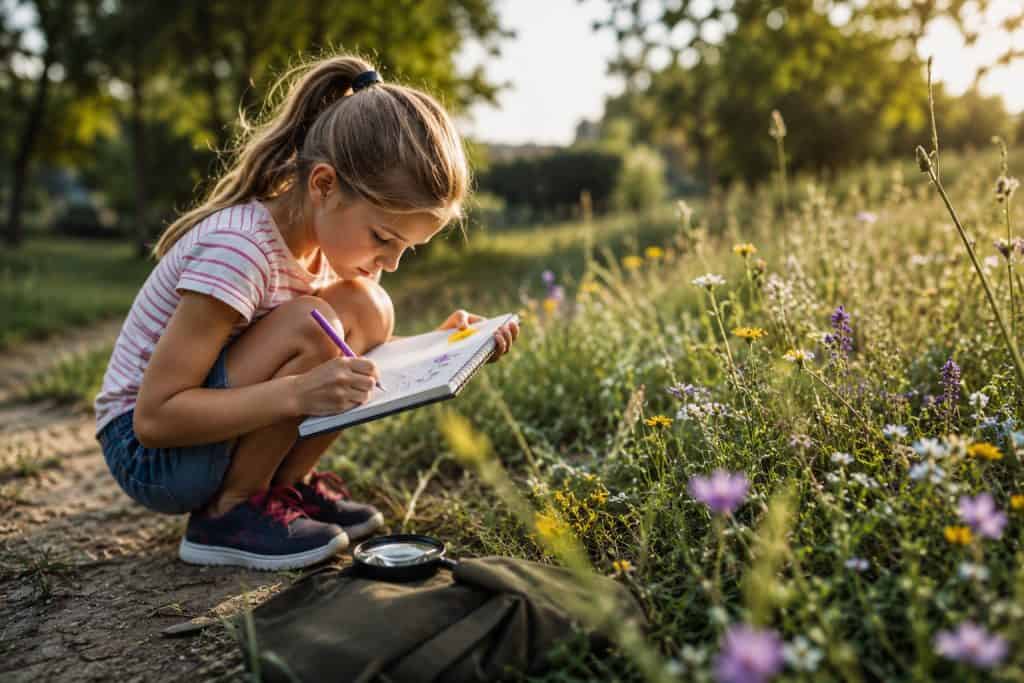
A notebook can turn casual observation into a hobby. Children can record dates, make quick sketches, describe colours or note where they found something. If they already have access to a family phone, photographs can create a simple record without buying a camera.
The pleasure gradually shifts from merely finding something to recognising it. The first time a child identifies a bird or tree without help feels surprisingly significant because they have learned something through their own attention.
Give the Hobby Somewhere to Grow
Once interest develops, local libraries can provide wildlife guides without requiring parents to buy them. Free identification resources from established wildlife organisations can also help older children research what they have found.
However, resist the urge to turn every walk into a lesson. Sometimes the discovery itself is enough. The same sense of exploration works brilliantly at the seaside too; our guide to rockpooling and discovering Britain’s hidden seaside wildlife is a great next step for children who enjoy searching for creatures in the natural world.
Drawing Costs Almost Nothing and Can Go Almost Anywhere
Drawing has one great advantage over many children’s hobbies: it barely cares where you are.
A pencil and the back of an old sheet of paper are enough to begin. Children can draw at the kitchen table, in the garden, on a train, while visiting grandparents or during the sort of rainy afternoon when everyone has already heard “I’m bored” several times.
More importantly, drawing can expand in almost any direction.
One child might enjoy copying animals while another creates fashion designs, cartoon characters, football badges or complicated machines that could never function under any known laws of physics. There is no requirement to start with bowls of fruit and careful lessons about perspective.
Encourage observation without constantly correcting the result. If a child’s horse has strangely short legs, the world will survive. The useful question is whether they enjoyed making it.
Over time, children naturally begin comparing their newer drawings with older ones. That visible improvement can provide its own motivation and helps turn an occasional activity into a hobby they choose to continue.
If drawing becomes one of the hobbies they keep coming back to, that is when a dedicated set can start to feel worthwhile. The BROTOU 28-Piece Drawing and Sketching Pencils Set includes a sketchbook, graphite and coloured pencils, an eraser, sharpener and pencil case, giving a keen young artist more room to experiment. There is no need to buy it to discover whether a child enjoys drawing; think of it as a possible next step once the pencils and scrap paper are already getting plenty of use.
Creative Writing Begins Long Before Someone Writes a Novel
Some children love stories but freeze when somebody tells them to “write a story”. The blank page suddenly looks enormous.
Creative writing works better as a hobby when it starts smaller.
Invent a ridiculous newspaper headline and explain what happened. Write the diary of the family cat. Create three sentences about a mysterious door. Design a superhero and describe the world’s most inconvenient superpower.
Children who dislike handwriting can dictate stories, type them or create illustrated comics instead. The hobby lies in inventing and shaping ideas, not in producing perfect handwriting.
Reading and writing often feed one another too. A child fascinated by fantasy books may eventually want to invent their own creatures and worlds, while someone who loves football can write imaginary match reports or create a magazine about their favourite team.
The best encouragement is genuine interest. Ask what happens next. Laugh at the joke. Remember the character’s name. Nothing makes a young writer feel more like a writer than discovering somebody actually wants to know how the story ends.
Walking Becomes a Hobby When There Is Something to Discover
“Would you like to go for a walk?” does not always produce wild enthusiasm from children.
Give the walk a purpose, however, and the reaction can change completely.
Four Signs You’ve Found the Right Hobby
A hobby has a much better chance of lasting when curiosity comes from the child rather than the adult.
Curiosity continues after the activity finishes. They want to identify what they found, discover how something works or learn what they could try next.
Nobody needs to remind them. They pick up the pencil, look for birds, continue their story or suggest doing the activity again themselves.
They recognise more birds, draw with greater confidence, walk further or begin tackling harder challenges because their skills are developing naturally.
The hobby remains something they look forward to rather than another organised activity they feel obliged to complete.
This also turns an ordinary family activity into useful movement. Current UK guidance recommends that children and young people aged 5 to 18 average at least 60 minutes of moderate or vigorous physical activity each day across the week, and walking, active travel and play all contribute towards that total.
You can read the current UK physical activity guidance for children and young people on GOV.UK.
Birdwatching Does Not Require Binoculars to Begin
Binoculars are useful for birdwatching, but they are not an entrance fee.
A child can begin from a window, garden, park bench or walk to school. The first challenge might simply be learning to recognise five common birds by sight. Later, they can notice different calls, feeding behaviour, seasonal visitors and the remarkable amount of arguing that takes place around an apparently peaceful bird feeder.
Children often enjoy keeping records because birdwatching provides natural little victories. First robin. First woodpecker. Ten species in one morning. A bird they have never seen before.
It also rewards patience without demanding silence for hours. Even a few minutes watching what visits a garden can become interesting once a child knows what they are looking for.
If the interest grows, borrowed library books and free online identification resources can take it surprisingly far before specialist equipment becomes necessary. If birdwatching becomes one of the hobbies they keep returning to, binoculars can be a worthwhile upgrade rather than something they need on day one. The Hontry 10×25 Compact Binoculars are designed for both adults and children and are small enough to take on walks, camping trips and days out, as well as being budget friendly. Start with your eyes and ears for free; consider binoculars later if seeing those more distant birds would genuinely add to the hobby.
Stargazing May Be One of the Best Free Hobbies for Kids
Few hobbies offer more subject matter for less money than looking at the night sky.
Children do not need a telescope to start. The Moon is visible with the naked eye, as are bright planets, familiar constellations, satellites and occasional meteor showers. The Royal Astronomical Society specifically notes that beginners can enjoy astronomy with the naked eye rather than needing substantial equipment from the outset.
Start with something recognisable. Follow the changing shape of the Moon for a month. Learn one constellation rather than twenty. Find a bright planet and check which one it is.
The scale of the subject also gives children endless questions to chase. Why does the Moon change shape? How far away is that star? Why can we sometimes see a planet before the sky becomes completely dark?
For younger children, simply going outside after dark with an adult can feel like an adventure. For older ones, astronomy can develop into science, photography, reading and observation without ever losing the fundamental pleasure of looking up. If the night sky captures their imagination, our guide to stargazing as a hobby explains how to explore it further. For older ones, astronomy can develop into science, photography, reading and observation without ever losing the fundamental pleasure of looking up.
Photography Can Be Free When You Use What You Already Have
Photography is only a free hobby if you resist the industry’s heroic efforts to convince everyone they urgently require more equipment.
If a child already has permitted access to a phone, tablet or old family camera, they have enough to start learning how to make interesting pictures.
Give them challenges rather than technical lectures. Photograph reflections. Find five interesting textures. Tell a story in three pictures. Take ten photographs without photographing a person.
These small projects encourage children to look rather than simply point the camera at everything around them.
They also teach an important creative lesson: good photographs depend on ideas, timing, light and composition far more than they depend on owning an expensive camera.
Parents should, of course, remain sensible about privacy and where children share photographs online. A photography hobby does not require a social media audience. A folder of favourite pictures can be just as satisfying.
Collecting Can Start Without Buying Anything
The word “collecting” tends to suggest shelves of purchased objects, but childhood collecting often begins much more simply.
A child might collect fallen leaves for identification, photograph different postboxes, record football statistics, catalogue interesting stones or keep a list of every train class they have spotted. The collection can even exist entirely in a notebook or photo folder.
There is an important difference between collecting and simply bringing half the outdoors home. Children can learn early that some natural objects should remain where they are and that protected plants, wildlife and archaeological finds may have rules surrounding them.
Recording rather than removing often makes a better hobby anyway. A photographed collection can include enormous trees, butterflies and historic buildings without creating storage problems in the bedroom.
The real attraction is classification. Children begin noticing differences, organising information and deciding what counts as a new addition. Those are surprisingly sophisticated skills hiding inside something that feels like fun.
Free Hobbies for Kids Can Include Creative Digital Activities
A free hobby does not automatically need to be screen-free.
There is a considerable difference between endlessly scrolling through content and using a computer to make something.
Children can experiment with coding, digital drawing, music creation, animation, photo editing or designing simple games using free tools and educational resources. For the right child, the screen becomes a workshop rather than merely entertainment.
Parents still need to choose age-appropriate platforms and supervise online activity appropriately. However, rejecting every digital hobby simply because it involves a screen risks overlooking activities that demand imagination, problem-solving and persistence.
The useful test is straightforward: is the child mainly consuming something, or are they creating, solving, designing or learning?
A healthy hobby should leave them with more than another hour of content watched.
The Library May Be the Best Free Hobby Resource in Town
Libraries deserve far more credit in discussions about free hobbies for kids.
A library card can provide access to books on drawing, crafts, astronomy, wildlife, coding, puzzles, history, storytelling, chess and almost any other interest a child suddenly decides is the most fascinating subject in existence.
Many libraries also run free activities, reading challenges, craft sessions and children’s events. What is available varies locally, but it is always worth checking before assuming a hobby requires buying books or materials.
Libraries also allow children to explore interests without commitment. Borrow three books about dinosaurs, discover that volcanoes are now more interesting, return the dinosaurs and start again.
That freedom is exactly what childhood hobbies need.
Do Not Turn a Free Hobby Into an Expensive One Too Quickly
There is a familiar parental temptation when a child finally becomes interested in something: buy the kit.
A child enjoys drawing, so suddenly there are professional pencils. They spot Saturn, and somebody starts researching telescopes. They take three nice photographs, and an entry-level DSLR begins appearing in browser tabs.
Sometimes equipment genuinely helps. The trick is waiting long enough to know whether the interest will survive it.
Let the hobby establish itself first. Borrow books. Use existing equipment. Improvise where sensible. Notice whether the child returns to the activity without being reminded.
If they are still drawing, birdwatching or photographing things several months later, a birthday or Christmas present connected with the hobby may suddenly have far more meaning because it supports something they already care about.
“Do not rush to buy the kit. Let the hobby prove that it deserves the equipment first.”
What Makes a Free Hobby Stick?
The hobby that lasts is rarely the one an adult has carefully selected because it looks educational.
Children return to hobbies that give them some combination of curiosity, ownership, challenge and enjoyment. They like noticing that they are improving, discovering something nobody else in the family spotted or becoming the person who knows which bird has just landed on the fence.
Adults can help by making the hobby possible without taking it over. Provide paper. Walk somewhere interesting. Visit the library. Make time to listen to the story or look at the photograph. Answer questions when you can and help find answers when you cannot.
Then allow some interests to fail.
A child who abandons sketching after two weeks has not wasted two weeks. They have learned something about what does and does not hold their attention. That is one of the advantages of starting with hobbies that cost nothing.
Four Signs You’ve Found the Right Hobby
Curiosity continues after the activity finishes and they genuinely want to know more.
Nobody needs to remind them. They choose to draw, look for birds or continue their story again.
They recognise more birds, draw with greater confidence or begin tackling harder challenges.
The hobby remains something they look forward to rather than another activity they feel obliged to complete.
The Best Free Hobby Is the One They Want to Do Again
Free hobbies for kids do not need elaborate plans, expensive starter kits or a timetable pinned to the fridge. They need enough opportunity for curiosity to take over.
One child may become fascinated by birds. Another will fill notebooks with strange invented creatures. Someone else may discover that walking is enjoyable when they control the route, while their sibling learns the Moon’s phases and starts reminding everyone when the next clear night is forecast.
The hobby itself matters less than what happens next.
Does the child ask to do it again? Do they begin noticing things without being prompted? Do they want to know more? Are they becoming slightly better at something simply because they keep returning to it?
That is the point where an activity becomes a hobby.
And occasionally, the hobby that costs absolutely nothing to begin becomes one of the interests a child remembers long after the toys, kits and organised activities have been forgotten.
Free hobbies are not just for children, of course. If all this talk of drawing, exploring and looking up at the night sky has made you wonder when you last tried something new yourself, our guide to free hobbies for adults has plenty of ideas that can be started with what you already have.
Free Hobbies for Kids: Frequently Asked Questions
What are some good free hobbies for kids?
Drawing, creative writing, nature spotting, birdwatching, walking, stargazing, photography using an existing device, collecting and creative digital activities can all become rewarding free hobbies.
How can I find a hobby my child will actually enjoy?
Start by noticing what already attracts their attention. A child who constantly watches wildlife, draws characters, invents stories or explores outdoors may already be showing you the type of hobby they would enjoy.
Do children’s hobbies need special equipment?
No. Many hobbies can begin with things already available at home or through a local library. It usually makes sense to let an interest develop before buying specialist equipment.
What are good free outdoor hobbies for children?
Nature spotting, birdwatching, walking, wildlife photography, stargazing and recording interesting local places are all outdoor hobbies that children can begin with little or no equipment.
Can screen-based activities count as hobbies?
Yes. Coding, digital drawing, animation, music creation and photography can all be creative hobbies. The important distinction is whether the child is actively creating, solving problems or learning rather than simply consuming content.
Should I encourage my child to stick with a hobby they lose interest in?
Not necessarily. Trying different hobbies helps children discover what genuinely interests them. A free hobby can be abandoned without wasting an expensive course or pile of specialist equipment, making experimentation part of the process.
Affiliate Disclosure: Hobby Ideas may earn a small commission from qualifying purchases made through links in this article, at no extra cost to you. We only recommend products or resources that we believe are relevant and useful to our readers.
Sometimes the Best Hobbies Begin With Almost Nothing
It is easy to assume that giving children more opportunities means buying more things. Yet hobbies have never really worked that way. A pencil can become hundreds of drawings. A library card can open the door to dozens of interests. A familiar footpath can become somewhere completely different once a child starts noticing the birds, buildings, plants and tiny details along the way.
The real advantage of free hobbies for kids is the freedom to experiment. There is no expensive kit sitting in the cupboard creating guilt if an interest lasts a fortnight. Children can try something, enjoy it, abandon it, return to it six months later or unexpectedly discover the thing they cannot quite stop doing.
That last one is worth watching for. When a child starts drawing without being asked, wants to go outside because they spotted something yesterday, keeps adding to a notebook or begins explaining facts that nobody else in the family knew, the hobby is starting to belong to them.
At that point, encouragement matters far more than equipment. Take an interest. Ask to see what they made. Go outside with them occasionally. Help them find a library book when the questions become harder. Most importantly, give them enough space to decide where the interest goes next.
Of course, a free hobby does not have to remain completely free forever. Once a child has found something they genuinely enjoy and keeps returning to it, a useful book, better set of pencils, pair of binoculars or simple piece of equipment can help the hobby grow. If you reach that stage, you can browse the Hobby Ideas Amazon storefront, where we have brought together useful books, starter equipment and hobby gear covering many of the interests featured on Hobby Ideas.
Childhood is full of activities adults arrange for children. A hobby is slightly different. At its best, it becomes something a child chooses for themselves — and some of the interests that eventually mean the most begin with little more than curiosity and the chance to follow it.