

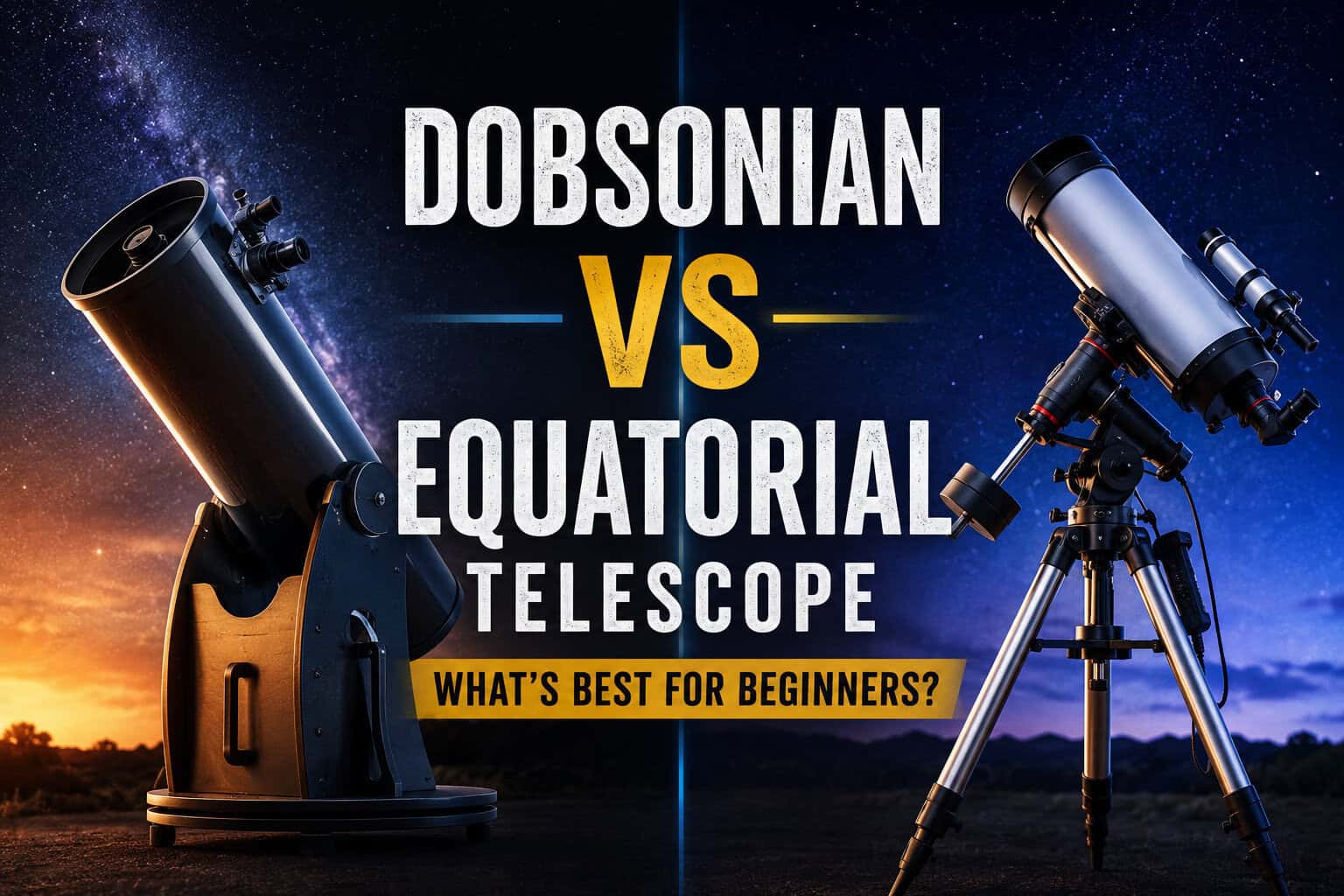
There is a particular moment familiar to almost every new stargazer. You have learned a few constellations, watched the Moon through binoculars and perhaps spotted Jupiter shining above the rooftops. Then curiosity takes over. You decide it is finally time to buy a telescope, begin researching the options and almost immediately encounter the great beginner’s debate: Dobsonian vs equatorial telescope.
At first, the choice appears straightforward. One telescope sits on a simple wooden base, while the other balances on a tripod decorated with knobs, counterweights and mysterious-looking adjustment controls. However, each design offers a very different way of exploring the night sky. So what are the choices to make between a Dobsonian vs an equatorial telescope?
A Dobsonian invites you to point, look and discover. An equatorial telescope asks for a little more preparation but rewards that effort by following objects as they move across the heavens. Neither approach is universally better. The right choice depends on whether you want uncomplicated visual stargazing, precise tracking, future astrophotography or simply the quickest route from opening the box to seeing Saturn’s rings.
Quick Answer: Dobsonian vs Equatorial Telescope
For most beginners interested mainly in looking at the Moon, planets, star clusters and deep-sky objects, a Dobsonian telescope is usually the easiest and best-value choice. Its simple mount, generous aperture and intuitive movement allow newcomers to begin observing quickly. An equatorial telescope suits beginners who enjoy learning technical equipment, want smoother celestial tracking or hope to explore more serious astrophotography later.

Before We Compare Them, There Is One Important Detail
The phrase “Dobsonian vs equatorial telescope” is useful, although it is not a perfectly equal comparison.
A Dobsonian usually combines a Newtonian reflecting telescope with a simple altazimuth rocker-box mount. The tube moves upwards, downwards and from side to side, rather like a cannon mounted on a rotating base.
Equatorial, meanwhile, describes the mount rather than the optical design. Refractors, Newtonian reflectors, Maksutov telescopes and other optical tubes can all sit on an equatorial mount.
Therefore, the real decision is largely about how you want your telescope to move and how much setting up you are willing to do before observing. The optics still matter, of course, but the mount often determines whether a first telescope becomes a much-loved companion or a complicated object gathering dust in the spare room.
The Dobsonian Philosophy: Keep It Simple and Look Up
Dobsonian telescopes have an appealing honesty about them. There are no counterweights hanging from metal shafts, no polar-alignment routine and, on a traditional manual model, no batteries or electronic handset. You place the base on firm ground, fit the telescope tube into its supports and begin exploring.
The design became popular because it made larger telescope apertures affordable. Instead of spending much of the budget on an elaborate mount and tripod, the money could go into the mirror that gathers light.
That matters because aperture remains one of the most important features of any visual telescope. A wider mirror collects more light, revealing fainter objects and showing additional detail when conditions allow. Consequently, a modestly priced Dobsonian can often deliver brighter and more impressive visual views than a smaller telescope supplied on a complicated mount.
There is something wonderfully direct about using one. You loosen the tube, guide it towards the Moon and look through the eyepiece. When the object drifts, you nudge the telescope gently to follow it. Within a few evenings, those movements begin to feel natural.
For a beginner standing beneath a clear sky and impatient to see something remarkable, that simplicity has enormous value.
What Using a Dobsonian Telescope Actually Feels Like
Imagine carrying your telescope into the garden on a crisp autumn evening. The base goes down first, followed by the tube. There is no need to point the mount north or calculate your latitude. After checking that the finder is aligned, you turn towards the Moon.
The experience feels physical and immediate. You move the telescope by hand, sweep slowly across the sky and learn how the constellations connect. Searching for objects becomes part of the hobby rather than a task completed by machinery.
That approach suits people who enjoy exploration. Finding the Andromeda Galaxy after several unsuccessful attempts feels surprisingly rewarding, even when it first appears as little more than a misty patch. Likewise, locating Saturn and discovering that its rings are genuinely visible through your own telescope creates the kind of memory that keeps people interested in astronomy for decades.
However, a manual Dobsonian does require regular nudging. The Earth continues rotating beneath you, so stars and planets gradually drift across the eyepiece. At low magnification this movement feels gentle. At higher magnification, particularly when observing planets, targets leave the field more quickly.
Most observers soon develop a smooth touch, although anyone hoping to share the view with several people may occasionally hear the words, “It’s disappeared,” before the next person reaches the eyepiece.
“The best beginner telescope is not the one with the most controls. It is the one that makes you eager to step outside whenever the clouds clear.”
HobbyIdeas • Stargazing Inspiration
The Equatorial Philosophy: Work With the Turning Earth
An equatorial mount takes a more technical approach. Instead of moving only up, down and sideways, one of its axes is angled to align with the Earth’s rotational axis.
Once the mount has been positioned correctly, an object can be followed across the sky mainly by turning a single control. Add a suitable motor drive and the mount can track automatically, keeping the target in view for much longer.
This ability explains why equatorial mounts remain so important in astronomy. Through a telescope, the apparent movement of the stars becomes much more noticeable than it does to the naked eye. A correctly aligned equatorial mount compensates for that movement in an orderly and precise way.
The first encounter can nevertheless feel slightly bewildering. The telescope may appear to lean at an odd angle. The counterweight points towards the ground, the tube can rotate into unexpected positions and the slow-motion controls do not always move the instrument in the direction a beginner anticipates.
None of this makes equatorial mounts impossibly difficult. Thousands of amateur astronomers learned to use them long before smartphone apps and online tutorials appeared. Nevertheless, they demand a little patience.
The reward comes when the system begins to make sense. Instead of repeatedly pushing the telescope in two directions, you turn one slow-motion control and watch Jupiter remain comfortably inside the eyepiece. For people who enjoy understanding equipment, that moment feels extremely satisfying.
Dobsonian vs Equatorial Telescope: The Real Beginner Differences
Both designs can provide superb views, yet they encourage different styles of observing.
Choose a Dobsonian for Simplicity
A Dobsonian removes many of the obstacles that can frustrate first-time users. The base stands firmly on the ground, the movement feels intuitive and the telescope can usually be assembled without a lengthy routine.
That means more of your first evening goes into observing and less into wondering whether a metal axis is pointing in precisely the right direction.
Choose an Equatorial Mount for Tracking
An equatorial mount comes into its own when you want to keep an object centred. Once properly aligned, it follows the curved path that stars and planets appear to take across the sky.
This makes longer planetary observing sessions more comfortable, especially at high magnification. It also allows several people to take turns at the eyepiece without someone needing to relocate the object every few moments.
Choose a Dobsonian for Aperture and Value
Because the rocker-box mount remains relatively inexpensive to manufacture, Dobsonians often offer more light-gathering aperture for the same budget.
A six-inch or eight-inch Dobsonian can reveal an impressive selection of celestial sights, including lunar craters, Saturn’s rings, Jupiter’s cloud belts and moons, bright nebulae, galaxies and glittering star clusters.
Exactly what you see will also depend on light pollution, weather, atmospheric steadiness and your own observing experience. However, a larger aperture gives you more opportunities to explore.
Choose an Equatorial Mount If You Enjoy Technical Learning
Some beginners find adjustment knobs and alignment routines annoying. Others find them fascinating.
If you enjoy understanding how machines work, setting coordinates, learning celestial movement and gradually improving your accuracy, an equatorial mount adds another rewarding dimension to astronomy.
The setup becomes part of the experience rather than an inconvenience.
At a Glance: Which Beginner Are You?
🌙 The Relaxed Visual Observer
You want to step outside, point towards the Moon and begin observing with minimal fuss. You are mainly interested in seeing celestial objects with your own eyes.
🔭 The Practical Explorer
You want the largest useful aperture your budget can provide. You enjoy finding targets manually and do not mind nudging the telescope as they drift.
⚙️ The Patient Technician
You enjoy learning how equipment works and do not mind spending time levelling, balancing and aligning a mount before observing.
📷 The Future Astrophotographer
You hope eventually to photograph faint nebulae and galaxies using longer exposures, and you accept that this will involve a steeper learning curve and a larger equipment budget.
What About Astrophotography?
Astrophotography often becomes the deciding factor in this comparison, although beginners should be careful not to let distant ambitions overshadow what they will actually enjoy now.
A manual Dobsonian works beautifully for visual observing. You can also hold a smartphone near the eyepiece and capture satisfying photographs of the Moon. With patience, suitable equipment and good technique, brighter planets may also be possible.
However, traditional Dobsonian mounts do not naturally compensate for the Earth’s rotation. During longer camera exposures, stars appear to move and the field of view rotates. That makes conventional deep-sky astrophotography much more difficult.
A properly aligned and motorised equatorial mount tracks the sky in the way long-exposure imaging requires. Nevertheless, owning an equatorial mount does not automatically make a telescope an ideal astrophotography system. The mount must carry the equipment steadily and accurately, while the telescope, camera, guiding equipment and balance all influence the results.
Therefore, a lightweight equatorial mount supplied with an inexpensive beginner telescope should not be mistaken for a complete deep-sky imaging platform.
If your immediate dream is to enjoy the Moon, planets and brighter deep-sky objects, buying a Dobsonian now does not close the door on astrophotography forever. Many enthusiasts keep their visual telescope and build a separate imaging setup later, once they understand the sky and know which subjects they most enjoy.
Capture Your First Moon Photographs
One of the great surprises for many beginners is how quickly they want to share what they have discovered. After your first detailed view of the Moon, it is only natural to wonder whether your smartphone can capture the same scene.
The answer is yes. While holding a phone against the eyepiece can produce the occasional good image, keeping everything perfectly aligned is surprisingly difficult. A dedicated smartphone adapter makes the process much easier by securely positioning the camera over the eyepiece, reducing movement and allowing you to concentrate on focus rather than balancing your phone. Modern three-axis adapters also make fine adjustments far simpler than basic spring-clamp designs, helping to eliminate black edges and improve image alignment. :contentReference[oaicite:0]{index=0}
If you would like to try photographing the Moon, planets or bright star clusters with your existing telescope, the APEXEL 3-Axis Metal Telescope Phone Adapter with Bluetooth is worth a look. Its precision CNC metal construction, universal compatibility and Bluetooth shutter remote make it a practical accessory for beginners taking their first steps into smartphone astrophotography.
The Question of Size, Weight and Storage Differences of a Dobsonian vs Equatorial Telescope
An eight-inch Dobsonian may look delightfully uncomplicated in a photograph, but it is still a substantial object. The tube can be awkward to carry through narrow doors, while the base occupies a noticeable amount of floor space.
Fortunately, the instrument usually separates into two manageable pieces. Many owners carry the base outside first and return for the tube. Collapsible and tabletop Dobsonian models offer alternatives where storage or transport causes concern.
An equatorial setup may appear more portable because it stands on a tripod. However, it often breaks down into several separate components: telescope tube, tripod, mount head, counterweight, accessory tray and sometimes a power supply.
Consequently, neither design automatically wins the portability contest. The best telescope is one you can move comfortably from its storage place to your observing spot without turning every clear night into a small removal job.
Before buying, measure the cupboard, doorway and car boot involved. Astronomy feels far more spontaneous when your telescope can be outdoors and ready within a few minutes.
What Beginners Often Get Wrong When Choosing A Dobsonian vs Equatorial Telescope
The most common mistake is choosing a telescope by magnification. Large numbers printed on a box may look impressive, but useful magnification depends on aperture, optical quality and atmospheric conditions. A stable, sharp view at moderate power usually reveals far more than a dim, trembling image pushed beyond the telescope’s realistic limits.
Another mistake is underestimating the mount. Excellent optics on a shaky tripod quickly become frustrating because every touch causes the image to wobble. A simple, stable Dobsonian base can therefore feel far more enjoyable than a smaller telescope balanced on an inadequate equatorial mount.
Beginners also sometimes choose equipment for the astronomer they imagine becoming five years from now. Ambition is wonderful, but a telescope must still be enjoyable during the first week.
“A telescope should open the universe, not create a barrier between you and it.”
HobbyIdeas • Night Sky Wisdom
How to Make the Right Choice Before Choosing A Dobsonian vs Equatorial Telescope
Begin by deciding what you most want to see. If your answer includes the Moon, planets, star clusters and brighter galaxies, a Dobsonian provides a wonderfully capable introduction.
Next, consider where you will observe. A garden with level paving suits either design. A narrow balcony may favour a more compact telescope, while regular trips to dark-sky sites make vehicle space and lifting weight more important.
Then be honest about setup. Some people happily spend twenty minutes preparing equipment because the process helps them settle into the evening. Others lose enthusiasm if observing cannot begin almost immediately.
Whenever possible, visit a local astronomy society or public observing event before spending money. Seeing different mounts in use teaches far more than comparing specifications on a screen. The Royal Astronomical Society’s guide to getting started in astronomy also provides useful resources for UK beginners.
If you are still learning your way around the heavens, our guide to stargazing as a hobby will help you begin recognising constellations, planning observing sessions and enjoying the night sky before a telescope enters the picture.
Our Verdict: Dobsonian vs Equatorial Telescope for Beginners
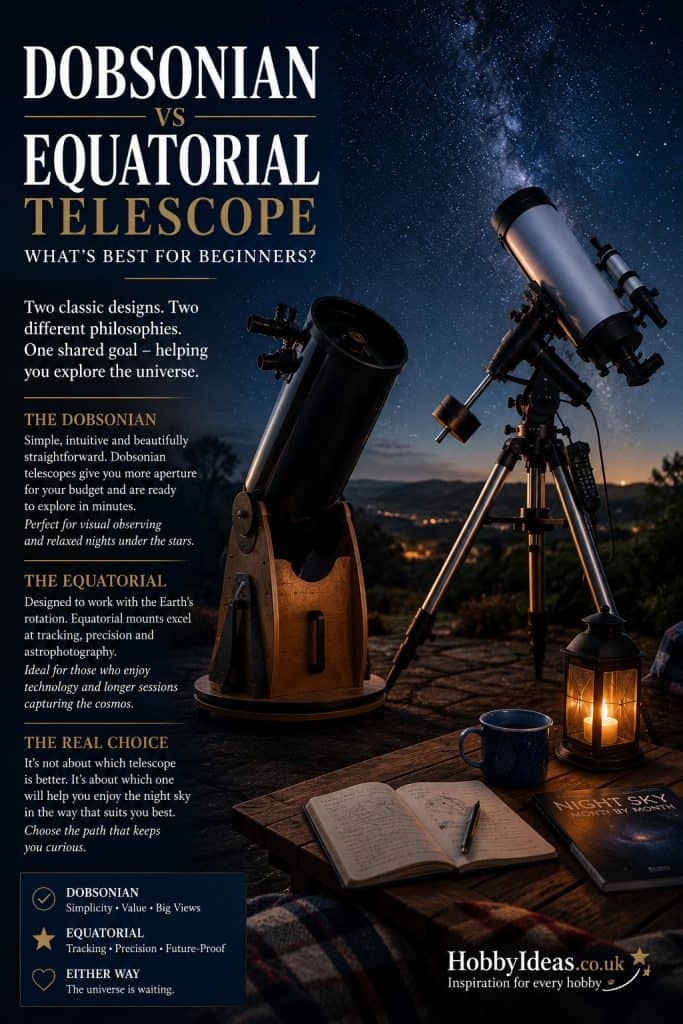
For a beginner whose main ambition is visual observing, the Dobsonian wins this comparison. It offers an unusually satisfying combination of simplicity, stability, aperture and value. More importantly, it allows the telescope to disappear into the background so the sky becomes the centre of attention.
The equatorial mount remains the better choice for a different sort of newcomer. If you enjoy technical equipment, value accurate tracking or already know that long-exposure astrophotography will become your main interest, learning an equatorial system can prove worthwhile from the beginning.
There is no inferior path here. One design encourages relaxed exploration, while the other introduces precision and celestial mechanics. The question is not which telescope sounds more advanced. It is which one will persuade you to keep going outside.
Experience What a Large Dobsonian Can Really Do
One of the biggest attractions of a Dobsonian telescope is the amount of light it can gather for the money. As aperture increases, fainter galaxies, nebulae and star clusters become easier to observe, while the Moon and planets reveal even finer detail. Larger models such as the Sky-Watcher Skyliner 250PX 10-inch Dobsonian take that experience even further, although the extra size and weight mean they suit observers who have enough storage space and are happy moving a substantial telescope. If you are ready for that commitment, a large Dobsonian offers an unforgettable visual experience under dark skies.
See the Sky-Watcher Skyliner 250PX 10-inch
Frequently Asked Questions About Dobsonian vs Equatorial Telescopes
Is a Dobsonian telescope easy for a complete beginner?
Yes. A traditional Dobsonian is one of the easiest telescope designs to set up and move. Beginners still need to learn how to align the finder, focus correctly and locate objects, but the mount itself feels intuitive.
Can a Dobsonian telescope track stars and planets?
A standard manual Dobsonian does not track automatically. Instead, the observer gently nudges the telescope to keep an object centred. Some motorised or Go-To Dobsonians can track, while an equatorial platform can add limited tracking to certain manual models.
Is an equatorial mount too complicated for a beginner?
No, although it has a steeper learning curve. Beginners must learn how to balance the telescope, set the mount to the correct latitude and align its polar axis. Once understood, the controls become much more logical.
Which telescope is better for viewing planets?
Both can produce excellent planetary views when fitted with suitable optics. A Dobsonian often provides more aperture for the money, while an equatorial mount makes it easier to keep a planet centred at higher magnification.
Which is better for deep-sky objects?
For visual deep-sky observing, a larger-aperture Dobsonian usually offers outstanding value because it gathers more light. For long-exposure photographs of galaxies and nebulae, a suitably strong motorised equatorial mount is generally the better foundation.
Do Dobsonian telescopes need electricity?
Traditional manual Dobsonians require no electricity. Computerised Go-To or tracking models need a battery or external power source to operate.
Can I photograph the Moon through a Dobsonian?
Yes. The Moon is bright enough for short exposures, and many beginners capture impressive images using a smartphone with an eyepiece adaptor. Long-exposure deep-sky photography is considerably more demanding and is better suited to an equatorial mount.
The Beginning of Many Clear Nights
The first telescope rarely becomes the last word in anyone’s astronomy journey. It becomes the instrument that teaches you what holds your attention.
Perhaps you will discover that you love sweeping through the Milky Way, searching for faint clusters and galaxies with a broad Dobsonian mirror. Alternatively, the quiet precision of an equatorial mount may lead you towards planetary imaging, careful tracking and long nights spent photographing light that began its journey thousands of years ago.
Either choice can reveal mountains on the Moon, the four bright Galilean moons beside Jupiter and the unmistakable rings of Saturn. Those first views matter far more than the style of mount beneath the telescope.
Choose the design that suits your temperament, your available space and the way you hope to enjoy the sky. Then wait for a clear evening, carry it outside and look up. The universe will provide the rest.
Continue Exploring
Explore more inspiration in our Outdoor Hobbies collection, where you will find practical guides for enjoying more time beneath open skies.
If you are preparing for your first observing sessions, visit the HobbyIdeas Stargazing Essentials collection. It brings together useful beginner equipment, including star guides, red-light torches and practical accessories selected to make nights outdoors more comfortable and enjoyable.
Affiliate Disclosure: HobbyIdeas participates in the Amazon Associates Programme. If you purchase through one of our recommended links, we may earn a small commission at no extra cost to you. We only recommend products we believe genuinely add value to the hobby.