

Learning how to start journaling can feel surprisingly intimidating at first, despite the fact that journaling itself remains one of the simplest hobbies anyone can begin.
After all, the basic concept involves little more than writing thoughts down regularly.
However, many beginners quickly become stuck worrying about: – what to write – how often to journal – whether entries sound “good enough” – which notebook to buy
Ironically, that overthinking often stops people from starting entirely.
Why Journaling Has Become So Popular
Journaling appeals to people for many different reasons.
Some people use journals creatively.
Meanwhile, others use journaling to: – organise thoughts – reduce stress – track habits – improve mindfulness – record memories – brainstorm ideas
Additionally, journaling requires very little equipment compared with many hobbies.
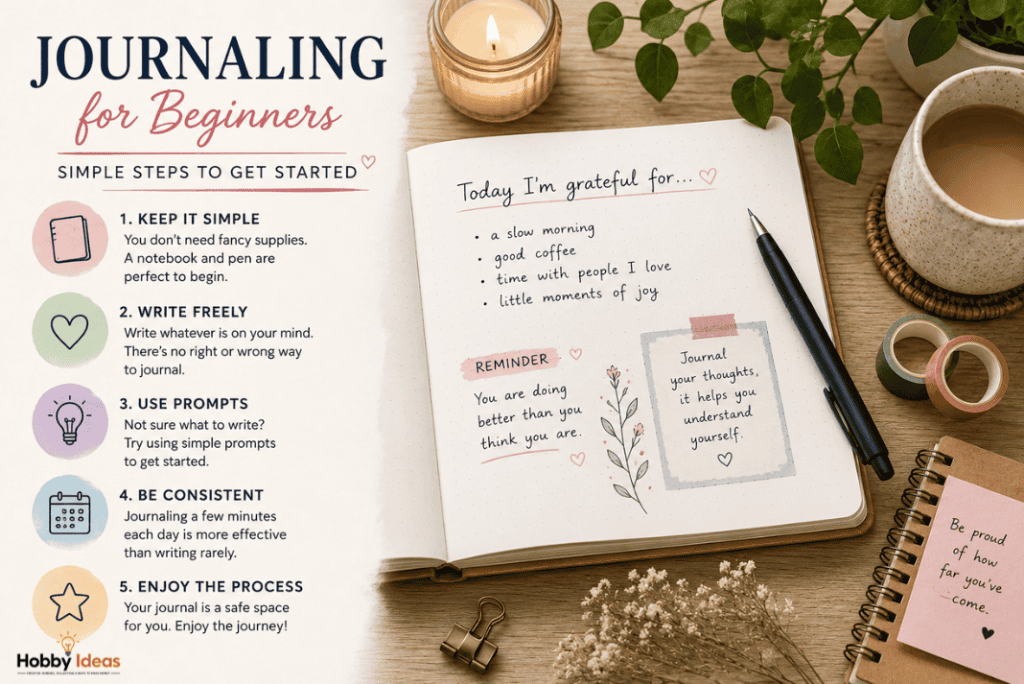
A notebook and pen remain more than enough to begin.
According to Positive Psychology, regular journaling may help improve self-awareness, emotional processing, and mental clarity.
You Do Not Need Fancy Supplies
Beginners often believe they need expensive journals, colour-coded pens, stickers, or elaborate layouts immediately.
Fortunately, none of that matters at the start.
In fact, simple notebooks often work best because they remove pressure and perfectionism.
Many experienced journalers eventually discover that half-used notebooks scattered around the house somehow become part of the hobby anyway.
Different Types of Journaling
One reason journaling remains so popular involves flexibility.
There is no single “correct” way to keep a journal.
Popular styles include:
- Daily reflection journals
- Gratitude journals
- Creative writing journals
- Travel journals
- Dream journals
- Goal tracking journals
- Bullet journals
Consequently, beginners can experiment until they find a style that feels natural.
Start Small Rather Than Writing Essays
Beginners often quit journaling because they try to write enormous entries immediately.
Actually, short consistent entries work far better.
Even writing: – a few sentences – a quick list – one observation – one idea
…still counts as journaling.
Importantly, building consistency matters more than writing dramatic life reflections every evening beside a candle while pretending to be a Victorian novelist.
Simple Journaling Prompts for Beginners
Prompts help many beginners overcome blank-page anxiety.
Simple prompts include:
- What made me smile today?
- What am I currently worried about?
- What do I want to improve?
- What inspired me recently?
- What would make tomorrow better?
These small prompts often lead naturally into longer thoughts and reflections.
Handwritten Journals Feel Different From Digital Notes
Some people prefer digital journaling apps.
However, handwritten journals often feel more personal and calming because writing by hand slows thinking slightly.
Additionally, physical notebooks create a stronger sense of progress over time.
Seeing filled pages gradually accumulate feels surprisingly satisfying.
Perfectionism Ruins Journaling Quickly
Many beginners stop journaling because they become overly focused on neat handwriting, perfect layouts, or aesthetically pleasing pages.
That pressure usually makes journaling less enjoyable.
Real journals often contain: – crossed-out thoughts – messy pages – unfinished ideas – random observations
That messiness forms part of the process.
Journaling Often Connects With Other Hobbies
People interested in learning how to start journaling frequently explore related hobbies including:
- creative writing
- watercolour painting
- calligraphy
- scrapbooking
- reading
Creative hobbies naturally overlap because they encourage reflection and self-expression.
If you enjoy calm creative hobbies, you might also enjoy our guide to watercolour painting for beginners.
Final Thoughts On How To Start Journaling
Learning how to start journaling does not require perfect writing skills, artistic layouts, or expensive supplies.
More importantly, journaling should feel useful and personal rather than stressful.
Whether you write a few lines each evening or fill entire notebooks over time, journaling provides a simple way to slow down and organise thoughts more clearly.
Most importantly, beginners should remember that there is no “wrong” way to keep a journal.
The best journaling method usually becomes the one you actually continue using.