

Advanced stamp collecting begins when a collection stops feeling like a pile of stamps and starts becoming a story.
At first, most collectors enjoy the simple pleasure of filling spaces, sorting countries, spotting attractive designs and discovering older stamps in mixed lots. However, after a while, something changes. You start noticing small differences. A postmark catches your eye. A watermark raises a question. A slightly odd perforation makes you reach for a catalogue.
That is where advanced stamp collecting becomes fascinating.
It is no longer only about owning more stamps. Instead, it becomes about understanding them. You begin to ask why a stamp exists, how it travelled, who used it, what changed between printings and why one ordinary-looking example might matter far more than another.
What Is Advanced Stamp Collecting?
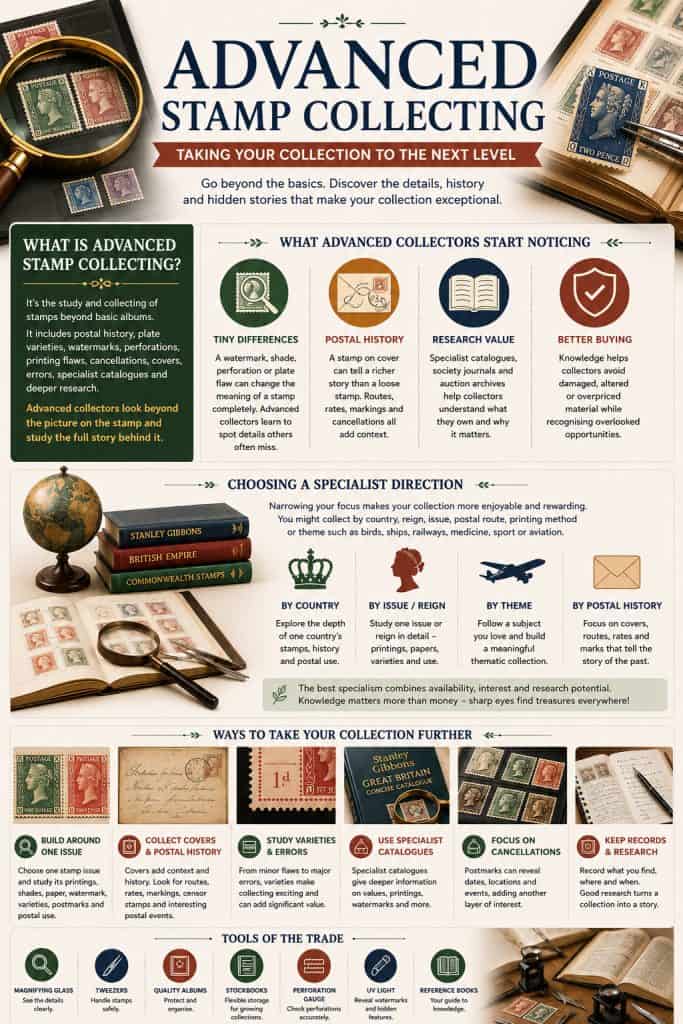
Advanced stamp collecting is the study and collecting of stamps beyond basic country, theme or album collecting. It often includes postal history, plate varieties, watermarks, perforations, printing flaws, cancellations, covers, errors, specialist catalogues and deeper research.
In simple terms, advanced collectors look beyond the picture on the stamp and study the full story behind it.
When Advanced Stamp Collecting Becomes More Interesting
Every collector reaches a point where ordinary sorting no longer feels quite enough.
You may still enjoy filling album spaces, yet the real excitement starts coming from the odd details. Perhaps you find two stamps that look identical until you notice a different perforation. Maybe a cheap cover suddenly becomes interesting because of its route, cancel or wartime marking. Alternatively, you may discover that a tiny printing flaw turns a common stamp into something worth researching.
Advanced stamp collecting rewards curiosity. It suits people who enjoy puzzles, history, design, geography and detective work. Better still, it does not always require expensive stamps. In many cases, knowledge matters more than money.
That is one of the great pleasures of the hobby. A collector with a sharp eye can sometimes find overlooked material in ordinary boxes, club books, online lots and dealer stock.
What Advanced Collectors Start Noticing
Ask an experienced stamp collector what changed as their collection developed and they will rarely mention buying rarer stamps.
Instead, they usually talk about seeing things they once overlooked.
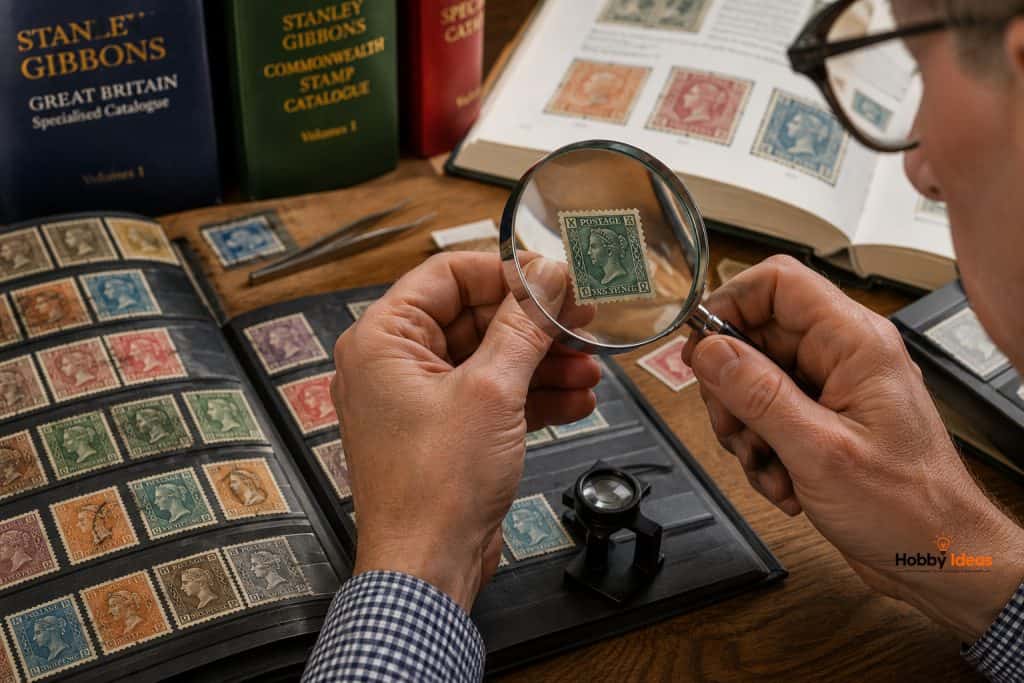
A watermark that seemed unimportant suddenly becomes the key to identifying a stamp correctly. A tiny difference in perforation reveals an entirely different printing. A faint plate flaw, almost invisible at first glance, turns an ordinary stamp into something worth investigating further.
The same change often happens with postal history.
Many beginners focus on stamps themselves, yet advanced collectors frequently become fascinated by the envelopes, postcards and covers that carried them. A stamp on cover can reveal where it travelled, how much postage was paid, which route it followed and even the historical circumstances surrounding its journey. What first appears to be a worn old envelope can sometimes tell a richer story than the stamp attached to it.
As knowledge grows, research becomes part of the hobby too.
Specialist catalogues, society journals, auction archives and reference books stop being intimidating and start becoming valuable tools. Collectors begin connecting information, comparing examples and understanding why certain items matter. The process feels less like sorting stamps and more like solving a historical puzzle.
Perhaps the biggest change of all appears when buying material.
Experienced collectors often purchase fewer items than beginners. However, they usually buy more carefully. They know what to look for, what to avoid and where hidden opportunities might exist. Rather than chasing quantity, they focus on adding pieces that genuinely improve the collection.
That shift in perspective is often the moment stamp collecting becomes truly rewarding. The hobby stops being about accumulating stamps and starts becoming about understanding them.
Choosing A Specialist Direction
One of the biggest steps in advanced stamp collecting involves narrowing your focus.
That may sound restrictive, yet it often makes the hobby more enjoyable. A general worldwide collection can become overwhelming because there is always more to buy. However, a focused collection gives you a clear purpose.
Some collectors specialise by country. Others choose one reign, one issue, one postal route, one printing method or one historic event. Meanwhile, thematic collectors may build serious collections around subjects such as birds, ships, railways, medicine, sport or aviation. In the UK, there are a huge number of British stamp collectors.
A general catalogue helps, yet a specialist catalogue often reveals deeper information on varieties, printings, shades and postal use. The Stanley Gibbons Collect British Stamps Catalogue has become a standard reference on many collectors’ desks and provides an excellent starting point for anyone looking to take their knowledge beyond the basics.
The best specialism usually combines availability, interest and research potential. For example, British stamps offer plenty of depth through watermarks, plate numbers, phosphor bands, controls and postal history. Commonwealth stamps provide rich variety and historical context. Local postal history can also become deeply rewarding, especially when you connect covers to towns, villages, businesses or events.
If you are still building confidence, our beginner guide to stamp collecting gives a useful foundation before moving into specialist areas.
Every Collection Eventually Finds Its Own Direction
One of the most interesting things about advanced stamp collecting is that collectors rarely end up where they expected.
A person who starts by collecting British commemoratives may suddenly become fascinated by Victorian postal history. Someone researching one stamp issue may discover an unexpected interest in printing varieties. Meanwhile, a collector who simply enjoys attractive designs might find themselves building an entire collection around aviation, wildlife or maritime history.
The deeper you go into the hobby, the more connections you begin to notice.
A stamp is no longer just a stamp. It becomes part of a larger story. A postmark leads to a place. A cover reveals a journey. A watermark identifies a different printing. An unusual shade raises new questions. Before long, one discovery leads naturally to another.
This is why many advanced collections become increasingly focused over time.
Rather than trying to collect everything, experienced collectors often follow their curiosity. They build around subjects that genuinely interest them, whether that means studying one stamp issue in extraordinary detail, exploring the postal history of a local town, researching wartime mail routes or documenting printing varieties across an entire series.
The collection gradually develops its own identity.
In many ways, that is the point where stamp collecting becomes most rewarding. You stop asking, “What stamps do I need next?” and start asking, “What story am I trying to tell?”
The answer will be different for every collector, which is precisely what makes the hobby so endlessly fascinating.
Why Postal History Changes Everything
Many collectors begin with stamps, then eventually discover covers.
At first, an envelope may look less tidy than a loose stamp. It takes up more space. It may show creases, handwriting, marks and uneven edges. Yet those details often make it more interesting.
A stamp on cover shows real postal use. It can reveal the sender, destination, date, route, rate and sometimes even the circumstances behind its journey. A wartime censor mark, a redirected address or an unusual rural postmark can transform an ordinary item into something full of character.
Postal history also brings local collecting to life. A cover from your town, village or county can connect directly with real places and people. Therefore, even modest material can become highly meaningful when it fits a focused collection.
This is where advanced stamp collecting starts feeling less like accumulation and more like historical investigation.
Errors, Varieties And The Joy Of Looking Closely
Errors and varieties attract many advanced collectors because they add excitement to the hunt.
Some errors look dramatic. Missing colours, inverted centres and major printing mistakes can attract serious attention. However, many varieties appear much more quietly. A small plate flaw, retouch, broken frame line or colour shift may need a magnifier and patience.
That is part of the appeal.
Advanced collectors train their eyes. They compare examples. They study catalogues. They learn which flaws matter and which ones simply reflect normal printing variation.
If this side of the hobby appeals to you, our article on rare stamp errors explores some of the mistakes and varieties that make stamp collecting so addictive.
Many collectors begin with a simple magnifier. However, one of the most useful tools I have added to my own collecting desk is a digital microscope for stamp collecting. Being able to enlarge perforations, postmarks, plate flaws and overprints on a computer screen makes identification and research far easier, especially when comparing similar stamps.
A Practical Advanced Collector’s Toolkit
Advanced stamp collecting does not require a room full of equipment. However, a few well-chosen tools make identification, storage and research much easier.
🔍 Magnifier
A good magnifier helps you inspect perforations, printing flaws, repairs, cancellations and tiny design details that often go unnoticed.
📏 Perforation Gauge
Perforation differences can identify separate printings, varieties and catalogue numbers, making this one of the most useful specialist tools.
💧 Watermark Detection
Watermarks often provide the key to identifying a stamp correctly. Many collectors use a simple black watermark tray and watermark fluid, while others rely on suitable lighter fluid as a traditional and inexpensive alternative.
📚 Specialist Catalogue
A general catalogue helps, yet a specialist catalogue often reveals deeper information on varieties, printings, shades and postal use.
Collector’s Tip: Knowledge usually provides a bigger advantage than expensive equipment. Many advanced collectors build remarkable collections with little more than a magnifier, a good catalogue and plenty of curiosity.
How To Research A Stamp Properly
Good research turns advanced stamp collecting into a far richer hobby.
Start with the obvious details. Identify the country, issue date, denomination, design and condition. Then move deeper. Check watermark, perforation, paper type, shade and any visible flaws. If the stamp remains on cover, note the date, postmark, address, rate and any transit or receiving marks.
Next, compare your item with catalogue descriptions and trusted reference material. Do not rely on one source if something looks unusual. Auction archives, specialist society publications and collector forums can all help, although you should treat online claims with care.
For serious research, the Royal Philatelic Society London provides access to one of the most respected philatelic organisations in the world and offers useful routes into deeper study.
Finally, record what you discover. A collection becomes far more valuable to you when each item carries notes. Even a simple spreadsheet can transform loose information into a proper collecting record.
Condition Still Matters
Advanced collectors often care more about detail than perfection, yet condition still matters.
A rare postmark, scarce variety or important cover can remain desirable with faults. However, damaged material needs honest assessment. Thins, tears, heavy creases, clipped perforations, fading, toning and repairs can all affect collectability.
Therefore, always inspect carefully before buying. Use a magnifier. Check the back. Look at the perforations. Examine hinges, gum and any suspiciously bright colours. If a stamp looks too good to be true, slow down.
Experienced collectors do not rush because rushed buying often leads to expensive mistakes.
Advanced Stamp Collecting Questions
As collectors move beyond the basics, the same questions tend to arise. Here are some of the most common answers.
Do I Need Expensive Stamps?
No. Many advanced collections focus on research, postal history, varieties, postmarks or local material rather than high catalogue values. Knowledge often matters far more than spending power.
Should I Specialise?
Eventually, yes. A clear focus helps you buy better material, research more deeply and build a collection with a stronger sense of purpose and direction.
Are Covers Worth Collecting?
Absolutely. Covers often reveal postal rates, routes, markings and social history that loose stamps cannot show. In many cases, they tell a far richer story than the stamp itself.
How Do I Avoid Costly Mistakes?
Use catalogues, compare examples, inspect condition carefully and take your time. Most experienced collectors learn that patience and research are usually the best investments they can make.
Buying Better Material
Advanced stamp collecting does not mean buying everything that looks impressive.
In fact, it often means buying less.
A focused collector can ignore hundreds of tempting lots because they do not fit the collection. That discipline saves money and creates a stronger result.
Before buying, ask a simple question: does this item improve the collection or merely add bulk?
Good material adds knowledge, fills a genuine gap or strengthens a theme. Poor material simply takes up space. Therefore, advanced collectors often prefer one carefully chosen cover, variety or study item over a large mixed lot of ordinary stamps.
That does not mean mixed lots have no value. They can still produce discoveries. However, they work best when you know what you are looking for.
Building A Collection With A Purpose
The most satisfying advanced collections usually have a clear idea behind them.
That idea might centre on one stamp issue, one postal route, one town, one reign, one theme or one historical moment. Once you define the purpose, every new item has a role to play.
This approach also makes the collection more enjoyable to revisit. Instead of flipping through pages of unrelated stamps, you follow a story. You see development, variation and context. You notice gaps. You understand why each item matters.
Advanced stamp collecting becomes especially rewarding when your collection starts teaching you something every time you open it.
Where Advanced Stamp Collecting Can Lead
The beauty of advanced stamp collecting is that there is no single destination. As your knowledge grows, your collection often develops its own personality and direction.
📖 A Research Collection
Some collectors become researchers as much as collectors. They study one issue, postmark, route or variety in great detail, recording discoveries and building knowledge that may not exist elsewhere. These collections often become valuable references for other collectors.
🏆 An Exhibition Collection
Exhibition collections tell a story. Every stamp, cover and supporting item has a purpose. Strong presentation, careful research and clear explanations transform a collection into something that can be shared and judged at competitive level.
✉️ A Local Postal History Collection
Many collectors become fascinated by the postal history of their own town, county or region. Covers, postmarks and correspondence create a direct connection to local people, businesses and events, often revealing stories that have long been forgotten.
🔬 A Specialist Reference Collection
Some collectors focus on understanding every variation within a stamp issue. Shades, papers, watermarks, perforations, plate flaws and printings all become part of a detailed study collection that helps identify and compare future discoveries.
The Key Point: Advanced collectors rarely stop at simply owning stamps. Instead, they build collections that answer questions, tell stories and deepen their understanding of postal history and philately.
Final Thoughts On Advanced Stamp Collecting
Advanced stamp collecting is not about making the hobby more complicated for the sake of it.
Instead, it opens the door to a deeper and more rewarding way of collecting.
Once you begin studying postal history, varieties, watermarks, postmarks and specialist areas, stamps stop looking like small printed labels. They become evidence. They become design objects. They become pieces of communication, travel, politics, commerce and personal history.
That is why advanced stamp collecting remains such a satisfying hobby. There is always another detail to spot, another cover to interpret and another question to answer.
You do not need to own the rarest stamps in the world to become a better collector. You simply need curiosity, patience and the willingness to look more closely.
And often, that is where the real pleasure begins.
Affiliate Disclosure: HobbyIdeas.co.uk participates in the Amazon Associates Programme. This means we may earn a small commission if you purchase through links on this page, at no additional cost to you. We only recommend products that are relevant to the hobby or activity being discussed.