


Most people assume postage stamps must be perfect; many don’t realise rare stamp errors exist. After all, they are official items produced in huge quantities under strict quality control. However, stamp collectors know a surprising secret. Sometimes the mistakes become far more interesting than the stamps that came out exactly as intended.
Rare stamp errors have fascinated collectors for generations. In fact, some of the world’s most valuable and famous stamps owe their reputation entirely to a printing mistake, design flaw, or production error. While most errors never leave the printing works, a few slip through and enter circulation. When that happens, collectors start paying attention.
Whether you already collect stamps or simply enjoy stories of hidden treasures, stamp errors offer a fascinating glimpse into the unexpected side of philately.
What Are Stamp Errors?
Stamp errors occur when something goes wrong during the design, printing, perforating, or production process. Sometimes the mistake appears dramatic and obvious. At other times, it takes a trained eye and a magnifying glass to spot the difference.
Collectors generally separate true errors from minor flaws and varieties. A genuine error usually involves a significant production mistake that escaped into public circulation. Consequently, these examples often become highly desirable because so few exist.
If you are new to the hobby, our guide on how to start stamp collecting explains the basics and provides a useful introduction to the world of philately.
The Inverted Jenny: One Of The World’s Most Famous Rare Stamp Errors
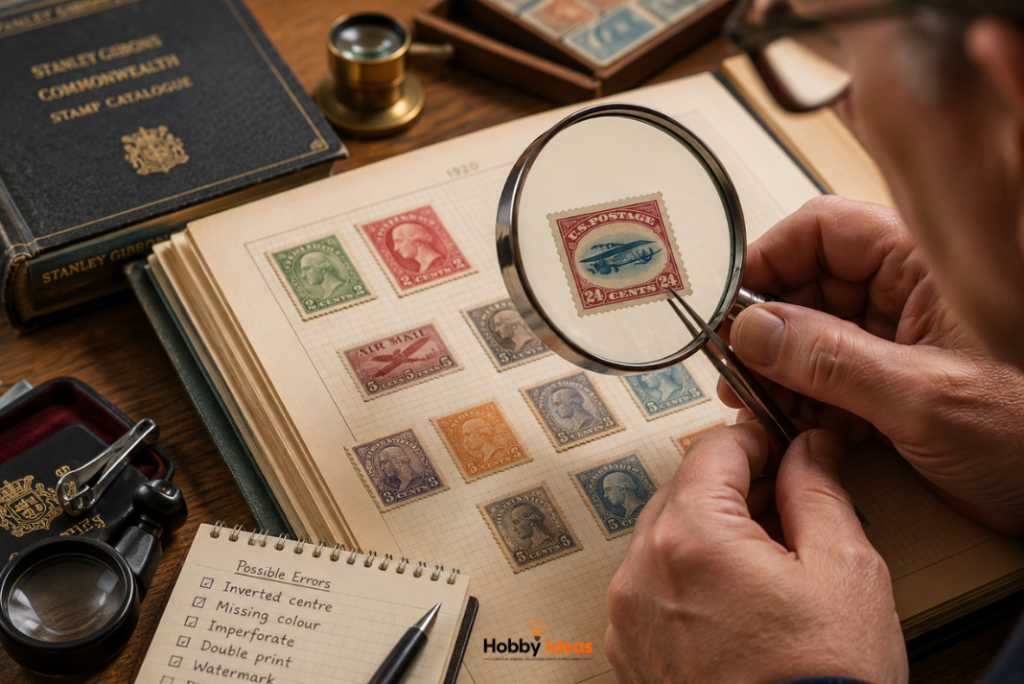
No discussion of stamp errors would feel complete without mentioning the legendary Inverted Jenny.
Issued in the United States in 1918, this stamp featured a Curtiss JN-4 aeroplane. Unfortunately for the printers, the aircraft appeared upside down in a small number of sheets.
The mistake occurred because the design required two separate printing stages. During production, one sheet accidentally passed through the press the wrong way round. As a result, the blue aeroplane printed upside down within the red frame.
Only one sheet of 100 reached the public. Today, individual examples can sell for hundreds of thousands of pounds, while the finest examples have achieved prices exceeding one million dollars.
Missing Colours Create Dramatic Errors
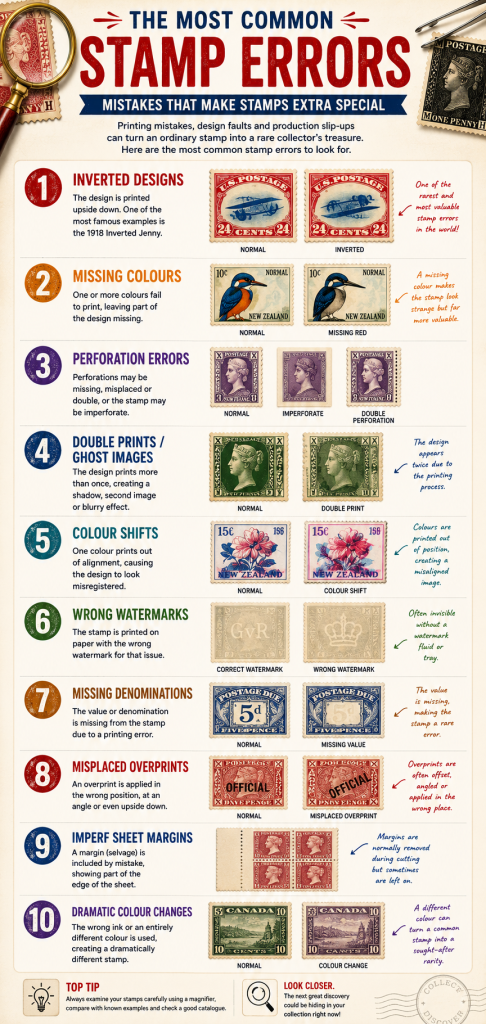
Modern stamps often require multiple colours printed in separate stages. Therefore, if one stage fails, the result can look remarkably strange.
Imagine a stamp showing a bright red telephone box. Now imagine the red ink never printed. Suddenly the design looks incomplete, unusual, and highly collectible.
These missing colour errors often catch collectors’ attention because they are easy to spot. Furthermore, they create a dramatic visual difference between the normal stamp and the error version.
Upside-Down Centres
The Inverted Jenny may be the most famous example, yet it is far from the only stamp to feature an upside-down centre.
During the nineteenth and early twentieth centuries, many stamps required separate printing passes for different parts of the design. Consequently, mistakes occasionally occurred when sheets were loaded incorrectly.
An upside-down portrait, emblem, aircraft, or scene instantly transforms an ordinary stamp into something far more intriguing. Collectors have chased these dramatic errors for decades.
When Perforations Go Missing
Most collectors rarely think about perforations until they disappear.
Perforations allow stamps to separate neatly from one another. However, if a sheet bypasses the perforating machine entirely, every stamp remains joined together.
These imperforate errors often stand out immediately. Although some were produced deliberately for collectors, genuine accidental examples remain highly desirable.
In many cases, a normal stamp worth pennies suddenly becomes worth significantly more because someone forgot one crucial production step.
Double Prints and Ghost Images
Sometimes a sheet passes through the printing press twice.
When that happens, parts of the design may appear duplicated, shifted, or blurred. Collectors call these double prints.
The effect can range from subtle shadows to obvious duplicate images. In some cases, lettering appears twice. In others, portraits seem to float slightly away from their original position.
These unusual appearances often attract collectors because they reveal exactly how the printing process went wrong.
Colour Shift Errors
Colour shift errors occur when one colour layer prints slightly out of position.
As a result, the stamp can appear strangely misaligned. Faces may look distorted, buildings may appear doubled, and text may drift away from its intended location.
Although some shifts remain minor, dramatic examples can create highly unusual visual effects. Consequently, collectors often search through large numbers of stamps hoping to discover one particularly striking example. Colour shifts are one of the few easily recognisable rare stamp errors.
Wrong Watermarks and Hidden Surprises
Some of the most fascinating stamp errors remain almost invisible.
Watermarks sit within the paper itself and often require special equipment or fluid to reveal them. Occasionally, printers use the wrong paper stock, creating stamps with unexpected watermarks.
To the casual observer, the stamp appears perfectly normal. However, experienced collectors know that hidden differences can sometimes transform a common stamp into an important rarity.
British Stamp Errors Worth Knowing About
British philately has produced its own share of fascinating mistakes.
One famous example involves the 1971 Christmas issue where some stamps appeared with missing phosphor bands. Other British errors include missing colours, imperforate examples, and unusual printing varieties that collectors continue to study today.
Many remain affordable and obtainable, which makes them particularly appealing to newer collectors. While they may never reach Inverted Jenny prices, they still offer an exciting glimpse into the unexpected side of stamp production.
How Collectors Spot Stamp Errors
Most stamp errors do not reveal themselves immediately. Therefore, collectors often rely on patience and careful observation.
- Magnifying glasses
- Stamp tongs
- Stockbooks
- Reference catalogues
- Good lighting
- Watermark detectors
More importantly, collectors compare stamps against known examples. A tiny difference may seem insignificant until it matches a documented error listed in a specialist catalogue.
The Stanley Gibbons catalogue remains one of the most respected resources for identifying British and Commonwealth stamp varieties.
Many stamp errors remain surprisingly difficult to spot without the right tools. While some mistakes stand out immediately, others require close inspection before the difference becomes obvious. The VISION AID 30X 10X Hands-Free Magnifying Glass with Bright LED Lights makes examining fine details much easier. Because it works as both a handheld and desktop magnifier, it suits collectors who enjoy comparing stamps, checking perforations, studying printing flaws, or searching for hidden varieties within larger collections.
Are Stamp Errors Always Valuable?
Not necessarily.
Rarity alone does not guarantee value. Demand matters too.
A dramatic error with strong collector demand may become highly valuable. Meanwhile, a minor printing variety that attracts little interest may remain relatively inexpensive.
Condition also plays a huge role. Collectors generally prefer examples with good centring, strong colours, and minimal damage.
Even so, stamp errors often provide excitement that goes beyond simple monetary value. Many collectors enjoy the detective work involved in discovering and identifying unusual examples.
Could You Find a Stamp Error in an Old Collection?
Surprisingly, yes.
Many collectors inherit albums, boxes, and stockbooks without fully examining the contents. As a result, unusual varieties sometimes remain hidden for decades.
While discovering an Inverted Jenny remains extremely unlikely, lesser-known errors still turn up in family collections, charity shop purchases, and mixed lots bought at fairs and auctions.
That possibility adds an element of treasure hunting to the hobby. Every album contains potential surprises, and every page offers another opportunity to spot something unusual.
Finding stamp errors often involves comparing large numbers of stamps side by side. Therefore, keeping a collection organised can make a surprising difference. The Leuchtturm Stamp Collecting Album Stockbook provides a practical way to sort, store, and review stamps while searching for unusual varieties. With 64 white A4 pages and clear display strips, it allows collectors to compare examples easily and keep potential discoveries safe from damage.
Why Stamp Errors Continue to Fascinate Collectors
Stamp collecting combines history, art, geography, and detective work. Stamp errors add another layer entirely.
They remind us that even carefully controlled processes sometimes go wrong. Yet those mistakes often become more memorable than the stamps that printed perfectly.
Perhaps that explains why collectors remain fascinated by them. A rare error tells a story. It reveals a moment when something unexpected happened, escaped detection, and survived long enough for future generations to discover.
If you enjoy hobbies that combine history, curiosity, and the thrill of finding hidden treasures, you may also enjoy exploring our guide to collecting hobbies for curious minds.
For many philatelists, that sense of discovery remains one of the most rewarding parts of the hobby. After all, the next rare stamp error could be sitting quietly in an old album, waiting for someone to notice it.
Disclosure: Some links on HobbyIdeas are affiliate links. If you buy through these links, we may earn a small commission at no extra cost to you. We only recommend products we believe are useful, relevant, and good value for hobbyists.