

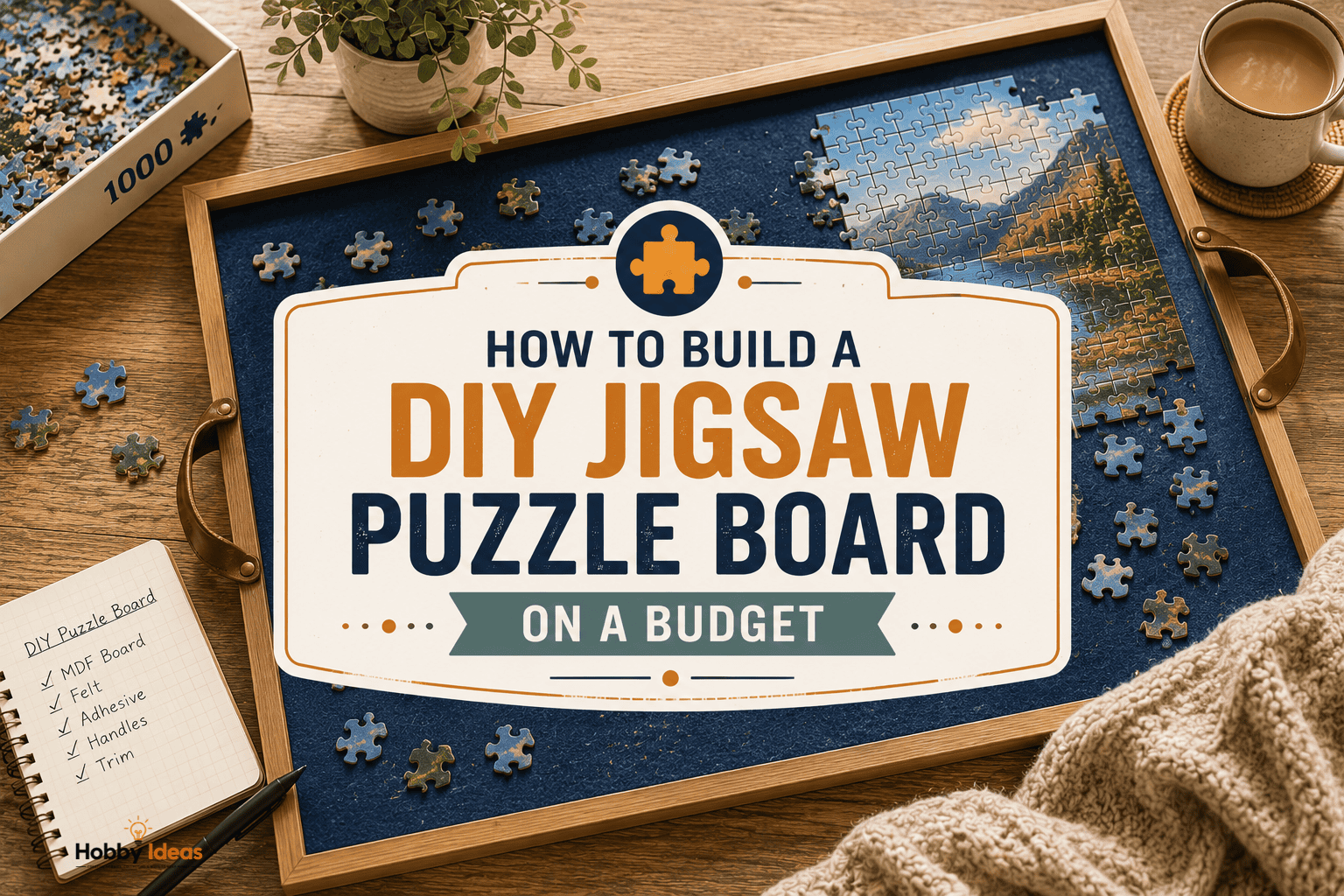
A DIY jigsaw puzzle board is one of the simplest ways to enjoy jigsaw puzzles without taking over your dining table. For puzzle lovers living in smaller homes, flats or shared spaces, a homemade puzzle board can provide the perfect storage solution while costing far less than many commercial alternatives.
However, many puzzle lovers face the same problem. Where do you put a half-finished puzzle when you need the dining table back?
In smaller UK homes, flats, shared houses and busy family spaces, leaving a 1,000-piece jigsaw spread across a table for days simply does not work. Pets jump up. Children move pieces. Dinner needs serving. Guests arrive. Before long, the puzzle goes back in the box and the hobby quietly disappears.
That is where a DIY jigsaw puzzle board can make all the difference.
Many people discover jigsaws while looking for relaxing hobbies for adults that provide a break from screens and everyday distractions.
DIY Jigsaw Puzzle Board Quick Facts
Typical Cost
£15–£30
Build Time
30–60 Minutes
Skill Level
Beginner Friendly
Best Material
MDF or Plywood
Best For
Small Homes & Flats
Storage
Under Sofa or Bed
Why Build Your Own Puzzle Board?
A homemade puzzle board solves the biggest problem many jigsaw fans face: space.
Commercial puzzle boards can look smart, but they often cost far more than many beginners want to spend. Meanwhile, a DIY version gives you control over the size, finish and storage method.
Why it works so well
🧩 Keep puzzles safe, move half-finished puzzles without breaking them apart.
🏠 Save space, ideal for smaller homes, flats and shared living areas.
💷 Spend less, build one for much less than many shop-bought puzzle boards.
🛋️ Store it easily, slide it under a sofa, under a bed or behind furniture.
🎨 Customise the finish, choose felt colour, trim style and board size to suit your home.
The Space Problem: Why People Give Up on Jigsaws
Jigsaws sound wonderfully simple until they take over the only useful table in the house.
A 500-piece puzzle may fit neatly on a coffee table. However, a 1,000-piece puzzle often needs a much larger surface. As a result, many people start with enthusiasm, then quickly realise the puzzle has nowhere to live between sessions.
This becomes especially frustrating in flats, small terraces, shared homes and busy family houses. The dining table needs clearing. The coffee table needs using. The cat decides the corner pieces look interesting. Then, suddenly, a relaxing hobby starts feeling like clutter.
A simple DIY jigsaw puzzle board changes that. Instead of dedicating a whole table to one puzzle, you create a moveable surface that can appear when needed and disappear when life gets busy.
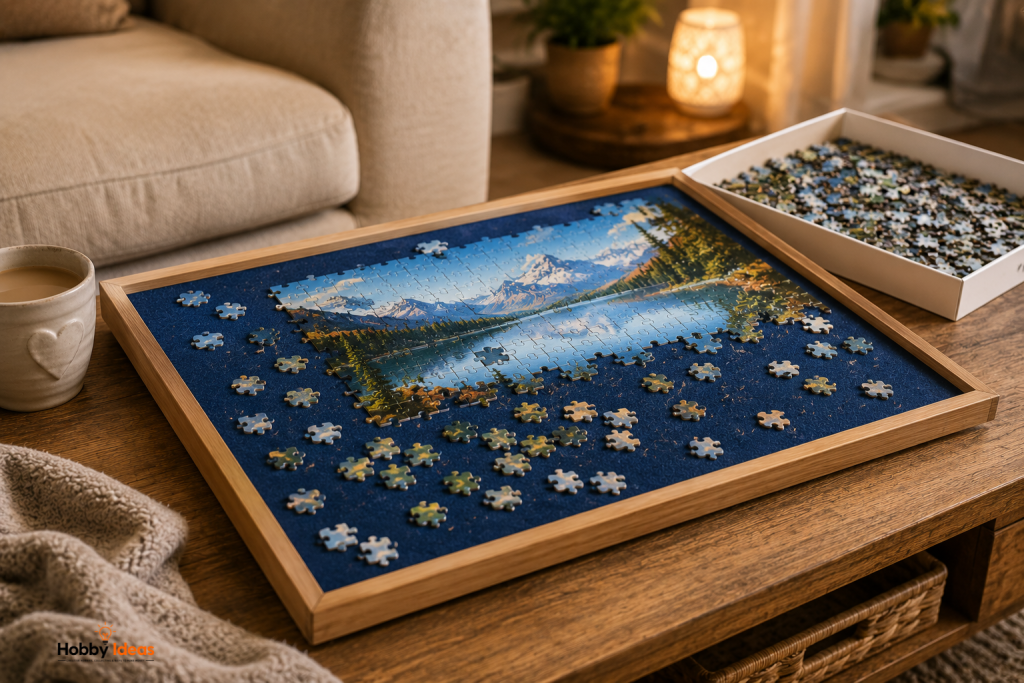
What Wood Should I Use for a DIY Puzzle Board?
For most beginners, MDF offers the simplest and most affordable option.
MDF gives you a smooth, flat surface, which works well for jigsaws. It is also widely available in UK DIY shops and often comes in handy pre-cut sizes. However, it can feel a little heavy if you choose a thick sheet.
Plywood also works well, especially if you want something lighter and stronger. It usually costs more than MDF, but it can make a more durable board if you plan to move it around regularly.
Hardboard can work for smaller puzzles, although it may flex too much for larger ones.
Best Beginner Choice
For a simple DIY jigsaw puzzle board, choose a lightweight sheet of MDF around 6mm thick. It should feel sturdy enough to support the puzzle while remaining light enough to move around the room.
Materials You Will Need
You can keep this project very simple. In fact, the most basic version only needs a board, felt and adhesive.
Shopping List
🪵 MDF board, the main puzzle surface.
🧶 Felt fabric, helps prevent pieces sliding around.
🧴 Spray adhesive, secures the felt to the board.
🪚 Sandpaper, smooths rough edges.
🧰 Optional handles, make moving the board easier.
📏 Optional wooden trim, creates a raised edge to stop pieces falling off.
Before buying materials, it can be helpful to compare the different properties of MDF, plywood and hardboard. The B&Q DIY advice centre contains useful guidance for beginners planning simple home projects.
If you plan to trim felt or make precise measurements, a self-healing cutting mat can help protect work surfaces while providing a convenient grid for accurate cutting. They are particularly useful if you enjoy other craft and DIY projects as well.
How to Build Your DIY Jigsaw Puzzle Board
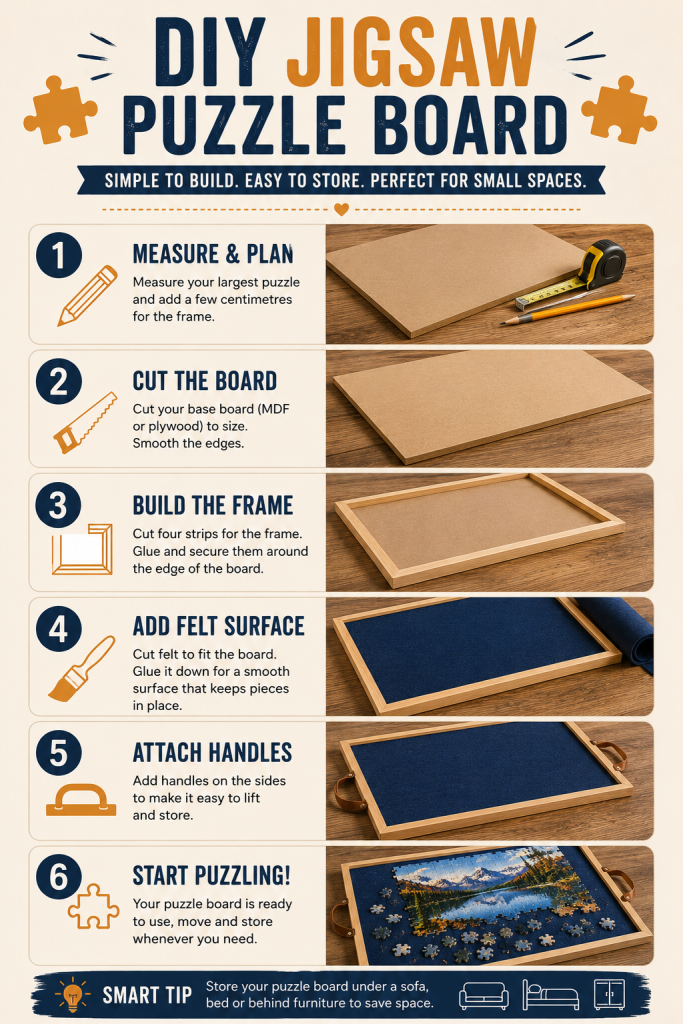
The good news is that this project requires very little DIY experience. If you can measure, sand and glue, you can build a puzzle board that will last for years.
Before You Start
Measure the largest puzzle you normally build
Choose where you plan to store the board
Check it will fit under your sofa or bed if that is your intended storage space
Allow a little extra room around the edges for sorting pieces
Step 1: Choose the Right Size Board
A standard 1,000-piece jigsaw puzzle usually needs a surface measuring around 70cm x 50cm. However, many puzzlers appreciate extra space around the edges for sorting pieces and keeping box lids nearby.
If in doubt, go slightly larger than you think you need.
Common Board Sizes
🧩 500-piece puzzles – Around 60cm × 45cm
🧩 1,000-piece puzzles – Around 80cm × 60cm
🧩 1,500-piece puzzles – Around 90cm × 70cm
🧩 2,000-piece puzzles – Around 110cm × 80cm
Step 2: Smooth the Edges
Once you have your board cut to size, lightly sand all edges and corners.
This only takes a few minutes, yet it makes the finished board look neater and prevents rough edges catching clothing, furniture or skin.
You do not need a perfectly polished finish. A quick smoothing pass is usually enough.
Step 3: Apply the Felt Surface
The felt layer is what transforms a simple board into a practical puzzle station.
Lay the felt flat over the board and trim it slightly oversized. Apply spray adhesive evenly across the surface, then carefully smooth the felt into place.
Work slowly from one side to the other to avoid wrinkles or bubbles.
Why Felt Works So Well
Felt provides gentle grip. Puzzle pieces stay where you place them rather than sliding across a smooth wooden surface every time the board moves.
Step 4: Add Optional Raised Edges
If you regularly move your puzzles, consider attaching thin strips of wooden trim around the perimeter.
These raised edges help prevent loose pieces falling off when transporting the board from room to room.
Many commercial puzzle boards use this exact approach.
Step 5: Fit Handles (Optional)
Simple drawer handles fitted to either side make larger boards much easier to move.
This step is particularly useful if you enjoy 1,500-piece or 2,000-piece puzzles, where the completed board can become surprisingly heavy.
Finished!
Your DIY jigsaw puzzle board is now ready to use.
You should have a lightweight, portable puzzle surface that costs a fraction of many commercial alternatives and can be stored neatly when not in use.
DIY vs Commercial Puzzle Boards
DIY Puzzle Board
💷 Usually £15–£30
📏 Custom size
🎨 Custom finish
🏠 Designed for your storage space
🧩 Easy to repair or modify
Commercial Puzzle Board
💷 Often £50–£120+
📏 Fixed dimensions
🎨 Limited styles
🏠 May not suit your available space
🛒 Ready to use immediately
Where to Store Your Puzzle Board in a Small Home
The beauty of a DIY jigsaw puzzle board is that it allows you to enjoy puzzles without dedicating a permanent table to the hobby.
Once you have finished for the day, simply move the board and continue later exactly where you left off.
Smart Storage Ideas
🛋️ Under a Sofa
One of the most popular solutions. Many sofas provide enough clearance for a slim puzzle board, keeping your project hidden but easily accessible.
🛏️ Under a Bed
Ideal for larger boards and long-term projects. Most beds offer plenty of storage space without disturbing your puzzle.
🚪 Behind a Wardrobe
A simple solution if you have unused space behind furniture. Perfect for occasional puzzlers who want to keep things out of sight.
📦 Inside a Storage Box
Protects the puzzle from dust while keeping loose pieces secure. A great option in homes with children or pets.
🪑 Beside a Bookcase
Many slim boards fit neatly between furniture and walls, making use of otherwise wasted space.
🏠 Spare Cupboard
If you have a hallway cupboard or utility cupboard, it can provide an excellent dust-free storage location.
Another useful addition for keen puzzlers is a set of puzzle sorting trays. These allow you to organise edge pieces, colours and specific sections of the puzzle, making larger projects much easier to tackle without cluttering the table.
How to Make Your Puzzle Board Look More Attractive
If your puzzle board is likely to be visible around the home, a few simple upgrades can make it look far more attractive. Moreover, these finishing touches can help it blend naturally with your existing décor.
For example, you could paint the edges to match your furnishings, choose felt in a colour that complements the room or add decorative trim around the outside. As a result, the board can look more like a piece of furniture than a practical hobby project.
Furthermore, some puzzle enthusiasts add small brass handles or furniture feet to create a more premium appearance. Consequently, even a budget DIY jigsaw puzzle board can look surprisingly professional.
If you enjoy personalising projects like this, you may also enjoy exploring other creative hobbies for adults that combine practical skills with a satisfying finished result.
Budget Upgrade Idea
A coat of furniture paint around the board edges and a quality felt surface can make a £20 DIY puzzle board look surprisingly professional.
Can You Build a Puzzle Board for Under £20?
Yes, in many cases you can.
If you already own basic tools, a simple MDF board, felt sheet and adhesive often come in well below the cost of commercial alternatives.
Prices vary depending on location and materials, although many DIY puzzle boards cost between £15 and £30 to complete.
Typical DIY Budget
🪵 MDF board: £8–£15
🧶 Felt fabric: £3–£8
🧴 Adhesive: £3–£6
🪚 Sandpaper: £1–£3
Total: Approximately £15–£30
🧩 DIY Jigsaw Puzzle Board FAQs
What wood should I use for a DIY puzzle board?
MDF is usually the best choice for beginners because it is affordable, widely available and provides a smooth, flat surface for puzzle pieces. Plywood is another excellent option if you prefer something lighter.
How big should a puzzle board be?
For most 1,000-piece puzzles, a board around 80cm × 60cm works well. If you enjoy larger puzzles or like extra sorting space, choose a slightly bigger board.
Can I slide a puzzle board under a sofa?
Yes. Many people specifically build puzzle boards thin enough to fit beneath sofas or beds. Measure your available clearance before buying materials.
Is MDF or plywood better?
MDF is cheaper and smoother, while plywood is lighter and often more durable. Both work well, although MDF is usually the simplest choice for first-time builders.
How much does a DIY jigsaw puzzle board cost?
Most homemade puzzle boards cost between £15 and £30 depending on size and materials. That is significantly cheaper than many commercial puzzle boards.
Final Thoughts
You do not need a dedicated hobby room or a permanent puzzle table to enjoy jigsaws.
A simple DIY jigsaw puzzle board allows you to build puzzles whenever you have time, then store them safely when life gets busy.
Better still, the project is inexpensive, beginner friendly and highly customisable. Whether you live in a small flat, a busy family home or simply want a more practical way to enjoy puzzles, a homemade puzzle board could be one of the most useful hobby projects you undertake this year.
Most importantly, it removes one of the biggest barriers to enjoying jigsaw puzzles: finding enough space to leave them unfinished.
Whether you are new to puzzles or simply looking for a fresh pastime, building a DIY puzzle board can be an excellent first step if you are wondering how to start a hobby that is affordable, relaxing and easy to enjoy at home.
Affiliate Disclosure: Some links in this article are affiliate links. If you choose to purchase through these links, HobbyIdeas may earn a small commission at no extra cost to you. We only recommend products, tools and resources that are relevant to the hobby being discussed and that we believe offer genuine value to our readers.