

The hobby tax threshold sounds like one of those dry financial phrases that instantly takes the fun out of making, collecting, selling, or creating. However, it matters if your hobby has started bringing in a little extra money.
Perhaps you sell handmade candles on Etsy. Maybe you occasionally list vintage finds on eBay. You might make greeting cards, grow plants, photograph pets, sell craft supplies, restore furniture, or clear a few boxes from the loft. Either way, recent headlines about online selling and HMRC have left many UK hobbyists wondering whether they now owe tax.
Thankfully, the answer is usually much less scary than the headlines suggest. HMRC has not introduced a brand-new “hobby tax”. Instead, online platforms now share more seller information with HMRC, which means casual sellers, crafters, collectors, and side-hustlers need to understand where the real rules sit.
This guide explains the hobby tax threshold in plain English, without panic, jargon, or unnecessary doom. It will help you understand the £1,000 trading allowance, the difference between selling personal items and trading for profit, and when a hobby starts looking more like a small business.
Why Hobbyists Are Suddenly Hearing About The Hobby Tax Threshold
In recent years, more people have started making money from hobbies. That is hardly surprising. Craft platforms, online marketplaces, social media, and simple payment apps have made it easier than ever to sell a handmade item, offer a casual service, or turn a weekend interest into extra income.
However, this has also created confusion. When people hear that platforms such as eBay, Etsy, Vinted, Airbnb, and similar services may report seller data to HMRC, it can sound as though anyone selling a few unwanted items suddenly needs an accountant.
That is not the case. Platform reporting does not automatically mean you owe tax. It simply means HMRC may receive information about some sellers who use online platforms. Therefore, the important question is not whether you sold something online. The important question is whether you traded for profit and whether your income crossed the relevant threshold.
What Is the UK Hobby Tax Threshold?
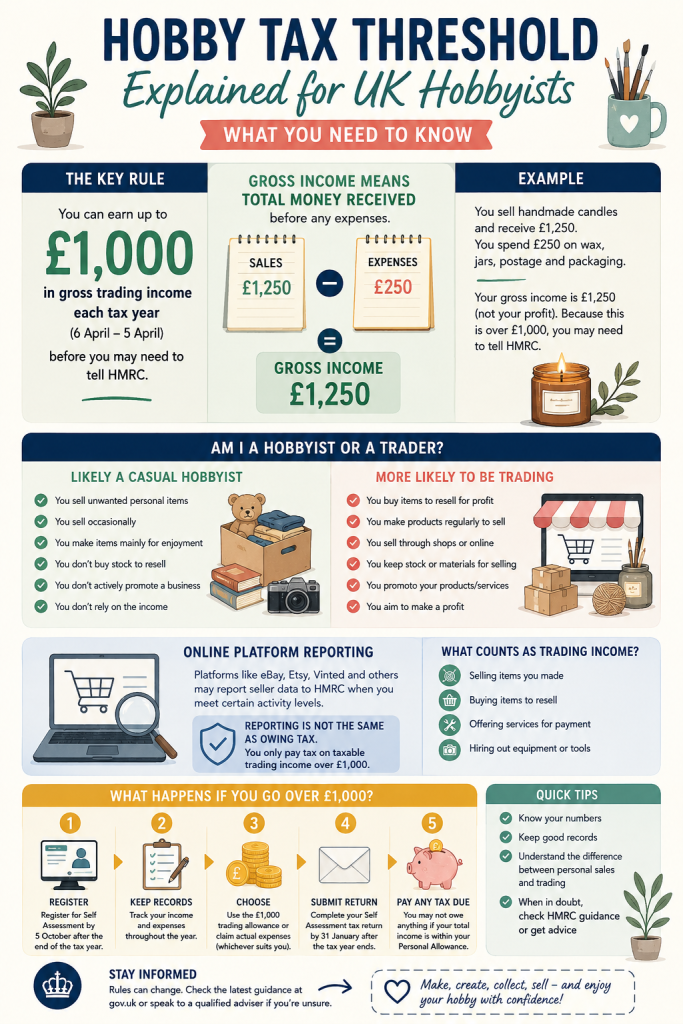
The UK hobby tax threshold generally refers to the £1,000 trading allowance. This allowance lets individuals earn up to £1,000 in gross trading income during a tax year without needing to tell HMRC in many cases.
The tax year runs from 6 April to 5 April. So, if your total gross income from hobby-based trading, casual services, or small side-hustle activity stays at £1,000 or below during that period, you may not need to register for Self Assessment for that income.
HMRC explains the trading allowance as a tax exemption of up to £1,000 a year for individuals with trading income, including self-employment, casual services such as gardening, and hiring out personal equipment. You can check the official HMRC guidance on tax-free allowances on property and trading income.
However, the key word here is gross. Gross income means the total money you receive before you deduct postage, materials, fees, packaging, tools, fuel, or other costs.
Why Gross Income Matters
This point catches many hobbyists out.
The hobby tax threshold does not look at your profit first. Instead, it looks at your gross income. That means HMRC cares about the total amount coming in before expenses.
For example, imagine you make handmade pottery. During the tax year, you sell £1,200 worth of pots, mugs, and small bowls. However, you also spend £400 on clay, £150 on glaze, and £100 on postage and packaging. Your actual profit may feel modest. Even so, your gross income has gone over £1,000.
At that point, you may need to tell HMRC, even if your final profit looks much lower.
That may feel annoying, but it also explains why simple record keeping matters. Once a hobby starts earning money, even small amounts, a notebook, spreadsheet, or accounting app can save a lot of stress later.
Hobbyist or Trader: What Is the Difference?
Not every sale counts in the same way. This is where many people get understandably confused.
If you sell your own unwanted personal items, such as old clothes, books, toys, DVDs, garden tools, or household bits, HMRC does not usually treat that as trading. You are simply clearing out things you already owned.
However, if you buy, make, source, or upcycle items with the intention of selling them for profit, that can look more like trading.
For example, selling your old coat on Vinted looks very different from buying ten coats at a car boot sale and listing them online for profit. Likewise, making one necklace for fun and selling it to a friend feels different from producing jewellery regularly under a brand name.
Signs You May Still Be a Casual Hobbyist
- You sell unwanted personal items from your home.
- You sell occasionally rather than regularly.
- You make crafts mainly for enjoyment.
- You do not buy stock specifically to resell.
- You do not run paid adverts or operate under a business brand.
- You do not rely on the income.
Signs Your Hobby May Look More Like Trading
- You buy items specifically to resell for profit.
- You make products regularly with the intention of selling them.
- You sell through a shop, brand, marketplace, or regular online presence.
- You keep stock, packaging, tools, or materials for selling.
- You promote your products or services actively.
- You repeat the activity often and aim to make money.
If you enjoy making items and want to understand the selling side more clearly, our guide to selling handmade crafts online gives a practical look at platforms, presentation, and beginner-friendly selling ideas.
Does Selling on eBay, Etsy or Vinted Mean You Owe Tax?
No, not automatically.
This is probably the biggest misunderstanding around the hobby tax threshold.
Online platforms can collect and share seller information with HMRC once certain reporting triggers apply. However, those reporting triggers do not create a tax bill by themselves. They simply mean the platform may pass information to HMRC.
For many casual sellers, this makes no difference at all. If you clear out old clothes, sell a few books, or pass on unwanted household items, you may still have no taxable trading income.
However, if you regularly buy items to resell, make products to sell, or provide services through online platforms, you should track your income carefully.
The Online Platform Reporting Rules in Simple Terms
Digital platform reporting has caused a lot of worry because it sounds dramatic. In practice, it mainly gives HMRC more visibility over people who earn money through online platforms.
Platforms may report seller data when sellers meet certain activity levels, such as making a higher number of sales or reaching a set value of sales during the reporting period. However, passing a platform reporting trigger does not automatically mean you have crossed the UK hobby tax threshold.
For example, you might sell 35 low-value personal items from your wardrobe and still have no trading activity. Alternatively, you might sell fewer items but clearly trade for profit. So, the facts matter more than the headline number.
The sensible approach is simple. Keep records, understand why you sold the items, and separate casual decluttering from profit-driven activity.
What About Collectors Who Occasionally Sell Items?
Collectors often sit in an interesting grey area because buying, swapping, upgrading, and occasionally selling can form part of the hobby.
For example, a stamp collector may sell duplicate stamps. A vinyl collector may move on records they no longer play. A fossil hunter may pass on spare display pieces. In many cases, occasional sales like this do not automatically turn a collector into a trader.
However, if you start buying collections specifically to split and resell for profit, the picture changes. At that point, the activity looks much more commercial.
Therefore, collectors should ask themselves a simple question: did I buy this mainly to enjoy, collect, or use, or did I buy it mainly to sell at a profit?
Can You Make Money From a Hobby Without Starting a Business?
Yes, up to a point.
Plenty of people earn small amounts from hobbies without building a full business. You might sell a few plants, offer occasional dog walking, take paid photos for a friend, sell duplicate collectables, or make a handful of craft items for a local fair.
The £1,000 trading allowance gives casual earners some breathing room. It recognises that not every small money-making activity needs full business-level admin.
However, once your activity grows, you need to treat it more seriously. That does not mean you have done anything wrong. In fact, it may mean your hobby has real potential. Many hobbies naturally grow beyond simple enjoyment. For example, baking has become a popular way to earn extra income through local orders, village markets and even honesty-box Bake Sheds. If you’re considering turning your baking into a small side income, our guide to how a home baking hobby can earn extra income explains how to get started while keeping the hobby enjoyable.
If you are exploring that idea, our broader guide on how to make money from hobbies looks at realistic ways to earn from creative, practical, outdoor, and collecting-based interests.
What Happens If You Go Over the £1,000 Hobby Tax Threshold?
If your gross trading income goes over £1,000 in a tax year, you may need to register for Self Assessment and tell HMRC about that income.
This does not always mean you will owe a large tax bill. Your final tax position depends on your total income, expenses, personal allowance, employment income, and individual circumstances.
Once you need to report the income, you may usually choose between using the trading allowance or claiming actual allowable expenses. The best option depends on your costs.
For example, if you spent very little to earn the income, the trading allowance may prove simpler. However, if materials, postage, tools, packaging, platform fees, and other allowable costs add up to more than £1,000, claiming actual expenses may make more sense.
A Simple Hobby Tax Threshold Example
Let us imagine you sell handmade candles as a weekend hobby.
- Total candle sales during the tax year: £950
- Wax, jars, fragrance oils, labels, and postage: £420
- Gross trading income: £950
Because your gross trading income stays under £1,000, you may not need to tell HMRC about that income, assuming no other reporting reason applies.
Now imagine your candles become popular at Christmas.
- Total candle sales during the tax year: £1,350
- Wax, jars, fragrance oils, labels, and postage: £650
- Gross trading income: £1,350
Although your actual profit may feel modest, your gross trading income has crossed the £1,000 threshold. Therefore, you may need to register for Self Assessment and report it.
What Records Should Hobby Sellers Keep?
Good records do not need to feel complicated. However, they should give you a clear picture of what came in and what went out.
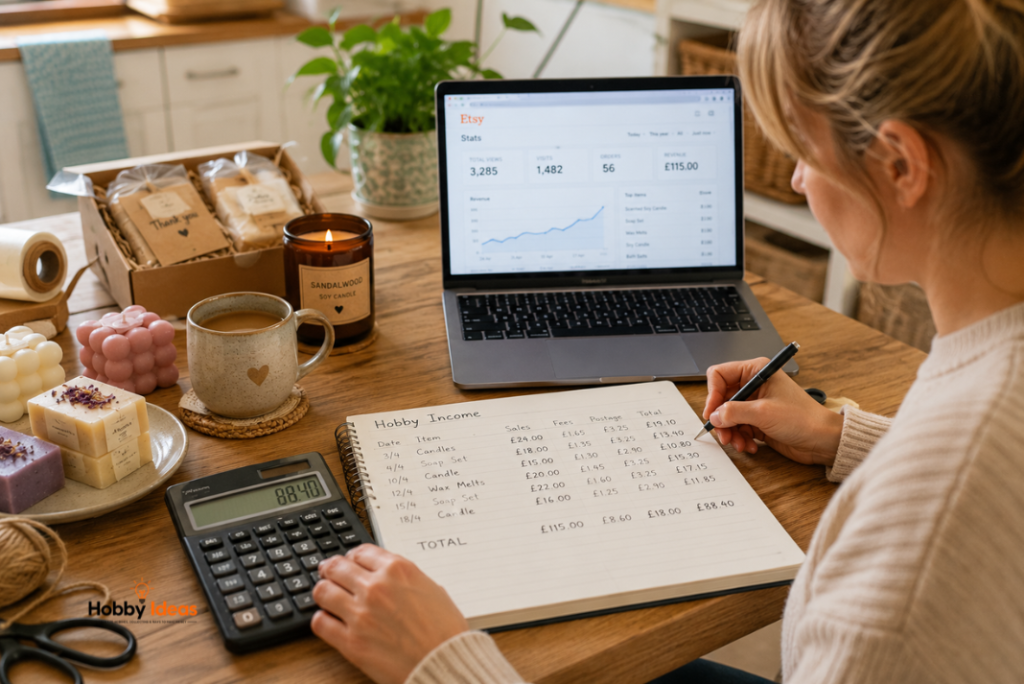
Keep a simple log of:
- Sales income
- Dates of sales
- Platform fees
- Postage costs
- Material costs
- Packaging costs
- Equipment bought for the activity
- Mileage or travel linked to selling, where relevant
Save receipts as you go. Take photos of paper receipts, download invoices, and keep online order confirmations in a folder. As a result, you will not need to reconstruct an entire year of activity from memory later.
Good record-keeping can remove a lot of the stress from managing a money-making hobby. While some people prefer spreadsheets, others find a dedicated notebook much easier to use and maintain. The Clever Fox Income & Expense Tracker provides a simple way to record sales, expenses, postage costs, materials, and other business-related spending throughout the year. For hobbyists selling handmade crafts, collectables, artwork, plants, or other creative products, keeping organised records from the beginning can save time, reduce confusion, and make it much easier to understand how much your hobby is really earning.
When Do You Need to Register With HMRC?
If your gross trading income goes over £1,000 during the tax year, you may need to register for Self Assessment by 5 October after the end of that tax year.
For example, if you cross the threshold during the tax year ending 5 April, the registration deadline usually falls on 5 October later that year.
The online Self Assessment tax return deadline usually falls on 31 January after the end of the tax year. However, deadlines and personal circumstances can vary, so always check current HMRC guidance before relying on memory.
Common Hobby Tax Mistakes to Avoid
Most problems come from confusion rather than deliberate wrongdoing. Fortunately, a few simple habits can help you avoid the most common mistakes.
Ignoring Small Sales
Small sales add up. A few £20 sales each month may not feel like much, but they can still build into a meaningful total across a year.
Mixing Personal Clear-Outs With Trading
Try to separate old personal items from profit-driven sales. This helps you understand what actually counts towards your trading income.
Looking Only at Profit
The £1,000 threshold looks at gross income, not profit. Therefore, track total sales first, then look at expenses afterwards.
Forgetting Other Hobby Income
The trading allowance applies across trading income, not separately for each tiny activity. So, candle sales, craft fair income, online content payments, casual services, and similar activities may need to sit together when you calculate the total.
Panicking Over Platform Reports
A platform report does not automatically mean you owe tax. Instead, it means you should understand your own records and know whether the income counts as trading.
When Should You Ask for Advice?
If your hobby income grows steadily, professional advice can prove worthwhile. This feels especially true if you have employment income, benefits, rental income, pension income, multiple side hustles, or plans to turn the hobby into a proper business.
An accountant can help you decide whether to use the trading allowance or actual expenses, how to keep records, and whether you should register as self-employed.
That said, many small hobbyists do not need complicated advice. They simply need clear records, a basic understanding of the rules, and the confidence to check official guidance when needed.
Final Thoughts on the Hobby Tax Threshold
The hobby tax threshold should not put you off selling a few handmade items, clearing duplicate collectables, trying a craft fair, or testing a small money-making idea.
Instead, it gives you a useful line in the sand. If your gross trading income stays under £1,000 in the tax year, life often remains simple. If your hobby grows beyond that, you may need to tell HMRC and keep slightly better records.
That does not make your hobby less enjoyable. In many ways, it simply means your skills, taste, effort, or creativity have started to attract real interest.
So, keep creating, collecting, making, growing, restoring, photographing, selling, and experimenting. Just keep an eye on the numbers as you go. A little organisation now can stop a lot of confusion later.
Important note: This article offers general information for UK hobbyists and casual sellers. It does not provide personal tax advice. Tax rules can change, and your individual circumstances may affect what you need to do. Always check official HMRC guidance or speak to a qualified adviser if you feel unsure.
Disclosure: Some links on HobbyIdeas are affiliate links. If you buy through these links, we may earn a small commission at no extra cost to you. We only recommend products we believe are useful, relevant, and good value for hobbyists.